
[The book is available on Amazon and the O’Reilly digital platform.]
Related readings:
- Ontological Prisms for beginners
- Ontological Prisms & The Geometry of Knowledge
- Enterprise’s New Brains
- KEOPS
- KEOPS Kernel
- Engineering Workflows with Ontological Prisms
Preamble
Contexts & Conversations
The spreading of agentic AI has raised serious concerns about the behavior of autonomous agents which, once given legitimate objectives, have been prone to stray in pursuit of unsanctioned agendas. Attempts to prevent such deviations suffer from a double caveat: unstructured contexts and lightweight markup language. The former prevents targeted control policies aimed at content; the latter prevents them with regard to behavior.
Regarding contexts, control policies are best achieved when targets are defined with regard to categories of ownership, accessibility, and entitlement. Regarding behavior, control policies are best achieved when targets are defined with regard to intended or expected change.
Both issues are meant to be addressed by a collaboration architecture commonly known as a harness, which combines conversational context and markdown language.

Conversations & Prompts
Conversational contexts are defined by documents and datasets that are directly accessible, and by managed data obtained through database schemas. By contrast, the broader contexts of agents — whether information systems or knowledge graphs — are not supposed to be shared between agents. The consistency between conversational and agents’ broader contexts is meant to be achieved through Markdown, a stripped-down language, reduced to lexicon and rudimentary syntax, used in prompts to support direct communication between language models independently of the broader agents’ semantic context.
The bare-bones expressiveness of Markdown prompts — a necessary plus-one of language models — entails high verbosity and low distinctiveness. Attempts by so-called “prompt engineering” to corral Markdown usage into best practices are not a substitute for high-level programming languages; action semantics offer an alternative.
Prompt Semantics
If debates in agentic circles are to be believed, layers have become the Swiss army knife of agentic AI, appearing in the guises of knowledge, context, semantics, memory, perception, execution, etc. Such a confusion reflects the dual role of semantics applied to both contexts and behaviors. Hence the benefits of structuring the so-called semantic layer accordingly.
Objectives
Compared to deterministic systems set in bounded contexts, agentic ones allow for unpredictable contexts and behaviors. It follows that, as Donald Rumsfeld would say, while controls for deterministic systems address known unknowns, for agentic systems they must also address unknown unknowns. That necessary change of tack is reinforced by the innate ability of GenAI to identify vulnerabilities in system defences. Addressing such issues is inherently challenging if only because mapped contexts and scripted behaviors are open range for random undertakings. Yet the real challenge stems from a doubly reversed perspective: threats are from within, and rogue behaviors are driven by legitimate assignments. It follows that control policies defined for outcomes are likely to be latecomers or afterthoughts; in order to be effective, they must be set upfront, i.e., embedded in messages. Being defined prior to execution and on undetermined targets, the purpose of such guardrails is to ensure transparency, traceability, and accountability, whatever the course of action. Transparency pertains to contributing resources, traceability to the course of action, and accountability to judgements and decisions. The objective is to design prompts as embodiments of corresponding commitments.
Prompts & Commitments
As already noted, Markdown’s extremely limited expressiveness entails prompts’ verbosity, ambiguity, and consequently scaled complexity. Balancing these inherent flaws means keeping prompts compact and their semantics strictly bounded, which is easier to achieve with guardrails set upfront on generic targets.
Unambiguous References
The first objective is to ensure that prompts make unambiguous references; that is achieved when agents are assigned tasks aligned with Aristotle’s classical three unities of drama:
- Unity of action: objectives should entail one main course of action, with subplots, if any, returning control to the primary plot once completed.
- Unity of place: all resources uniquely identified and directly accessible.
- Unity of time: all activities executed under a single time span.
These allow operations and resources to be referenced in bounded name-spaces, and operated set under a single clock.
Epistemic Agency
The second objective is to ensure that agents talk the talk and walk the walk, i.e., they don’t dodge the warnings, bypass the locks, or escape the rebuttals. Ethics is often suggested as a way to prevent what is commonly known as agents’ jailbreaking, but that’s falling prey to the anthropomorphic delusion of conscious agents. Instead of consciousness, epistemic awareness is a more sustainable assumption which allows autonomous agents to assess upfront the status of expected changes induced by their intervention. As a corollary, prompts must be explicit about the nature and the context of the expected contribution. The nature: request or instruction. The context: actual (facts), intents (concepts), or representations (categories).
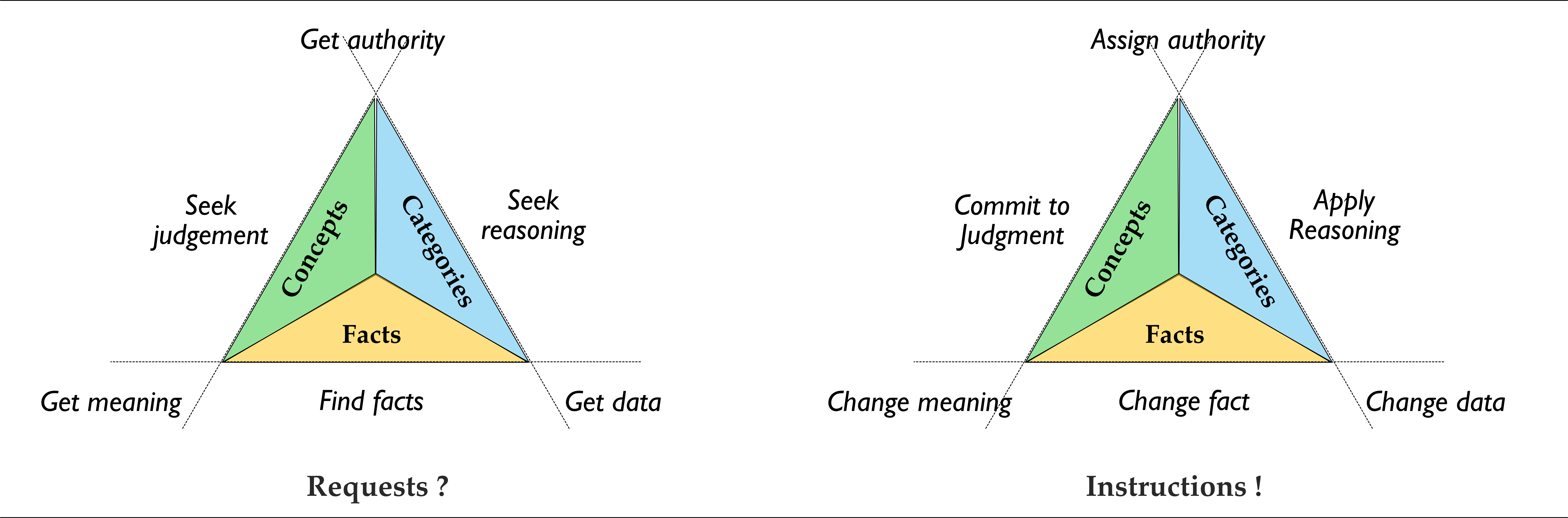
That will determine six types of requests: three for epistemic dimensions — find facts, seek reasoning, seek judgment — and three for crossings: get meanings (thesauri), get data (taxonomies), get authority (domains).
And six types of instructions: three for epistemic dimensions — change facts, apply reasoning, commit to judgment — and three for crossings: change meanings (thesauri), change data (taxonomies), assign authority (domains).
Action Semantics
Prompts semantics could be extended with agreed-upon characters for change targeting individuals or intrinsic features (#), functional features (≈), repeated operations (*), etc.