
Preamble
Just as models represent sets of actual instances that correspond to categories deemed relevant, meta-models represent sets of categories appearing in sets of models. It ensues that contrary to models meta-model abstractions are detached from actual realms, they are like rainbows, enticing but out of reach: beyond the terms employed, meta-models, profiles, templates, blueprints, patterns, …, there is no comprehensive theoretical or practical consensus except the ones set in a specific context, e.g. Object oriented programming. Yet, taking cue from rainbows diffraction, ontological prisms may help to revisit meta-models in terms of meta-languages.
Meta-models caveats
Compared to the consensus achieved by design patterns, in particular the Gang of Four’s ones, the poor record of meta-models can be explained by two major caveats:
- Rigid and detailed descriptions that makes no difference between business, organisational, and engineering perspectives, and consequently between modeling languages semantics
- A blind eye to changes as part and parcel of architectures, arguably a critical obstacle to reuse along time
These caveats can be disposed of by defining meta-model abstractions in an ontological perspective:
- Ontologies, as hatched by early Greek philosophers, are meant to provide a systematic account of what can be known in a given domain of concern
- Knowledge graphs, the jack-of-all-trades of Machine-learning technologies, are a direct implementation of ontologies.
These aspects are especially relevant for the representation of organisations and systems immersed in digital environments.
Ontological Prisms & Abstractions
Ontological prisms provide a 3D modeling framework for data (facts), managed information (categories), and knowledge (concepts); abstractions can then be defined in terms of homogeneity and realms:
Homogeneous abstractions are set within the same symbolic realms and thus pertain to the same kind of representations:
- Extensional (data models): sets and subsets of facts characterized by variant features
- Intensional (business models): semantic networks representing concepts relationships
- Symbolic (systems models): structural and functional inheritance between categories
These distinctions coincide with established physical, conceptual, and logical ones.

Heterogeneous abstractions (or conversely realisations) are set across symbolic realms:
- Thesaurus, between terms (facts) and meanings (concepts)
- Taxonomies, between features (facts) and representations (categories)
- Ontologies, between representations (categories) and meanings (concepts)
That ontological framework can be applied to the mapping of abstractions.
Scope & Purposes
Meta-models can be compared to maps used by travellers to plan their journey and provide en route assistance; as such they must come with scope and serve clear purposes.
Scope
The scope of meta-models is best defined by realm and modalities:
- Extensional meta-models, for the representation of environments, physical or symbolic: observed, assessed, managed, …
- Intensional meta-models, for the representation of realms and intents: nominal, virtual, actual, …
- Design meta-models, for the specification of surrogates: identification, instanciation, life cycle, containers, …

Just like with maps, meta-model use cases can be homogeneous or set across realms: engineering (models>code), reverse engineering (code>models), data analytics (objectives>observations), business intelligence (observations>intents), planning (intents>designs), …
Purposes
The main purpose of meta-models is to provide a conceptual framework ensuring reliability and reusability of symbolic representations, typically templates and patterns. To that end meta-models must be unambiguously aligned with identified anchors yet flexible enough with regard to features and modus operandi. With the Protégé/CaKe ontology kernel, these purposes are materialised by postfixes:
- Built-in kernel entries (_), for representations not meant to be instanciated
- Ontological modalities (Ξ), are profiles of features deemed to be relevant
- User-defined patterns (≈), for representations not meant to be instanciated
- User-defined anchors (#), for representations possibly instanciated directly or through inheritance
- Taxonomies (2), for the definition of partitions
'Template' is use indifferently for any kind of abstract representation
For instance one could introduce a template or pattern for Organisation:
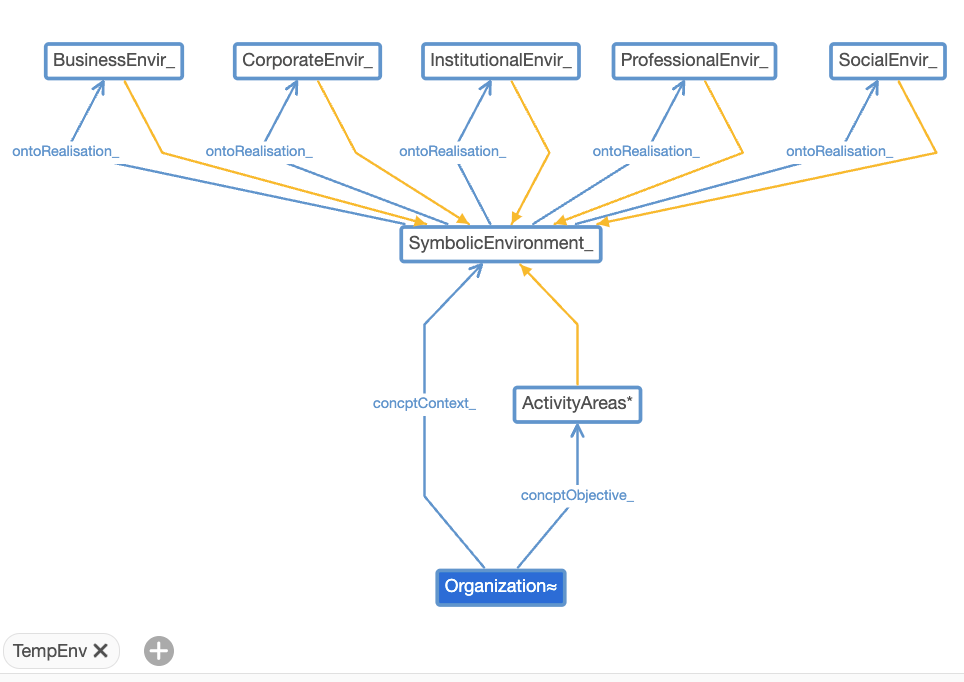
Concomitantly, the concept can be refined using built-in (_) categories, taxonomies (2), or standardised anchors (#):
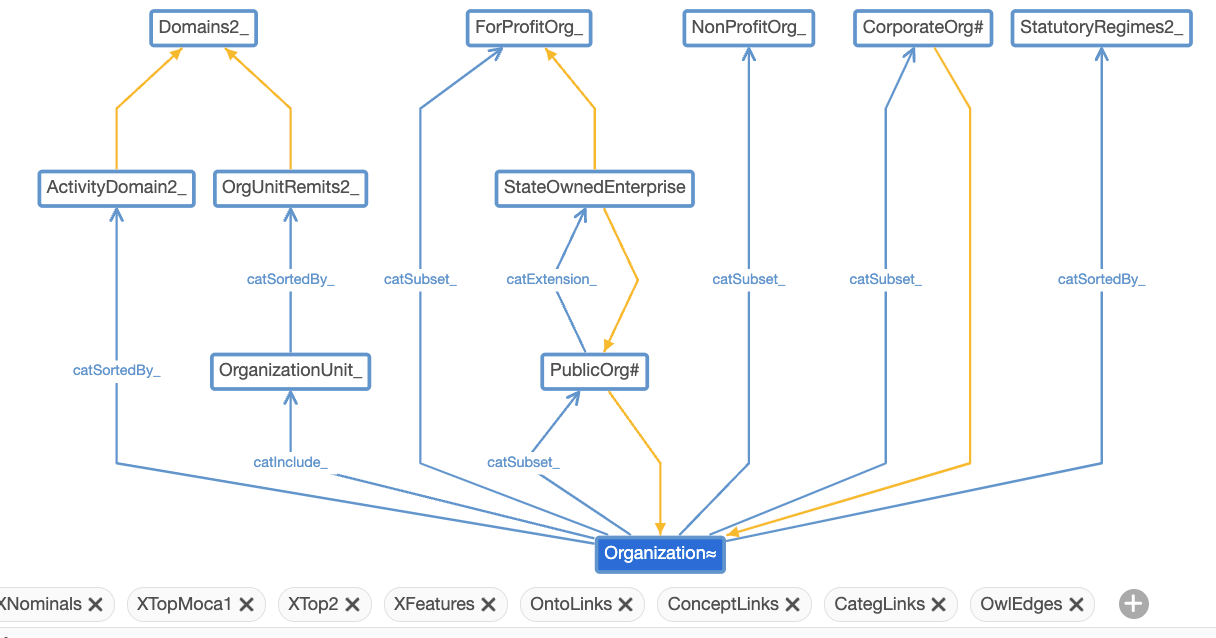
Alternatively, templates can be defined directly in terms of built-in modalities (Ξ):
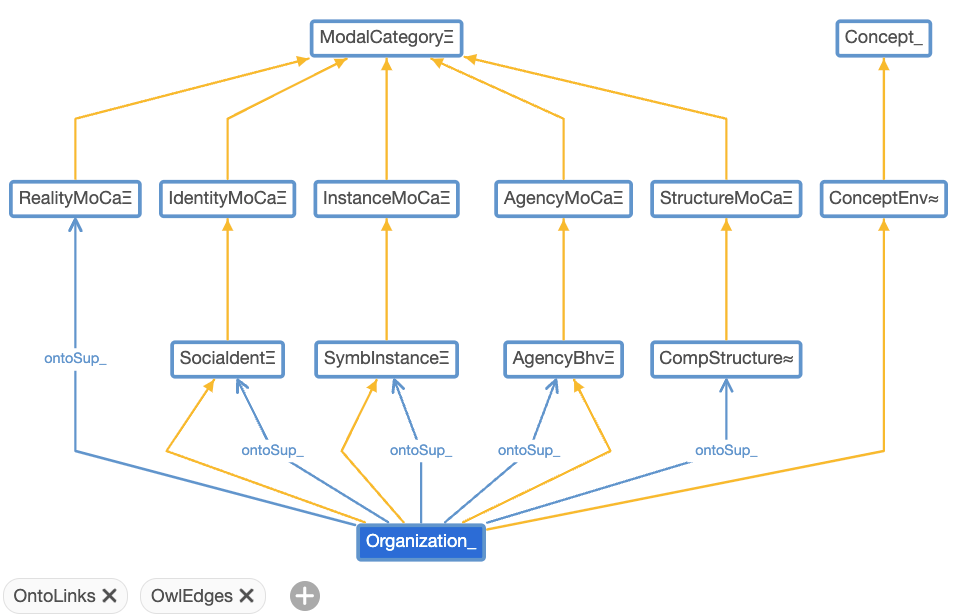
Semantics
Contrary to facts, concepts, or categories, meant to represent physical or symbolic individuals, aspects represent features that can only be instanciated through their owner, with semantics defined accordingly. They can be defined directly (include connectors) or as references; for instance, the semantics of a Customer template (≈) will be set by an implicit conceptual galaxy defined by concepts (#) like Agency, Organisation, or Party:

Ensuring some semantic consistency across domains is clearly a primary objective, yet one hardly met by most of data management tools. Given a flat data model, two main schemes can be considered: (1) bounded semantics supported by agreed upon data catalogs or, (2) thesauruses supporting a plurality of open-ended yet consistent domain semantics.
Agreed upon definitions may be a realistic option for undifferentiated and stable organisations but it falls short for complex organisations operating in changing business contexts. Alternatively, open-ended thesauruses must avoid ambiguous, contradictory, and circular definitions, a flaw affecting most of self-appointed standards. Still, the difficulty can be overcome by introducing a set of axioms operating like a music scale, with equivalent benefits:
- It circumscribes semantics controversies to small sets of clear-cut definitions meant to be either accepted or rejected as they are.
- Axioms can serve as firebreaks in thesauruses preventing circular definitions.
- Like keys for music variations, axioms enable open-ended definitions, facilitate translations, and can serve as semantic bridges between alternative representations.
Symbolic representations could thus be expressed or translated (played) using different sets of axioms (or key) depending on purpose, without unwarranted assumptions with regard to the truth of representations. To that effect the Caminao kernel introduces seven axioms meant to serve as roots for the modeling semantics of objects (property, instance, identity), activities (behavior, event, state), and containment (collection):

It must be stressed that the scope of such axioms (or any other set built on the same principle) is purely nominal and detached from meanings, their role being to eliminate circular definitions; conversely, ontological modalities pertain to meanings independently of the terms employed. Taking a Customer≈ pattern as exemple, it can define ‘Person_’ nominally for behavior (axBehavior_) and/or conceptually for identification (SocialIdentΞ).

Combining nominal, ontological, and categorical perspectives is the key to interoperability and differentiated abstractions.
Modus Operandi
To be of any use meta-models must be interoperable and support principled layers of abstraction.
Interoperability
Interoperability means that meta-models can be set across modeling realms:
- Extensions (facts) / Intensions (concepts): open-ended and acyclic thesauruses are used to align nominal networks with semantic or conceptual ones
- Extensions (facts) / Designs (categories): taxonomies are used to align sets and subsets with types and sub-types
- Designs (categories) / Intensions (concepts): ontologies are used to align representations with modalities

Given such interoperability meta-models can then serve different purposes, e.g.:
- Realisation: planning (from intensions to designs), engineering (from designs to extensions), forecasting (from intensions to extensions)
- Abstraction: data analysis (from extensions to intensions), requirements analysis (from extensions to designs), foresight (from designs to intensions)
That can be done with meta-models built on principled abstractions.
The Fabric of Abstractions
As already noted, the actual benefits of meta-models are hampered by excessive details and rigidity on the one hand, extraneous abstractions detached from actual concerns on the other hand. Such a conundrum can be avoided with layered graphs built from intensional, extensional, and design nodes and ontological connectors.
Layers are set across prisms according to the grammatical status of nodes: modalities, built-in, patterns or templates, and domain specific entries.

- Ontological modalities (Ξ) provide reference models (or meta-models, or profiles); as such their features are not supposed to be inherited but used to be checked against when referenced from sub layers.
- Built-in entries (_) provide the roots of all representations: non descript (Sculpture), or patterns (Customer≈, Organisation≈, Person≈)
- Patterns (≈) are representations whose semantics are meant to be shared across business domains; they defined through built-in (inheritance) and modalities (realisation)
- Domain-specific representations constitute the leaves of graphs
Taking for granted that meta-models and patterns are meant to ensure the versatility and plasticity of architectures, consistency is a primary concern.
Lexical (nominal) consistency: thesauruses connectors are used to check ambiguous and/or circular definitions.

Syntactic (modalities and patterns) consistency: typed connectors between layered nodes can be used to check circular inheritance:
- Ontological connectors for the realisation of modalities (ontoRealisationOf_) and conceptual hierarchies (ontoSup_)
- Category connectors for structural (catSubsetOf_) and functional (catExtensionOf_) hierarchies

Semantic (realms) consistency: given the different meanings of abstraction for facts (subsets), concepts (kind-of/is-a), and categories (structural and functional subtypes), inheritance hierarchies must be kept homogeneous.

Pragmatic (contexts) consistency: domain-specific semantics are meant to deal with overlapping designations, i.e. identical terms employed in different contexts, typically temporal or organisational; e.g. ‘IndividualCustomer” is represented differently depending on the status of instances.

Defining meta-models in terms of explicitly typed abstractions enables their design and use to be iterative, incremental, and declarative.
Implementation
Ontologies
Templates are meant to bring under a common roof actual systems, models, and knowledge graphs. That can be achieved though ontologies (OWL) or language models, using SQL and XML schemas, thesauruses, and Prolog through rdf/3.

SQL and XML schemas are used to translate models or other symbolic assets into OWL ontologies; templates can be defined and managed directly (OWL) or through modeling languages; further design and assessment can also be achieved through Prolog.

Language Models
Language models are learning machines aimed at the processing of multi-modal contents; to that effect they combine three main functions:
- Encoding: building neural networks of tokens from generic or specific resources (documents and datasets)
- Training: morphing neural networks into semantic ones
- Tuning: using prompts to guide conversations

Numerical vectors are the nuts and bolts of language models as they are used to represent numeric affinities between tokens as well as semantic connexions between words. As such they can provide vessels for embedded meanings obtained from specific resources, typically for templates:
- Systems legacy components, as identified in operational repositories
- Managed categories, for business domains and entities identified in database schemas
- Defining business concepts, as identified in organisational thesauruses

Ontologies & Copilots
But that approach that fuses language model with knowledge representation falls short with engineering requisites for transparency, traceability, and reliability, hence the benefits of using language models for user interfaces (copilots) and ontological prisms (knowledge graphs) for templates.

In any case templates design and management could be carried out through specialised SQL or Prolog tools.
Further Reading
Ontological Prism
- Signs & Symbols
- Generative & General Artificial Intelligence
- Thesauruses, Taxonomies, Ontologies
- EA Engineering interfaces
- Ontologies Use cases
- Complexity
- Cognitive Capabilities
- LLMs & the matter of transparency
- LLMs & the matter of regulations
- Learning
- Uncertainty & The Folds of Time
Other Caminao References
- Caminao Framework Overview
- A Knowledge Engineering Framework
- Knowledge interoperability
- Knowledgeable Organizations
- Edges of Knowledge
- The Pagoda Playbook
- EA Patterns: What’s The Point
- Models & Meta Models
- ABC of EA: Agile, Brainy, Competitive
- Caminao & UAFP
- Open Concepts
- Ontological Text Analysis: Example