
Related readings:
- Ontological Prisms for beginners
- Ontological Prisms & The Geometry of Knowledge
- Enterprise’s New Brains
- Knowledge Engineering with Ontological Prisms (KEOPS)
- KEOPS Kernel
[The book is available on Amazon and the O’Reilly digital platform.]
Preamble
The purpose of ontological prisms is to bring together extensional (facts), intensional (concepts), and logical (categories) dimensions. By contrast, when ontologies are reduced to semantics, reasoning about knowledge makes no distinction between factual, deontic, and managed dependencies; for instance, reasoning about persons will fuse biological, statutory, and data management rules into a single thread. Ontological prisms maintain these epistemic distinctions and use epistemic gears to weave reasoning.
We asked Claude how that could be done with the Prolog language.
Epistemic Gears
Contrary to naive understandings of ontologies, epistemic dimensions bring comprehensive and practical benefits to knowledge engineering, essentially through a separation of concerns between observation (facts), commitments (concepts), and implementation (categories). As a corollary, there must be mechanisms ensuring a coherent integration of these dimensions. That is achieved through epistemic gears: semantic (thesauri), operational (taxonomies), and organizational (domains).
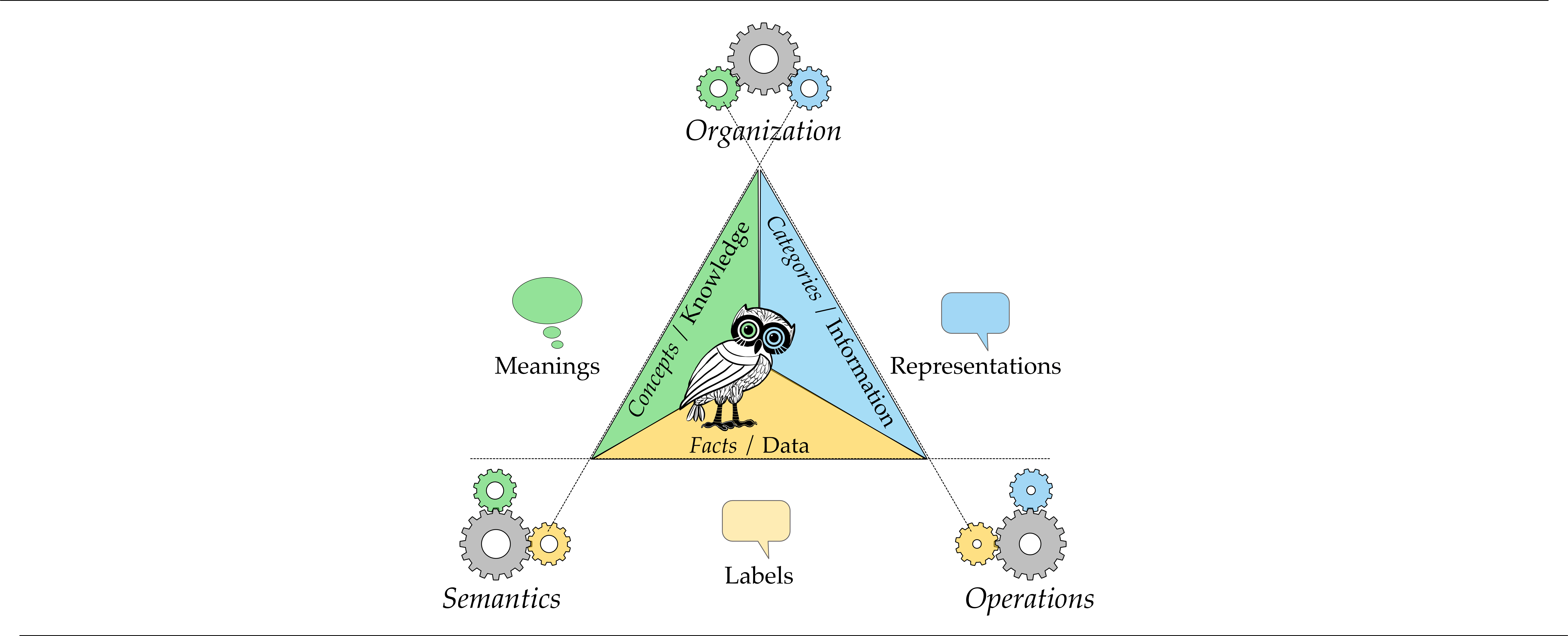
Semantic Gear
In flat 2D bounded contexts, words are used to characterize observed facts. As long as conversations are carried out locally and immediately, meanings can be set unambiguously; not so when they straddle contexts, which may differ for both facts and vocabularies. Nevertheless, assuming 2D semantic spaces, straddling meanings can still be aligned through unambiguous mapping of controlled vocabularies.
A gear becomes necessary when meanings escape the confines of 2D semantic spaces, introducing non-deterministic mappings. Such a third dimension, adding conceptual spaces to operational ones, induces a mapping complexity that must be made explicit.
Operational Gear
Intelligence is the ability to draw distinctions with regard to things as well as their use; while some labelled distinctions may be intrinsic, and therefore established once and for all, most are set by contexts and concerns. Hence the benefit of a gear in addressing the ways things are labelled and classified.
Taking for granted that distinctions may vary across contexts and over time, the role of an operational gear is twofold: maintain the distinction between the classification of natural (observed) facts and the classification of managed (designed) ones; ensure a continuous and consistent mapping of changes in nature (natural or managed), labels, and classifications.
Organizational Gear
The emergence of systems of autonomous digital agents, replacing organizations of human agents with bounded remits, has put governance issues front and center. As a balancing act between objectives, stakes, and expectations, governance has to weigh the scope and time-frame of decisions against the visibility of business environments. Assuming that stakes and horizons can be aligned with the organization, decisions can be made by mapping problem to solution spaces, and governance can be achieved by mapping business concerns (conceptual domains) to supporting systems (managed categories). However, when stakes straddle domains, or horizons cross time frames, decisions must detour through intermediate spaces where commitments are made regarding intents, assumptions, or modus operandi; the role of the indirection layers is to manage the induced complexity.
On that account, the organizational gear has to address the respective responsibilities for business (concepts) and engineering (categories) domains; the setting of tactical and strategic horizons; and the risk management policies.
Prolog Implementation (according to Claude)
Prolog can implement all three gears, because each one is a mapping between two layers that Prolog represents uniformly as clauses. The code below reuses a Pipe homonym as a running example.
1. Facts/concepts (semantic gear)
Facts are ground clauses. Concepts are rules that give those facts meaning by classifying them.
prolog
% factspipe(p1). use(p1, tobacco).pipe(p2). use(p2, water).% concepts: rules that interpret factssmoking_pipe(X) :- pipe(X), use(X, tobacco).fluid_pipe(X) :- pipe(X), use(X, water).
?- smoking_pipe(X). returns p1. The word “pipe” stays a mere label, and the two concepts are distinct predicates, which resolves the <Pipe-smoke> / <Pipe-fluid> ambiguity without touching the facts.
2. Facts/categories (operational glue)
Categories are schemas: what a record must contain to belong to a class. The mapping assigns facts to categories and checks conformity.
prolog
category(fluid_pipe_record, [material, diameter]).instance_of(p2, fluid_pipe_record).attr(p2, material, steel).attr(p2, diameter, 50).conforms(X) :- instance_of(X, C), category(C, Required), forall(member(A, Required), attr(X, A, _)).
This is relational logic in Prolog’s clothes: predicates play the role of tables, and conforms/1 plays the role of an integrity constraint. Taxonomies belong here too, via subcategory/2 with transitive closure. In SWI-Prolog, declare :- table ancestor/2. so the recursion terminates.
3. Categories/concepts (organizational glue)
This gear records which category supports which concept, and who is responsible for each.
prolog
concept(fluid_pipe).realizes(fluid_pipe_record, fluid_pipe).owner(fluid_pipe, engineering).steward(fluid_pipe_record, it_ops).unsupported(C) :- concept(C), \+ realizes(_, C).unowned(C) :- concept(C), \+ owner(C, _).
The unsupported/1 and unowned/1 queries audit governance gaps: concepts with no supporting system, or no accountable domain.
Where Prolog fits the prisms, and where it does not
- Strength: concept-level rules. Defining meaning by inference is what Prolog does best, so your assumption that it sits primarily between concepts and categories holds for its distinctive contribution. As shown above, though, it handles the other two gears without strain.
- Weakness: Prolog does not enforce the separation of layers. Facts, concepts, and categories all live in one clause space, so the prism geometry must be a design discipline. Put each layer in its own module (
facts,concepts,categories) and keep the mappings in a fourth. - Closed-world assumption:
\+is negation as failure, so “unsupported” means “not provable,” not “known to be false.” That suits enterprise governance audits but not open-world agentic contexts. OWL and SHACL handle open-world cases. - Bridging: SWI-Prolog’s semweb library reads RDF and SKOS directly, which lets thesauri feed gear 1 and taxonomies feed gear 2.