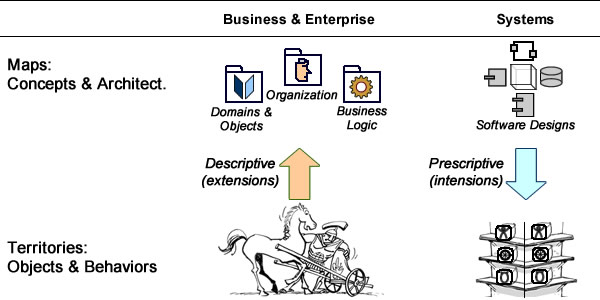
The immersion of enterprises into digital environments is blurring the traditional distinctions between architecture layers. Hence the need of clarifying the basic notions.
The Pagoda Architecture Blueprint is derived from the Zachman’s framework
Beyond the differences in terminologies (layers, levels, tiers, etc), four basic taxonomies can be applied:
Enterprise architecture: business processes and organization, systems, platforms (Pagoda blueprint).
As far as modeling is concerned a distinction has to be maintained between the symbolic description of activities and the processes describing their actual execution.
Given that distinction, the objective is to align action semantics with the constraints of their execution:
Action on symbolic representations without coupling with the context (no change).
Action on symbolic representations with coupling with context (change in expectations).
Interaction with actual context without direct coupling (change in process status).
Interaction with actual context with direct coupling (change in objects).
That taxonomy can then be applied to map use cases semantics to architecture capabilities.
Hitting the ground running with Caminao is meant to be easy as it relies on a well-founded modeling paradigm (Stanford Symbolic Systems Program) and a solid and well established reference framework (Zachman’s).
Moving On (Moises Levy)
Secured by these foundations, teams could carry on with agile and MBSE development models, helped, if and when necessary, by a comprehensive and consistent documentation freely available online.
Symbolic Systems Paradigm
The Stanford Symbolic System Program (SSP) is built on clear and incontrovertible evidence: the purpose of computer systems is to manage the symbolic counterparts (aka surrogates) of business objects and activities. Based on that understanding, enterprise architectures can be wholly and consistently defined by maps (the models) and territories (relevant business objects and activities and their symbolic counterparts in systems).
That paradigm is at the same time straightforward and aligned with the formal distinction between extensional and intensional representations, the former for requirements analysis (descriptive models), the latter for systems design (prescriptive models).
Zachman’s Framework
Given its clarity of purpose and concepts, the Zachman Framework is arguably a reference of choice; its core is defined by six columns and five lines, each of them associated with well known concepts:
That simple transformation significantly improves the transparency of enterprise architectures while bringing a new light on dependencies set across layers and capabilities. As it happens, and not by chance, it neatly fits with the Pagoda architecture blueprint.
Digital Transformation & The Pagoda Blueprint
The generalization of digitical environments bears out the Symbolic System modeling paradigm: to stay competitive, enterprises have to manage a relevant, accurate, and up-to-date symbolic representation of their business context and concerns. On that account, consequences go well beyond a shallow transformation of business processes and call for an in-depth transformation of enterprise architectures that should put the focus on their capacity to refine business data flows into information assets supporting knowledge management and decision-making:
Ubiquitous, massive, and unrelenting digitized business flows cannot be dealt with lest a clear distinction is maintained between raw data acquired across platforms and the information (previously data) models ensuring the continuity and consistency of systems.
Once structured and refined, business data flows must be blended with information models sustaining systems functionalities.
A comprehensive and business driven integration of organization and knowledge could then support strategic and operational decision-making at enterprise level.
Such an information backbone set across architecture layers tallies with the Pagoda architecture blueprint well known for its resilience and adaptability in unsettled environments.
The Pagoda Architecture Blueprint is derived from the Zachman’s framework
That blueprint can be much more than metaphoric: applied to enterprise architectures it would greatly enhance the traceability of transformations induced by digital environments.
Proceed With Agile & MBSE
Once set on track with a reliable paradigm and a clear reference framework, teams can carry on with their choice of development models:
Agile schemes for business driven applications for which conditions of shared ownership and continuous delivery can be met.
Phased schemes for architecture developments set across business processes.
Whatever the development methods, the modeling paradigm will put enterprise architecture and projects management on a principled basis, and the framework will significantly enhance their integration.
Take a knowledge PERSPECTIVE
The success of knowledge graphs in AI applications is putting a new light on ontologies, first expounded by Greek philosophers as a general knowledge management scheme.
Hence the benefits of using ontologies to bring under a common roof the full range of data, information, and knowledge pertaining to enterprise architectures.
In line with the Symbolic Systems paradigm, events are best understood in terms of interactions between systems (or enterprises) and the environment they represent (or live off).
Events with regard to nature and coupling
On that account events are to be associated with four kinds of notifications:
Actual (aka non symbolic) changes in the state of objects.
Actual (aka non symbolic) changes in the state of activities.
Changes in the state of expectations (e.g requests/acknowledgments).
Neutral changes in symbolic representations (e.g messages).
It must be noted that while synchronization constraints (e.g UML’s calls vs signals) characterize events’ communication semantics, they say nothing about events themselves.
That distinction is of a particular importance for the definition of time as a change in a dedicated physical device, ensuring that, according to Einstein, events don’t happen at once.
While processes and activities are often defined together, the primary purpose of processes is to specify how activities are to be carried out if and when activities have to be executed separately.
Given the focus on execution, definitions of processes should be aligned with the classification of events and time, namely the nature of flows and coupling:
No flows (computation).
Information flows between activities.
Actual flows between activities, asynchronous coupling.
Actual flows, synchronous coupling.
That taxonomy could be used to define execution units in line with activities and the states of objects and expectations.
“Computer systems, robots, and people are all examples of symbolic systems, agents that use meaningful symbols to represent the world around them so as to communicate and generally act in the world,”
Agile and phased development solutions are meant to solve different problems and therefore differ with artifacts and activities; that can be illustrated by requirements, understood as dialogs for the former, etched statements for the latter.
Running Stories (Kara Walker)
Ignoring that distinction is to make stories stutter from hiccupped iterations, or phases sputter along ripped milestones.
Agile & Phased Tell Different Stories Differently
As illustrated by ill-famed waterfall, assuming that requirements can be fully set upfront often put projects at the hazards of premature commitments; conversely, giving free rein to expectations could put requirements on collision courses.
That apparent dilemma can generally be worked out by setting apart business outlines from users’ stories, the latter to be scripted and coded on the fly (agile), the former analysed and documented as a basis for further developments (phased). To that end project managers must avoid a double slip:
Mission creep: happens when users’ stories are mixed with business models.
Jump to conclusions: happens when enterprise business cases prevail over the specifics of users’ concerns.
Interestingly, the distinction between purposes (users concerns vs business functions) can be set along one between language semantics (natural vs modeling).
Semantics: Capture vs Analysis
Beyond methodological contexts (agile or phased), a clear distinction should be made between requirements capture (c) and modeling (m): contrary to the former which translates sequential specifications from natural to programming (p) languages without breaking syntactic and semantic continuity, the latter carries out a double translation for dimension (sequence vs layout) and language (natural vs modeling.)
Semantic continuity (c>p) and discontinuity (c>m>p)
The continuity between natural and programming languages is at the root of the agile development model, enabling users’ stories to be iteratively captured and developed into code without intermediate translations.
That’s not the case with modeling languages, because abstractions introduce a discontinuity. As a corollary, requirements analysis is to require some intermediate models in order to document translations.
The importance of discontinuity can be neatly demonstrated by the use of specialization and generalization in models: the former taking into account new features to characterize occurrences (semantic continuity), the latter consolidating the meaning of features already defined (semantic discontinuity).
Confusion may arise when users’ stories are understood as a documented basis for further developments; and that confusion between outcomes (coding vs modeling) is often compounded by one between intents (users concerns vs business cases).
Concerns: Users’ Stories vs Business Cases
As noted above, users’ stories can be continuously developed into code because a semantic continuity can be built between natural and programming languages statements. That necessary condition is not a sufficient one because users’ stories have also to stand as complete and exclusive basis for applications.
Such a complete and exclusive mapping to application is de-facto guaranteed by continuous and incremental development, independently of the business value of stories. Not so with intermediate models which, given the semantic discontinuity, may create back-doors for broader concerns, e.g when some features are redefined through generalization. Hence the benefits of a clarity of purpose:
Users’ stories stand for specific requirements meant to be captured and coded by increments. Documentation should be limited to application maintenance and not confused with analysis models.
Use cases should be introduced when stories are to be consolidated or broader concerns factored out , e.g the consolidation of features or business cases.
Sorting out the specifics of users concerns while keeping them in line with business models is at the core of business analysts job description. Since that distinction is seldom directly given in requirements, it could be made easier if aligned on modeling options: stories and specialization for users concerns, models and generalization for business features.
From Stories to Cases
The generalization of digital environments entails structural and operational adjustments within enterprise architectures.
At enterprise level the integration of homogeneous digital flows and heterogeneous symbolic representations can be achieved through enterprise architectures and profiled ontologies. But that undertaking is contingent on the way requirements are first dealt with, namely how the specifics of users’ needs are intertwined with business designs.
As suggested above, modeling schemes could help to distinguish as well as consolidate users narratives and business outlooks, capturing the former with users’ stories and the latter with use cases models.
Use cases describe the part played by systems taking into account all supported stories.
That would neatly align means (part played by supporting systems) with ends (users’ stories vs business cases):
Users’ stories describe specific objectives independently of the part played by supporting systems.
Use cases describe the part played by systems taking into account all supported stories.
It must be stressed that this correspondence is not a coincidence: the consolidation of users’ stories into broader business objectives becomes a necessity when supporting systems are taken into account, which is best done with use cases.
Aligning Stories with Cases
Stories and models are orthogonal descriptions, the former being sequenced, the latter laid out; it ensues that correspondences can only be carried out for individuals uniformly identified (#) at enterprise and systems level, specifically: roles (aka actors), events, business objects, and execution units.
Crossing cases with stories: events, roles, business objects, and execution units must be uniformly and consistently identified (#) .
It must be noted that this principle is supposed to apply independently of the architectures or methodologies considered.
With continuity and consistency of identities achieved at architecture level, the semantic discontinuity between users’ stories and models (classes or use cases) can be managed providing a clear distinction is maintained between:
Modeling abstractions, introduced by requirements analysis and applied to artifacts identified at architecture level.
The semantics of attributes and operations, defined by users’ stories and directly mapped to classes or use cases features.
From Capture to Analysis: Abstractions introduce a semantic discontinuity
Finally, stories and cases need to be anchored to epics and enterprise architecture.
Business Cases & Enterprise Stories
Likening epics to enterprise stories would neatly frame the panoply of solutions:
At process level users’ stories and use cases would be focused respectively on specific business concerns and supporting applications.
At architecture level business stories (aka epics) and business cases (aka plots) would deal respectively with business models and objectives, and supporting systems capabilities.
Cases & Stories
That would provide a simple yet principled basis for enterprise architectures governance.
All too often choosing a development method is seen as a matter of faith, to be enforced uniformly whatever the problems at hand.
Tools and problems at hand (Jacob Lawrence)
As it happens, this dogmatic approach is not limited to procedural methodologies but also affect some agile factions supposedly immunized against such rigid stances.
A more pragmatic approach should use simple and robust principles to pick and apply methods depending on development problems.
Iterative vs Phased Development
Beyond the variety of methodological dogmas and tools, there are only two basic development patterns, each with its own merits.
Iterative developments are characterized by the same activity (or a group of activities) carried out repetitively by the same organizational unit sharing responsibility, until some exit condition (simple or combined) verified.
Phased developments are characterized by sequencing constraints between differentiated activities that may or may not be carried out by the same organizational units. It must be stressed that phased development models cannot be reduced to fixed-phase processes (e.g waterfall); as a corollary, they can deal with all kinds of dependencies (organizational, functional, technical, …) and be neutral with regard to implementations (procedural or declarative).
A straightforward decision-tree can so be built, with options set by ownership and dependencies:
Shared Ownership: Agile Schemes
A project’s ownership is determined by the organizational entities that are to validate the requirements (stakeholders), and accept the products (users).
Iterative approaches, epitomized by the agile development model, is to be the default option for projects set under the authority of single organizational units, ensuring shared ownership and responsibility by business analysts and software engineers.
Projects set from a business perspective are rooted in business processes, usually through users’ stories or use cases. They are meant to be managed under the shared responsibility of business analysts and software engineers, and carried out independently of changes in architecture capabilities (a,b).
Agile Development & Architecture Capabilities
Projects set from a system perspective potentially affect architectures capabilities. They are meant to be managed under the responsibility of systems architects and carried out independently of business applications (d,b,c).
Transparency and traceability between the two perspectives would be significantly enhanced through the use of normalized capabilities, e.g from the Zachman’s framework:
Who: enterprise roles, system users, platform entry points.
What: business objects, symbolic representations, objects implementation.
How: business logic, system applications, software components.
When: processes synchronization, communication architecture, communication mechanisms.
Where: business sites, systems locations, platform resources.
It must be noted that as far as architecture and business driven cycles don’t have to be synchronized (principle of continuous delivery), the agile development model can be applied uniformly; otherwise phased schemes must be introduced.
Cross Dependencies: Phased Schemes
Cross dependencies mean that, at some point during project life-cycle, decision-making may involve organizational entities from outside the team. Two mechanisms have traditionally been used to cope with the coordination across projects:
Fixed phases processes (e.g Analysis/Design/Implementation) have shown serious shortcomings, as illustrated by notorious waterfall.
Milestones improve on fixed schemes by using check-points on development flows instead of predefined activities. Yet, their benefits remain limited if development flows are still defined with regard to the same top-down and one-fits-all activities.
Model based systems engineering (MBSE) offers a way out of the dilemma by defining flows directly from artifacts. Taking OMG’s model driven architecture (MDA) as example:
Computation Independent Models (CIMs) describe business objects and activities independently of supporting systems.
Platform Independent Models (PIMs) describe systems functionalities independently of platforms technologies.
Platform Specific Models (PSMs) describe systems components as implemented by specific technologies.
Layered Dependencies & Development Cycles with MDA
Projects can then be easily profiled with regard to footprints, dependencies, and iteration patterns (domain, service, platform, or architecture, …).
That understanding puts the light on the complementarity of agile and phased solutions, often known as scaled agile.
“Clocks slay time… time is dead as long as it is being clicked off by little wheels; only when the clock stops does time come to life.”
William Faulkner
Preamble
The melting of digital fences between enterprises and business environments is putting a new light on the way time has to be taken into account.
Time is what happens between events (Josef Koudelka)
The shift can be illustrated by the EU GDPR: by introducing legal constraints on the notifications of changes in personal data, regulators put systems’ internal events on the same standing as external ones and make all time-scales equal whatever their nature.
Ontological Limit of WC3 Time Recommendation
The W3C recommendation for OWL time description is built on the well accepted understanding of temporal entity, duration, and position:
While there isn’t much to argue with what is suggested, the puzzle comes from what is missing, namely the modalities of time: the recommendation makes use of calendars and time-stamps but ignores what is behind, i.e time ontological dimensions.
Out of the Box
As already expounded (Ontologies & Enterprise Architecture) ontologies are at their best when a distinction can be maintained between representation and semantics. That point can be illustrated here by adding an ontological dimension to the W3C description of time:
Ontological modalities are introduced by identifying (#) temporal positions with regard to a time-frame.
Time-frames are open-ended temporal entities identified (#) by events.
How to add ontological modalities to time
It must be noted that initial truth-preserving properties still apply across ontological modalities.
Conclusion: OWL Descriptions Should Not Be Confused With Ontologies
Languages are meant to combine two primary purposes: communication and symbolic representation, some (e.g natural, programming) being focused on the former, other (e.g formal, specific) on the latter.
The distinction is somewhat blurred with languages like OWL (Web Ontology Language) due to the versatility and plasticity of semantic networks.
Ontologies and profiles are meant to target domains, profiles and domains are modeled with languages, including OWL.
That apparent proficiency may induce some confusion between languages and ontologies, the former dealing with the encoding of time representations, the latter with time modalities.