Focus: Users’ Stories & Use Cases

Preamble

Agile and phased development solutions are meant to solve different problems and therefore differ with artifacts and activities; that can be illustrated by requirements, understood as dialogs for the former, etched statements for the latter.

Kara_Walker_mural2
Running Stories (Kara Walker)

Ignoring that distinction is to make stories stutter from hiccupped iterations, or phases sputter along ripped milestones.

Agile & Phased Tell Different Stories Differently

As illustrated by ill-famed waterfall, assuming that requirements can be fully set upfront often put projects at the hazards of premature commitments; conversely, giving free rein to expectations could put requirements on collision courses.

That apparent dilemma can generally be worked out by setting apart business outlines from users’ stories, the latter to be scripted and coded on the fly (agile), the former analysed and documented as a basis for further developments (phased). To that end project managers must avoid a double slip:

  • Mission creep: happens when users’ stories are mixed with business models.
  • Jump to conclusions: happens when enterprise business cases prevail over the specifics of users’ concerns.

Interestingly, the distinction between purposes (users concerns vs business functions) can be set along one between language semantics (natural vs modeling).

Semantics: Capture vs Analysis

Beyond methodological contexts (agile or phased), a clear distinction should be made between requirements capture (c) and modeling (m): contrary to the former which translates sequential specifications from natural to programming (p) languages without breaking syntactic and semantic continuity, the latter carries out a double translation for dimension (sequence vs layout) and language (natural vs modeling.)

Scratch_lang
Semantic continuity (c>p) and discontinuity (c>m>p)

The continuity between natural and programming languages is at the root of the agile development model, enabling users’ stories to be iteratively captured and developed into code without intermediate translations.

That’s not the case with modeling languages, because abstractions introduce a discontinuity. As a corollary, requirements analysis is to require some intermediate models in order to document translations.

The importance of discontinuity can be neatly demonstrated by the use of specialization and generalization in models: the former taking into account new features to characterize occurrences (semantic continuity), the latter consolidating the meaning of features already defined (semantic discontinuity).

Confusion may arise when users’ stories are understood as a documented basis for further developments; and that confusion between outcomes (coding vs modeling) is often compounded by one between intents (users concerns vs business cases).

Concerns: Users’ Stories vs Business Cases

As noted above, users’ stories can be continuously developed into code because a semantic continuity can be built between natural and programming languages statements. That necessary condition is not a sufficient one because users’ stories have also to stand as complete and exclusive basis for applications.

Such a complete and exclusive mapping to application is de-facto guaranteed by continuous and incremental development, independently of the business value of stories. Not so with intermediate models which, given the semantic discontinuity, may create back-doors for broader concerns, e.g when some features are redefined through generalization. Hence the benefits of a clarity of purpose:

  • Users’ stories stand for specific requirements meant to be captured and coded by increments. Documentation should be limited to application maintenance and not confused with analysis models.
  • Use cases should be introduced when stories are to be consolidated or broader concerns factored out , e.g the consolidation of features or business cases.

Sorting out the specifics of users concerns while keeping them in line with business models is at the core of business analysts job description. Since that distinction is seldom directly given in requirements, it could be made easier if aligned on modeling options: stories and specialization for users concerns, models and generalization for business features.

From Stories to Cases

The generalization of digital environments entails structural and operational adjustments within enterprise architectures.

At enterprise level the integration of homogeneous digital flows and heterogeneous symbolic representations can be achieved through enterprise architectures and profiled ontologies. But that undertaking is contingent on the way requirements are first dealt with, namely how the specifics of users’ needs are intertwined with business designs.

As suggested above, modeling schemes could help to distinguish as well as consolidate users narratives and business outlooks, capturing the former with users’ stories and the latter with use cases models.

Scratch_USC1
Use cases describe the part played by systems taking into account all supported stories.

That would neatly align means (part played by supporting systems) with ends (users’ stories vs business cases):

  • Users’ stories describe specific objectives independently of the part played by supporting systems.
  • Use cases describe the part played by systems taking into account all supported stories.

It must be stressed that this correspondence is not a coincidence: the consolidation of users’ stories into broader business objectives becomes a necessity when supporting systems are taken into account, which is best done with use cases.

Aligning Stories with Cases

Stories and models are orthogonal descriptions, the former being sequenced, the latter laid out; it ensues that correspondences can only be carried out for individuals uniformly identified (#) at enterprise and systems level, specifically: roles (aka actors), events, business objects, and execution units.

Scratch_US2C
Crossing cases with stories: events, roles, business objects, and execution units must be uniformly and consistently identified (#) .

It must be noted that this principle is supposed to apply independently of the architectures or methodologies considered.

With continuity and consistency of identities achieved at architecture level, the semantic discontinuity between users’ stories and models (classes or use cases) can be managed providing a clear distinction is maintained between:

  • Modeling abstractions, introduced by requirements analysis and applied to artifacts identified at architecture level.
  • The semantics of attributes and operations, defined by users’ stories and directly mapped to classes or use cases features.
Scratch_USC3
From Capture to Analysis: Abstractions introduce a semantic discontinuity

Finally, stories and cases need to be anchored to epics and enterprise architecture.

Business Cases & Enterprise Stories

Likening epics to enterprise stories would neatly frame the panoply of solutions:

  • At process level users’ stories and use cases would be focused respectively on specific business concerns and supporting applications.
  • At architecture level business stories (aka epics) and business cases (aka plots) would deal respectively with business models and objectives,  and supporting systems capabilities.
Cases & Stories

That would provide a simple yet principled basis for enterprise architectures governance.

Further Reading

External Links

Squaring Software To Value Chains

Preamble

Digital environments and the ubiquity of software in business processes introduces a new perspective on value chains and the assessment of supporting applications.

Michel Blazy plante
Business & Supporting Processes (Michel Blazy)

At the same time, as software designs cannot be detached of architectures capabilities, the central question remains of allocating costs and benefits between primary and support activities .

Value Chains & Activities

The concept of value chain introduced by Porter in 1985 is meant to encompass the set of activities contributing to the delivery of a valuable product or service for the market.

porter1.png
Porter’s generic model

Taking from Porter’s generic model, various value chains have been refined according to business specific categories for primary and support activities.

Whatever their merits, these approaches are essentially static and fall short when the objective is to trace changes induced by business developments; and that flaw may become critical with the generalization of digital business environments:

  • Given the role and ubiquity of software components (not to mention smart ones), predefined categories are of little use for impact analysis.
  • When changes in value chains are considered, the shift of corporate governance towards enterprise architecture puts the focus on assets contribution, cutting down the relevance of activities.

Hence the need of taking into account changes, software development, and enterprise architectures capabilities.

Value Added & Software Development

While the growing interest for value chains in software engineering is bound to agile approaches and business driven developments, the issue can be put in the broader perspective of project planning.

With regard to assessment, stakeholders, start with business opportunities and look at supporting systems from a black box perspective; in return, software providers are to analyze requirements from a white box perspective, and estimate corresponding development effort and time delivery.

Assuming transparency and good faith, both parties are meant to eventually align expectations and commitments with regard to features, prices, and delivery.

With regard to policies, stakeholders put the focus on returns on investment (ROI), obtained from total cost of ownership, quality of service, and timely delivery. Providers for their part try to minimize development costs while taking into account effective use of resources and costs of opportunities. As it happens, those objectives may be carried on as non-zero sum games:

  • Business stakeholders foretell the actualized returns (a) to be expected from the functionalities under consideration (b).
  • Providers consider the solutions (b’) and estimate actualized costs (a’).
  • Stakeholders and providers agree on functionalities, prices and deliveries (c).

ReksRings_NZSG
Developing the value chain

Assuming that business and engineering environments are set within different time-frames, there should be room for non-zero-sum games winding up to win-win adjustments on features, delivery, and prices.

Continuous vs Phased Alignments

Notwithstanding the constraints of strategic planning, business processes are by nature opportunistic, and their ability to be adjusted to circumstances is becoming all the more critical with the generalization of digital business environments.

Broadly speaking, the squaring of supporting applications to business value can be done continuously or by phases:

  • Phased alignments start with some written agreements with regard to features, delivery, and prices before proceeding with development phases.
  • Continuous alignment relies on direct collaboration and iterative development to shape applications according to business needs.

ReksRings_PhasCont
Phased vs Continuous Adjustments

Beyond sectarian controversies, each approach has its use:

  • Continuous schemes are clearly better at harnessing value chains, providing that project teams be allowed full project ownership, with decision-making freed of external dependencies or delivery constraints.
  • Phased schemes are necessary when value chains cannot be uniquely sourced as they take roots in different organizational units, or if deliveries are contingent on technical constraints.

In any case, it’s not a black-and-white alternative as work units and projects’ granularity can be aligned with differentiated expectations and commitments.

Work Units & Architecture Capabilities

While continuous and phased approaches are often opposed under the guises of Agile vs Waterfall, that understanding is misguided as it extends the former to a motley of self-appointed agile schemes and reduces the latter to an ill-famed archetype.

Instead, a reasoned selection of a development models should be contingent on the problems at hand, and that can be best achieved by defining work-units bottom-up with regard to the capabilities targeted by requirements:

ReksRings_Capabs.jpg
Work units should be defined with regard to the capabilities targeted by requirements

Development patterns could then be defined with regard to architecture layers (organization and business, systems functionalities, platforms implementations) and capabilities footprint:

  • Phased: work units are aligned with architecture capabilities, e.g : business objects (a), business logic (b), business processes (c), users interfaces (d).
  • Iterative: work units are set across capabilities and defined dynamically according to development problems.

EARdmap_VChain
A common development framework for phased and iterative projects

That would provide a development framework supporting the assessment of iterative as well as phased projects, paving the way for comprehensive and integrated impact analysis.

Value Chains & Architecture Capabilities

As far as software engineering is concerned, the issue is less the value chain itself than its change, namely how value is to be added along the chain.

Given the generalization of digitized and networked business environments, that can be best achieved by harnessing value chains to enterprise architecture capabilities, as can be demonstrated using the Caminao layout of the Zachman framework.

To summarize, the transition to this layout is carried out in two steps:

  1. Conceptually, Zachman’s original “Why” column is translated into a line running across column capabilities.
  2. Graphically, the five remaining columns are replaced by embedded pentagons, one for each architecture layer, with the new “Why” line set as an outer layer linking business value to architectures capabilities:

Mapping value chains to enterprise architectures capabilities

That apparently humdrum transformation entails a significant shift in focus and practicality:

  • The focus is put on organizational and business objectives, masking the ones associated to systems and platforms layers.
  • It makes room for differentiated granularity in the analysis of value, some items being anchored to specific capabilities, others involving cross dependencies.

Value chains can then be charted from business processes to supporting architectures, with software applications in between.

Impact Analysis

As pointed above, the crumbling of traditional fences and the integration of enterprise architectures into digital environments undermine the traditional distinction between primary and support activities.

To be sure, business drive is more than ever the defining factor for primary activities; and computing more than ever the archetype of supporting ones. But in between the once clear-cut distinctions are being blurred by a maze of digital exchanges.

In order to avoid a spaghetti heap of undistinguished connections, value chains are to be “colored” according to the nature of links:

  • Between architectures capabilities: business and organization (enterprise), systems functionalities, or platforms and technologies.
  • Between architecture layers: engineering processes.

Pentaheds-Traces
Tracing value chains across architectures layers

When set within that framework, value chains could be navigated in both directions:

  • For the assessment of applications developed iteratively: business value could be compared to development costs and architecture assets’ depreciation.
  • For the assessment of features (functional or non functional) to be shared across business applications: value chains will provide a principled basis for standard accounting schemes.

Combined with model based system engineering that could significantly enhance the integration of enterprise architecture into corporate governance.

Model Driven Architecture & Value Chains

Model driven architecture (MDA) can be seen as the main (only ?) documented example of model based systems engineering. Its taxonomy organizes models within three layers:

  • Computation independent models (CIMs) describe organization and business processes independently of the role played by supporting systems.
  • Platform independent models (PIMs) describe the functionalities supported by systems independently of their implementation.
  • Platform specific models (PSMs) describe systems components depending on platforms and technologies.

Engineering processes can then be phased along architecture layers (a), or carried out iteratively for each application (b).

When set across activities value chains could be engraved in CIMs and refined with PIMs and PSMs(a). Otherwise, i.e with business value neatly rooted in single business units, value chains could remain implicit along software development (b).

Further Reading

 External Links


EA: Legacy & Latency

 “For things to remain the same, everything must change”

Lampedusa, “The Leopard”

Preamble

Whatever the understanding of the discipline, most EA schemes implicitly assume that enterprise architectures, like their physical cousins, can be built from blueprints. But they are not because enterprises have no “Pause” and “Reset” buttons: business cannot be put on stand-by and must be carried on while work is in progress.

Refactored Legacy (E. Lusito)

Systems & Enterprises

Systems are variously defined as:

  • “A regularly interacting or interdependent group of items forming a unified whole” (Merriam-Webster).
  • “A set of connected things or devices  that operate  together” (Cambridge Dictionary).
  • “A way of working, organizing, or doing something which follows a fixed plan or set of rules” (Collins Dictionary)
  • “A collection of components organized to accomplish a specific function or set of functions” (TOGAF from ISO/IEC 42010:2007)

While differing in focus, most understandings mention items and rules, purpose, and the ability to interact; none explicitly mention social structures or interactions with humans. That suggests where the line should be drawn between systems and enterprises, and consequently between corresponding architectures.

Architectures & Changes

Enterprises are live social entities made of corporate culture, organization, and supporting systems; their ultimate purpose is to maintain their identity and integrity while interacting with environments. As a corollary, changes cannot be carried out as if architectures were just apparel, but must ensure the continuity and consistency of enterprises’ structures and behaviors.

That cannot be achieved by off-soil schemes made of blueprints and step-by-step processes detached from actual organization, systems, and processes. Instead, enterprise architectures must be grown bottom up from actual legacies whatever their nature: technical, functional, organizational, business, or cultural.

EA’s Legacy

Insofar as enterprise architectures are concerned, legacies are usually taken into account through one of three implicit assumptions:

No legacy assumptions ignore the issue, as if the case of start-ups could be generalized. These assumptions are logically flawed because enterprises without legacy are like embryos growing their own inherent architecture, and in that case there would be no need for architects.

En Bloc legacy assumptions take for granted that architectures as a whole could be replaced through some Big Bang operation without having a significant impact on business activities. These assumptions are empirically deceptive because, even limited to software architectures, Big Bang solutions cannot cope with the functional and generational heterogeneity of software components characterizing large organizations. Not to mention that enterprise architectures are much more that software and IT.

Piecemeal legacies can be seen as the default assumption, based on the belief that architectures can be re-factored or modernized step by step. While that assumption may be empirically valid, it may also miss the point: assuming that all legacies can be dealt with piecemeal rubs out the distinction pointed above between systems and enterprises.

So, the question remains of what is to be changed, and how ?

EA as a Work In Progress

As with leopard’s spots and identity, the first step would be to set apart what is to change (architectures) from what is to carry on (enterprise).

Maps and territories do provide an overview of spots’ arrangement, but they are static views of architectures, whereas enterprises are dynamic entities that rely on architectures to interact with their environment. So, for maps and territories to serve that purpose they should enable continuous updates and adjustments without impairing enterprises’ awareness and ability to compete.

That shift from system architecture to enterprise behavior implies that:

  • The scope of changes cannot be fully defined up-front, if only because the whole enterprise, including its organization and business model, could possibly be of concern.
  • Fixed schedules are to be avoided, lest each and every unit, business or otherwise, would have to be shackled into a web of hopeless reciprocal commitments.
  • Different stakeholders may come as interested parties, some more equal than others, possibly with overlapped prerogatives.

So, instead of procedural and phased approaches supposed to start from blank pages, EA ventures must be carried out iteratively with the planning, monitoring, assessment, and adjustment of changes across enterprises’ businesses, organizations, and systems. That can be represented as an extension of the OODA (Observation, Orientation, Decision, Action) loop:

  • Actual observations from operations (a)
  • Data analysis with regard to architectures as currently documented (b).
  • Changes in business processes (c).
  • Changes in architectures (d).
DataInfoKnow_OODA
EA decision-making as an extension of the OODA loop

Moreover, due to the generalization of digital flows between enterprises and their environment, decision-making processes used to be set along separate time-frames (operational, tactical, strategic, …), must now be weaved together along a common time-scale encompassing internal (symbolic) as well as external (actual) events.

It ensues that EA processes must not only be continuous, but they also must deal with latency constraints.

Changes & Latency

Architectures are by nature shared across organizational units (enterprise level) and business processes (system level). As a corollary, architecture changes are bound to introduce mismatches and frictions across business-specific applications. Hence the need of sorting out the factors affecting the alignment of maps and territories:

  • Elapsed time between changes in territories and maps updates (a>b) depends on data analytics and operational architecture.
  • Elapsed time between changes in maps and revised objectives (b>c) depends on business analysis and organization.
  • Elapsed time between changes in objectives and their implementation (c>d) depends on engineering processes and systems architecture.
  • Elapsed time between changes in systems and changes in territories (d>a) depends on applications deployment and technical architectures.

Latency constraints can then be associated with systems engineering tasks and workshops.

DataInfoKnow_Worshops
EA changes & Latency

On that basis it’s possible to define four critical lags:

  • Operational: data analytics can be impeded by delayed, partial, or inaccurate feedback from processes.
  • Mapping: business analysis can be impeded by delays or discrepancies in data analytics.
  • Engineering: development of applications can be impeded by delays or discrepancies in business analysis.
  • Processes: deployment of business processes can be impeded by delays in the delivery of supporting applications.

These lags condition the whole of EA undertakings because legacy structures, mechanisms, and organizations are to be continuously morphed into architectures without introducing misrepresentations that would shackle activities and stray decision-making.

EA Latency & Augmented Reality

Insofar as architectural changes are concerned, discrepancies and frictions are rooted in latency, i.e the elapsed time between actual changes in territories and the updating of relevant maps.

As noted above, these lags have to be weighted according to time-frames, from operational days to strategic years, so that the different agents could be presented with the relevant and up-to-date views befitting to each context and concerns.

DataInfoKnow_intervs
EA views must be set according to contexts and concerns, with relevant lags weighted appropriately.

That could be achieved if enterprises architectures were presented through augmented reality technologies.

Compared to virtual reality (VR) which overlooks the whole issue of reality and operates only on similes and avatars, augmented reality (AR) brings together virtual and physical realms, operating on apparatuses that weaves actual substrates, observations, and interventions with made-up descriptive, predictive, or prescriptive layers.

On that basis, users would be presented with actual territories (EA legacy) augmented with maps and prospective territories.

DataInfoKnow_esh3
Augmented EA: Actual territory (left), Map (center), Prospective territory (right)

Composition and dynamics of maps and territories (actual and prospective) could be set and edited appropriately, subject to latency constraints.

Further Reading

Focus: Requirements Reuse

Preamble

Requirements is what to feed engineering processes. As such they are to be presented under a wide range of forms, and nothing should be assumed upfront about forms or semantics.


What is to be reused: Sketches or Models  ? (John Devlin)

Answering the question of reuse therefore depends on what is to be reused, and for what purpose.

Documentation vs Reuse

Until some analysis can be carried out, requirements are best seen as documents;  whether such documents are to be ephemeral or managed would be decided depending on method (agile or phased), contents (business, supporting systems, implementation, or quality of services), or purpose (e.g governance, regulations, etc).

What is to be reused.

Setting apart external conditions, requirements documentation could be justified by:

  • Traceability of decision-making linking initial requests with actual implementation.
  • Acceptance.
  • Maintenance of deliverables during their life-cycle.

Depending on development approaches, documentation could limited to archives (agile development models) or managed as intermediate products (phased development models). In the latter case reuse would entail some formatting of requirements.

The Cases for Requirements Reuse

Assuming that requirements have been properly formatted, e.g as analysis models (with technical ones managed internally at system level), reuse could be justified by changes in business, functional, or quality of services requirements:

  • Business processes are meant to change with opportunities. With requirements available as analysis models, changes would be more easily managed (a) if they could be fine-grained. Business rules are a clear example, but that could also be the case for new features added to business objects.
  • Functional requirements may change even without change of business ones, e.g if new channels and users are introduced addressing existing business functions. In that case reusable business requirements (b) would dispense with a repeat of business analysis.
  • Finally, quality of service could be affected by operational changes like localization, number of users, volumes, or frequency. Adjusting architecture capabilities would be much easier with functional (c) and business (d) requirements properly documented as analysis models.

Cases for Reuse

Along that perspective, requirements reuse appears to revolve around two pivots, documents and analysis models. Ontologies could be used to bind them.

Requirements & Ontologies

Reusing artifacts means using them in contexts or for purposes different of native ones. That may come by design, when specifications can anticipate on shared concerns, or as an afterthought, when initially unexpected similarities are identified later on. In any case, reuse policies have to overcome a twofold difficulty:

  • Visibility: business and functional analysts must be made aware of potential reuse without having to spend too much time on research.
  • Overheads: ensuring transparency, traceability, and consistency checks on requirements (documents or analysis models) cannot be achieved without costs.

Ontologies could help to achieve greater visibility with acceptable overheads by framing requirements with regard to nature (documents or models) and context:

With regard to nature, the critical distinction is between document management and model based engineering systems. When framed as ontologies, the former is to be implemented as thesaurus targeting terms and documents, the latter as ontologies targeting categories specific to organizations and business domains.

Documents, models, and capabilities should be managed separately

With regard to context the objective should be to manage reusable requirements depending on the kind of jurisdiction and stability of categories, e.g:

  • Institutional: Regulatory authority, steady, changes subject to established procedures.
  • Professional: Agreed upon between parties, steady, changes subject to accord.
  • Corporate: Defined by enterprises, changes subject to internal decision-making.
  • Social: Defined by usage, volatile, continuous and informal changes.
  • Personal: Customary, defined by named individuals (e.g research paper).

Combining contexts of reuse with architectures layers (enterprise, systems, platforms) and capabilities (Who,What,How, Where, When).

Combined with artificial intelligence, ontology archetypes could crucially extend the benefits of requirements reuse, notably through the impact of deep learning for visibility.

On a broader perspective requirements should be seen as a source of knowledge, and their reuse managed accordingly.

Further Reading

Flawed Code vs Model in the Loop

Preamble

Repeated announces of looming software apocalypse may take some edge off vigilance, but repeated systems failures should be taken seriously, if only because they  appear to be rooted in a wide array of causes, from wrongly valued single parameters (e.g 911 threshold or Apple’s free pass for “root” users) to architecture obsolescence (e.g reservation systems.)

Spreading hazardous digits (Mona Hatoum)

Yet, if alarms are not to be ignored, prognoses should go beyond syndromes and remedies beyond sticking plaster: contrary to what is suggested by The Atlantic’s article, systems are much more than piles of code, and programming is probably where quality has been taken the most seriously.

Programs vs Systems

Whatever programmers’ creativity and expertise, they cannot tackle complexity across space, time, and languages: today’s systems are made of distributed interacting components, specified and coded in different languages, and deployed and modified across overlapping time-frames. Even without taking into account continuous improvements in quality, apocalypse is not to loom in the particulars of code but on their ways in the world.

Solutions should therefore be looked for at system level, and that conclusion can only be bolstered by the ubiquity of digitized business flows.

Systems are the New Babel

As illustrated by the windfalls benefiting Cobol old timers, language is arguably a critical factor, for the maintenance of legacy programs as well as for communication between stakeholders, users, and engineers.

So if problems can be traced back to languages, it’s where solutions are to be found: from programming languages (for code) to natural ones (for systems requirements), everything can be specified as symbolic representations, i.e models.

Model in the Loop

Models are generally understood as abstractions, and often avoided for that very reason. That shortsighted mind-set is made up for by concrete employs of abstractions, as illustrated by the Automotive industry and the way it embeds models in engineering processes.

Summarily, the Automotive’s Model in Loop (MiL) can be explained through three basic ideas:

  • Systems are to be understood as the combination of physical and software artifacts.
  • Insofar as both can be implemented as digits, they can be uniformly described as models.
  • As a consequence, analysis, design and engineering can be carried out through the iterative building, simulating, testing, and adjusting various combinations of hardware and software.

By bringing together physical components and code into a seamless digitized whole, MiL brings down the conceptual gap between actual elements and symbolic representations, aka models. And that leap could be generalized to a much wider range of systems.

Models are the New Code

Programming habits and the constraints imposed by the maintenance of legacy systems have perpetuated the traditional understanding of systems as a building-up of programs; hence the focus put on the quality of code. But when large, distributed, and perennial systems are concerned, that bottom-up mind-set falls short and brings about:

  • An exponential increase of complexity at system level.
  • Opacity and discontinued traceability at application level between current use and legacy code.

Both flaws could be corrected by combining top-down modeling and bottom-up engineering. That could be achieved with iterative processes carried out from both directions.

Model in the Loop meets Enterprise Architecture

From a formal perspective models are of two sorts: extensional ones operate bottom-up and associate sets of individuals with categories, intensional ones operate top-down and specify the features meant to be shared by all instances of a type. based on that understanding, the former can be used to simulate the behaviors of targeted individuals depending on categories, and the latter to prescribe how to create instances of types meant to implement categories.

As it happens, Model-in-loop combines the two schemes at component level:

  • Any combination of manual and automated solution can be used as a starting point for analysis and simulation (a).
  • Given the outcomes of simulation and tests, the architecture is revisited (b) and corresponding artifacts (software and hardware) are designed (c).
  • The new combination of artifacts are developed and integrated, ready for analysis and simulation (d).

Model in the Loop

Assuming that MiL bottom-up approach could be tallied with top-down systems engineering processes, it would enable a seamless and continuous integration of changes in software components and systems architectures.

Further Reading

External Links

Focus: Enterprise Architect Booklet

Objective

Given the diversity of business and organizational contexts, and EA still a fledgling discipline, spelling out a job description for enterprise architects can be challenging.

hans-vredeman-de-vries-3b
Aligning business, organization, and systems perspectives (Hans Vredeman de Vries)

So, rather than looking for comprehensive definitions of roles and responsibilities, one should begin by circumscribing the key topics of the trade, namely:

  1. Concepts : eight exclusive and unambiguous definitions provide the conceptual building blocks.
  2. Models: how the concepts are used to analyze business requirements and design systems architectures and software artifacts.
  3. Processes: how to organize business and engineering processes.
  4. Architectures: how to align systems capabilities with business objectives.
  5. Governance: assessment and decision-making.

The objective being to define the core issues that need to be addressed by enterprise architects.

Concepts

To begin with, the primary concern of enterprise architects should be to align organization, processes, and systems with enterprise business objectives and environment. For that purpose architects are to consider two categories of models:

  • Analysis models describe business environments and objectives.
  • Design models prescribe how systems architectures and components are to be developed.

Enterprise architects must focus on individuals (objects and processes) consistently identified (#) across business and system realms.

That distinction is not arbitrary but based on formal logic: analysis models are extensional as they classify actual instances of business objects and activities; in contrast, design models are intensional as they define the features and behaviors of required system artifacts.

The distinction is also organizational: as far as enterprise architecture is concerned, the focus is to remain on objects and activities whose identity (#) and semantics are to be continuously and consistently maintained across business (actual instances) and system (symbolic representations) realms:

Relevant categories at architecture level can be neatly and unambiguously defined.

  • Actual containers represent address spaces or time frames; symbolic ones represent authorities governing symbolic representations. System are actual realizations of symbolic containers managing symbolic artifacts.
  • Actual objects (passive or active) have physical identities; symbolic objects have social identities; messages are symbolic objects identified within communications. Power-types (²) are used to partition objects.
  • Roles (aka actors) are parts played by active entities (people, devices, or other systems) in activities (BPM), or, if it’s the case, when interacting with systems (UML’s actors). Not to be confounded with agents meant to be identified independently of their behavior.
  • Events are changes in the state of business objects, processes, or expectations.
  • Activities are symbolic descriptions of operations and flows (data and control) independently of supporting systems; execution states (aka modes) are operational descriptions of activities with regard to processes’ control and execution. Power-types (²) are used to partition execution paths.

Since the objective is to identify objects and behaviors at architecture level, variants, abstractions, or implementations are to be overlooked. It also ensues that the blueprints obtained remain general enough as to be uniformly, consistently and unambiguously translated into most of modeling languages.

Languages & Models

Enterprise architects may have to deal with a range of models depending on scope (business vs system) or level (enterprise and system vs domains and applications):

  • Business process modeling languages are used to associate business domains and enterprises organization.
  • Domain specific languages do the same between business domains and software components, bypassing enterprise organization and systems architecture.
  • Generic modeling languages like UML are supposed to cover the whole range of targets.
  • Languages like Archimate focus on the association between enterprises organization and systems functionalities.
  • Contrary to modeling languages programming ones are meant to translate functionalities into software end-products. Some, like WSDL (Web Service Definition Language), can be used to map EA into service oriented architectures (SOA).

Scope of Modeling Languages

While architects clearly don’t have to know the language specifics, they must understand their scope and purposes.

Processes

Whatever the languages, methods, or models, the primary objective is that architectures support business processes whenever and wherever needed. Except for standalone applications (for which architects are marginally involved), the way systems architectures support business processes is best understood with regard to layers:

  • Processes are solutions to business problems.
  • Processes (aka business solutions) induce problems for systems, to be solved by functional architecture.
  • Implementations of functional architectures induce problems for platforms, to be solved by technical architectures.

Enterprise architects should focus on the alignment of business problems and supporting systems functionalities

As already noted, enterprise architects are to focus on enterprise and system layers: how business processes are supported by systems functionalities and, more generally, how architecture capabilities are to be aligned with enterprise objectives.

Nonetheless, business processes don’t operate in a vacuum and may depend on engineering and operational processes, with regard to development for the former, deployment for the latter.

EARdmap_XProcs
Enterprise architects should take a holistic view of business, engineering, and operational processes.

Given the crumbling of traditional fences between environments and IT systems under combined markets and technological waves, the integration of business, engineering, and operational processes is to become a necessary condition for market analysis and reactivity to changes in business environment.

Hence the benefits of combining bottom-up and top-down perspectives, the former focused on business and engineering processes, the latter business models and organization.

Crossing processes and architecture perspectives

Enterprise architects could then focus on the mapping of business functions to services, the alignment of quality of services with architecture capabilities, and the flows of information across the organization.

Architectures

Blueprints being architects’ tool of choice, enterprise architects use them to chart how enterprise objectives are to be supported by systems capabilities; for that purpose:

  • On one hand they have to define the concepts used for the organization, business domains, and business processes.
  • On the other hand they have to specify, monitor, assess, and improve the capabilities of supporting systems.

In between they have to define the functionalities that will consolidate specific and possibly ephemeral business needs into shared and stable functions best aligned with systems capabilities.

MapsTerrits_Archis
The role of functional architectures is to map conceptual models to systems capabilities

As already noted, enterprise architects don’t have to look under the hood at the implementation of functions; what they must do is to ensure the continuous and comprehensive transparency between existing as well a planned business objectives and systems capabilities.

Pagoda Blueprint: Resilience and adaptability to changes

Assessment

One way or the other, governance implies assessment, and for enterprise architects that means setting apart architectural assets and business applications:

  • Whatever their nature (enterprise organization or systems capabilities), the life-cycle of assets encompasses multiple production cycles, with returns to be assessed across business units. On that account enterprise architects are to focus on the assessment of the functional architecture supporting business objectives.
  • By contrast, the assessment of business applications can be directly tied to a business value within a specific domain, value which may change with cycles. Depending on induced changes for assets, adjustments are to be carried out through users’ stories (standalone, local impact) or use cases (shared business functions, architecture impact).

Enterprise architects deal with assets, business analysts with processes.

The difficulty of assessing returns for architectural assets is compounded by cross dependencies between business, engineering, and operational processes; and these dependencies may have a decisive impact for operational decision-making.

Business Intelligence & Decision-making

Embedding IT systems in business processes is to be decisive if business intelligence (BI) is to accommodate the ubiquity of digitized business processes and the integration of enterprises with their environments. That is to require a seamless integration of data analytics and decision-making:

Data analytics (sometimes known as data mining) is best understood as a refining activity whose purpose is to process raw data into meaningful information:

  • Data understanding gives form and semantics to raw material.
  • Business understanding charts business contexts and concerns in terms of objects and processes descriptions.
  • Modeling consolidates data and business understanding into descriptive, predictive, or operational models.
  • Evaluation assesses and improves accuracy and effectiveness with regard to objectives and decision-making.

Decision-making processes in open and digitized environment are best described with the well established OODA (Observation, Orientation, Decision, Action) loop:

  1. Observation: understanding of changes in business environments (aka territories).
  2. Orientation: assessment of the reliability and shelf-life of pertaining information (aka maps) with regard to current positions and operations.
  3. Decision: weighting of options with regard to enterprise capabilities and broader objectives.
  4. Action: carrying out of decisions within the relevant time-frame.

OKBI_BIDM
Seamless integration of data analytics and decision-making.

Along that perspective data analytics and decision-making can be seen as the front-offices of business intelligence, and  knowledge management as its back-office.

More generally that scheme epitomizes the main challenge of enterprise architects, namely the continuous and dynamic alignment of enterprise organization and systems to market environment, business processes, and decision-making.

Further Reading

Views, Models, & Architectures

Preamble

Views can take different meanings, from windows opening on specific data contexts (e.g DB relational theory), to assortments of diagrams dedicated to particular concerns (e.g UML).

Fortunato Depero tunnels
Deconstructing the Universe along Contexts and Concerns (Depero Fortunato)

Models for their part have also been understood as views, on DB contents as well as systems’ architecture and components, the difference being on the focus put on engineering. Due to their association with phased processes, models has been relegated to a back-burner by agile approaches; yet it may resurface in terms of granularity with model-based engineering frameworks.

Yet, whatever the terminology (layers vs levels), what is at stake is the alignment of two basic scales:

  • Architectures: enterprise (concepts), systems (functionalities), and platforms (technologies).
  • Models: conceptual (business context and organization), analysis (symbolic representations), design (physical implementation).

Views & Architectures

As far as systems engineering is concerned, understandings of views usually refer to Philippe Kruchten’s “4+1” View Model of Software Architecture” :

  • Logical view: design of software artifacts.
  • Process view: captures the concurrency and synchronization aspects.
  • Physical view: describes the mapping(s) of software artifacts onto hardware.
  • Development view: describes the static organization of software artifacts in development environments.

A fifth is added for use cases describing the interactions between systems and business environments.

Whereas these views have been originally defined with regard to UML diagrams, they may stand on their own meanings and merits, and be assessed or amended as such.

Apart from labeling differences, there isn’t much to argue about use cases (for requirements), process (for operations), and physical (for deployment) views; each can be directly associated to well identified parts of systems engineering that are to be carried out independently of organizations, architectures or methods.

Logical and development views raise more questions because they imply a distinction between design and implementation. That implicit assumption induces two kinds of limitations:

  • They introduce a strong bias toward phased approaches, in contrast to agile development models that combine requirements, development and acceptance into iterations.
  • They classify development processes with regard to predefined activities, overlooking a more critical taxonomy based on objectives, architectures and life-cycles: user driven and short-term (applications ) vs data-based and long-term (business functions).

These flaws can be corrected if logical and development views are redefined respectively as functional and application views, the former targeting business objects and functions, the latter business logic and users’ interfaces.

Architecture based views

That make views congruent with architecture levels and consequently with engineering workshops. More importantly, since workshops make possible the alignment of products with work units, they are a much better fit to model-based engineering and a shift from procedural to declarative paradigm.

Model-based Systems Engineering & Granularity

At least in theory, model-based systems engineering (MBSE) should free developers from one-fits-all procedural schemes and support iterative as well as declarative approaches. In practice that would require matching tasks with outcomes, which could be done if responsibilities on the former can be aligned with models granularity of the latter.

With coarse-grained phased schemes like MDA’s CIM/PIM/PSM (a), dependencies between tasks would have to be managed with regard to a significantly finer artifacts’ granularity.

Managing changes at architecture (a) or application (b) level.

For agile schemes, assuming conditions on shared ownership and continuous deliveries are met, projects would put locks on “models” at both ends (users’ stories and deliveries) of development cycles (b), with backlogs items defining engineering granularity.

Backlogs mechanism can be used to manage customized granularity and hierarchical dependencies across model layers

From the enterprise perspective it would be possible to unify the management of changes in architectures across layers and responsibilities: business concepts and organization, functional architecture, and systems capabilities:

EAGovern_EA
Functional architecture as symbolic bridge between business needs and system capabilities.

From the engineering perspective it would be possible to unify the management of changes in artifacts at the appropriate level of granularity: static and explicit using milestones (phased), dynamic and implicit using backlogs (agile).

Fine grained model based frameworks could support phased as well as agile development solutions

Such a declarative repository would greatly enhance exchanges and integration across projects  and help to align heterogeneous processes independently of the methodologies used.

Further Reading

External Links

iStar and the Requirements Conundrum

Synopsis

Whenever software engineering problems are looked at, the blame is generally put on requirements, with each side of the business/system divide holding the other responsible.

Requirements inception

The iStar approach tries to tackle the problem with a conceptual language focused on interactions between business processes and supporting systems.

Dilemma

Conceptual approaches to requirements try to breach the dilemma between phased and agile development schemes: the former takes for granted that requirements can be fully and definitively set upfront; the latter takes a more pragmatic path and tries to reconcile business and system analysts through direct and continuous collaboration.

Setting apart frictions between specific methods, the benefits of agile principles and practices are now well-recognized, contingent on the limits of agile scope. Summarily, agile development is at its best when requirements capture and analysis can be weaved with development and tests. The question remains of what happens when requirements are to be dealt with separately.

The iStar’s answer shares with agile a focus on collaboration and doesn’t take side for business (e.g users’ stories) or systems (e.g use cases). Instead, iStar modeling language is meant to support a conceptual description of interactions between business processes and supporting systems in terms of actors’ goals and commitments, and the associated dependencies.

Actors & Goals

The defining aspect of the iStar modeling approach is to replace one-sided perspectives (business or system) by a systemic one focused on the interactions between agents. The interactive part of a requirement will therefore comprise three basic items:

  • A primary actor trigger an interaction in order to meet some goal; e.g a car owner want his car repaired.
  • Secondary actors may be involved during the ensuing exchanges: e.g body shop, appraiser, insurance company.
  • Functions to be performed: actual task; e.g appraise damages; qualification (soft goal), e.g fair appraisal; and resources, e.g premium payment.

Actors & dependencies
Actors & Dependencies

Dependencies Semantics

The factual description of interactions is both detailed and enriched by elements set within a broader scope:

  • Goal (strong) dependency: assertions about actual state of affairs: object, activity, or expectations.
  • Soft-goal dependency: assertions about expected outcomes.
  • Task dependency: organizational, functional, or technical constraints pertaining to the execution of activities.
  • Resource dependency: constraints or conditions on the availability of inputs, actual or symbolic.

It would be tempting to generalize the strong/soft distinction to dependencies as to make use of modal logic, strong dependencies associated with deontic rules, soft dependencies with alethic ones. That would assume a formal and definitive boundary between systems and business, something put to rest by digital transformation and deep learning bots.

iStar & Caminao

Since iStar modeling categories are directly aligned with UML Use Cases, they can easily mapped to core Caminao stereotypes for actors, objects, events, and activities.

Actors & dependencies
iStar with Caminao Stereotypes

Interestingly, the iStar strong/soft distinction could translate to the actual/symbolic one which constitute the conceptual backbone of the Caminao paradigm.

Assessment

From the business perspective, iStar must be credited with two critical tenets:

  • The focus on interactions between agents is essential for business and system analysts to collaborate. Such benefits appear clearly for the definition of primary and secondary roles (aka actors), intents (business) and capabilities (supporting environments).
  • The distinction between strong and soft goals, even if the logical basis remains unexploited.

Yet, the system perspective lacks a functional dimension, e.g:

  • Architecture levels (enterprise and organization, systems and functionalities, platforms and technologies) are not taken into consideration, nor the nature of capabilities, e.g strategic and operational.
  • The strong/soft dependencies distinction is not explicitly associated with systems capabilities.

On the whole these pros and cons reflect iStar’s declared intent on conceptual modeling; as a corollary these flaws mark also the limits of conceptual modeling when it is detached from the symbolic description of supporting systems functionalities.

Nonetheless, as illustrated by the research quoted below, iStar remains a sound basis for the specification of interactions between users and systems, either as use cases or users’ stories.

Further Reading

External Links

Focus: Bounded Contexts & Open Concepts

Preamble

Domain Driven Design (DDD), the brainchild of Eric Evans, aims to map out system representations of business entities directly from business concepts and semantics.

Balazs
How to conciliate bounded contexts and open minds (Balazs Szabo)

Four basic tenets are often put ahead to characterize DDD:

  • Layered architectures.
  • Aggregates and threads of continuity and identity.
  • Bounded contexts.
  • Ubiquitous language supporting the communication between business domains and software representations.

If the meaning and benefits of layers and aggregates are widely understood, there is less of a consensus about practical implementation of bounded contexts and ubiquitous languages.

Architecture Layers

All too often, modelers overlook the difference between descriptive and prescriptive models, the former depicting business environments and objectives, the latter their symbolic representations in systems. Unfortunately, this seemingly benign neglect seems to imply that descriptive models have no other purpose than supporting the development of systems, which can subsequently stand on their own. But what may once have been a safe assumption is now a very hazardous one considering that today’s IT systems must be weaved with enterprise environment and accommodate continuously to its changes.

cc
Feeding development processes is not the only purpose of descriptive models.

On that regard Domain Driven Design seems inconclusive: on one hand it insists upon the tie between concepts and implementations, on the other hand it makes a clear distinction between concepts (roots and aggregates), and their use (contexts). Setting DDD layers with regard to enterprise architecture could help to clarify the point.

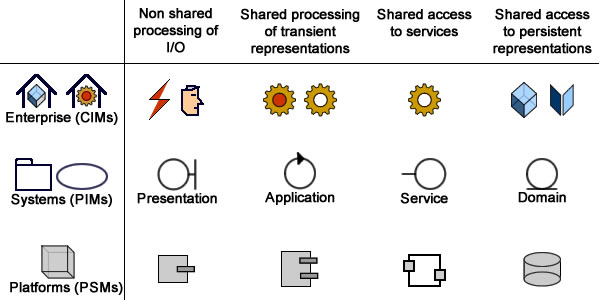
With regard to software (as opposed to enterprise) architecture, DDD identifies four layers: users interfaces (or presentation), applications, domains (or models), and infrastructures. Of these, the domain layer seems to be the only one unambiguously set apart, definitions of the others leaving room for overlaps; but potential qualms can be easily remedied by introducing formal criteria:

  • Presentation: non shared processing of I/O.
  • Application: shared processing of transient representations
  • Domain: shared access to persistent representations
  • Infrastructure: shared access to services.

Architecture Functional layers understood as PIM artifacts.

Furthermore, these layers are best understood when associated with the platform independent models (PIMs) of the model driven architecture (MDA) framework.

Aggregates & Roots

The distinction between the identity and structure of objects on one hand, features semantics and use on the other hand, is arguably a core tenet of DDD as it brings together objects designs and systems architectures.

With regard to objects design, aggregates to be accessed through a single root (#) guarantee the continuity and integrity of the threads anchoring business entities to their symbolic counterparts.

With regard to systems architectures, features of business entities surrogates can be shared across domains, each according to their own semantics, as epitomized by persons in the example below.

vvvv
Roots anchor identified (#) persons to their symbolic surrogates

Yet, the fact is that approach combines object with aspect oriented designs and its implementation at architecture level could come with serious drawbacks when functional facets are to be shared across domains. That’s where bounded contexts intervene.

Bounded Contexts

Contexts are introduced to conciliate continuity and integrity, managed through aggregates, and semantics and functional accesses, managed through contexts; bounded contexts (BCs) are ones with shared business entities. Adding to the example above, person usually appears in different functional contexts subject to specific responsibilities, with one and only one with explicit responsibility on aggregates (#).

Bounded contexts are used to distinguish between identification and integrity, managed through aggregates, and semantics and use, managed through contexts.

But as sound and useful as bounded contexts may be conceptually, their implementation is mostly entrusted to maps and best practices. Since the way shared business domains are managed by systems is arguably a key success factor of enterprise architectures, the lack of principled implementation schemes leaves the conceptual gap between business domains and software designs unaccounted for. That would be the purpose of ubiquitous languages (UL).

Ubiquitous or Domain Specific Languages.

The explicit objective of ubiquitous languages is to bring under a common semantic roof domain analysis and software design, and so to tie concepts and implementations. But that very endeavor may also be seen as controversial, shallow, and confusing:

  • Controversial: bringing together concepts and implementations appears to contradict OO principles as well as layered architectures.
  • Shallow: the so-called languages (as many as domains ?) are in fact just lists of entities and operations, without grammar or unifying semantics.
  • Confusing: they are supposedly derived from models, which would suggest specificity instead of ubiquity; that understanding would also belie the customary assumption that models are built with modeling languages.

One way out of the conundrum could be to see ubiquitous languages as variants of domain specific ones whose explicit objective is precisely to tie concepts with implementations. But that option would bypass the issue of principled BC design, and more generally the relationship between business domains, systems architectures, and software designs.

The other way would be to forsake ubiquitous (or specific) languages and use instead open concepts and functional patterns.

Bounded Contexts & Open Concepts

Open concepts are modeling artifacts whose semantics can be shared by business domains and systems functional architectures. For that purpose they have to meet standard OO principles:

  • Open-Closed Principle (OPC): open concepts should have no reason to change, they can only be refined. In other words open concepts are meant to be specialized, but not generalized. That ensures that the semantics of sub-types defined by different projects cannot be modified.
  • Substitution Principle (LSP): sets of instances denoted by specialized concepts are subsets of the sets denoted by more general ones. That ensures that individuals are consistently identified across projects.
  • Dependency-Inversion principle (DIP): higher levels semantics are defined independently of lower levels. That ensures that the semantics of sub-types are consistently, but not necessarily uniformly, defined across projects.
  • Interface-Segregation Principle (ISP): semantics and features are congruent, i.e all features are meaningful for whoever is using the concept. That ensures that there is no overlapping of semantics even when subsets of individuals overlap.

Assuming these criteria can be fulfilled, open concepts can be used as a modeling glue between bounded contexts overlaps.

Open concepts for entities (aka roots):

  • Structural inheritance means that the targeted entities (i.e shared between contexts) inherit both structures and aspects: parties are a subset of social agents.
  • Functional inheritance means that the targeted entities inherit all the aspects whatever the identified structure: an organization has all the features of a collective agent but is not necessarily identified as such.

Domains_BOCs
How to consolidate contexts overlaps using open concepts

Open concepts for aspects (aka features):

  • Structural inheritance is equivalent to composition, i.e inherited aspects are bound to domain individuals whatever their structure: symbolic references are an intrinsic component of products but can be used in any kind of domain.
  • Functional inheritance is equivalent to aggregation, i.e inherited aspects are not bound to domain individuals: business roles can combine different ones.

On a broader perspective, using open concepts to consolidate the overlaps between bounded contexts enables the formal verification of models, not only for internal consistency but also with regard to best practices. And best practices can be translated into functional (aka representation) patterns formally defined in terms of open concepts.

Further Readings

External Links

Models as Parachutes

Preamble

The recent paralysis of British Airways world operations (due to a power failure, if officials are to be believed), following the crash of Delta Airlines’ reservation system and a number of similar incidents, once again points to the reliability of large and critical IT systems.

László Moholy-Nagy-para
Models as Parachutes (László Moholy-Nagy)

Particularly at risk are airlines or banking systems, whose seasoned infrastructures, at the cutting edge when introduced half a century ago, have been strained to their limit by waves of extensive networked new functionalities. Confronted to the magnitude and complexity of overall modernization, most enterprises have preferred piecemeal updates to architectural leaps. Such policies may bring some respite, but they may also turn into aggravating factors, increasing stakes and urgency as well as shortening odds.

Assuming some consensus about stakes, hazards, and options, the priority should be to overcome jumping fears by charting a reassuring perspective in continuity with current situation. For that purpose models may provide heartening parachutes.

Models: Intents & Doubts

Models can serve two kinds of purposes:

  • Describe business contexts according to enterprise objectives, foretell evolution, and simulate policies.
  • Prescribe the architecture of supporting systems and the design of software components.

Business analyst figure maps from territories, software architects create territories from maps
Models Purposes: Describe contexts & concerns, Design supporting systems

Frameworks were supposed to combine the two perspectives, providing a comprehensive and robust basis to systems governance. But if prescriptive models do play a significant role in engineering processes, in particular for code generation, they are seldom fed by their descriptive counterpart.

Broadly speaking, the noncommittal attitudes toward descriptive models comes from a rooted mistrust in non executable models: as far as business analysts and software engineers are concerned, such models can only serve as documentary evidence. And since prescriptive models are by nature grounded to systems’ inner making, there is no secure conceptual apparatus linking systemic changes with their technical consequences. Hence the jumping frights.

Overcoming those frights could be achieved by showing the benefits of secure and soft landings.

Models for Secure Landings

As any tools, models must be assessed with regard to their purpose: prescriptive ones with regard to feasibility and reliability of architectures and design, descriptive ones with regard to correctness and consistency. As already noted, compared to what has been achieved for the former, nothing much has been done about the validity of the latter.

Yet, and contrary to customary beliefs, the rigorous verification of descriptive (aka extensional) models is not a dead-end. Of course these models can never be proven true because there is no finite scope against which they could be checked; but it doesn’t mean that nothing can be done to improve their reliability:

Models must be assessed with regard to their purpose
How to Check for secure landings

  • Correctness: How to verify that all the relevant individuals and features are taken into account. That can only be achieved empirically by building models open to falsification.
  • Consistency: How to verify that the symbolic descriptions (categories and connectors) are complete, coherent and non redundant across models and abstraction levels. That can be formally verified.
  • Alignment: How to verify that current and required business processes are to be seamlessly and effectively supported by systems architectures. That can be managed by introducing a level of indirection, as illustrated by MDA with platform independent models (PIMs) set between computation independent (CIMs) and platform specific (PSMs) ones.

Once established on secure grounds, models can be used to ensure soft landings.

Models for Soft Landings

Set within model based system engineering frameworks, models will help to replace piecemeal applications updates by seamless architectures modernization:

  • Systems: using models shift the focus of change from hardware to software.
  • Enterprise: models help to factor out the role of organization and regulations.
  • Project management: models provide the necessary hinge between agile and phased projects, the former for business driven applications, the latter for architecture oriented ones. Combining both approaches will ensure than lean and just-in-time processes will not be sacrificed to system modernization.

Seamless architectures modernization (a) vs Piecemeal applications updates (b).

More generally, and more importantly, models are the option of choice (if not the only one) for enterprise knowledge management:

  • Business: Computation independent models (CIMs), employed to trace, justify and rationalize business strategies and processes portfolios.
  • Systems: Platform specific models (PSMs), employed to trace, justify and rationalize technical alternatives and decisions.
  • Decision-making and learning: Platform independent models (PIMs), employed to align business and systems and support enterprise architecture governance.

And knowledge management is arguably the primary factor for successful comprehensive modernization.

Strategic Decision-making: Cash or Crash

Governance is all about risks and decision-making, but investing on truly fail-safe systems for airlines or air traffic control can be likened to a short bet on the Armageddon, and that cannot be easily framed in a neat cost-benefit analysis. But that may be the very nature of strategic decision-making: not amenable to ROI but aiming at risks assessment and the development of the policies apt to contain and manage them. That would be impossible without models.

Further Reading