The often mentioned distinction between problem and solution levels may make sense from an analyst’s particular point of view, whether business or system. But blending problems and solutions independently of their nature becomes a serious over simplification for enterprise architects considering that one of their prime responsibility is to keep apart business problems from IT solutions.
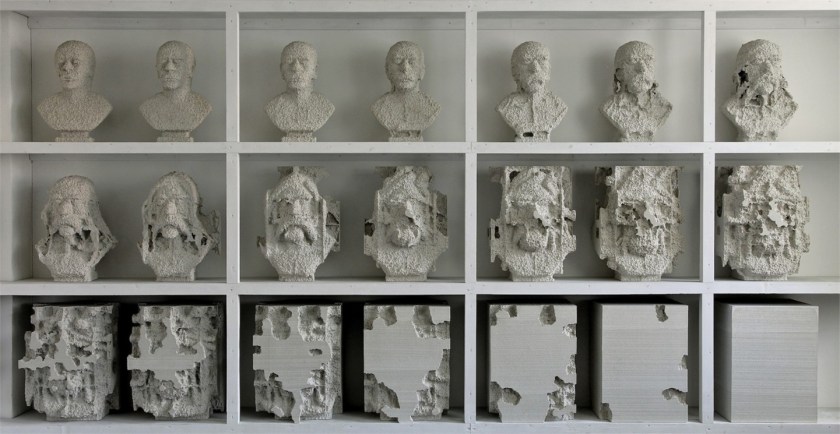
Functional problem with technical solution (Mircea Cantor)
That issue is relevant from engineering as well as business perspective.
Engineering View: Problem Levels & Architecture Layers
As long as computers are used to solve problems the only concern is to find the best solution, and the only architecture of concern is software’s.
But enterprise architects have to deal with systems, not computers, namely how to best serve business objectives with corporate resources, across business units and along business cycles. For that purpose resources (financial, human, technical) and their use are to be layered according to the nature of problems and solutions: business processes (enterprise), supporting functionalities (systems), and technologies (platforms).
From an engineering perspective, the intended congruence between problems levels and architecture layers can be illustrated with the OMG’s model driven architecture (MDA) framework:
Computation independent models (CIMs) deal with business processes solutions, to be translated into functional problems for supporting systems.
Platform independent models (PIMs) deal with functional solutions, to be translated into technical problems for supporting platforms.
Platform specific models (PSMs) deal with technical solutions, to be implemented as code.
MDA layers can be mapped to a clear hierarchy of problems and solutions
Along that understanding, architectures can be seen as solutions, and the primary responsibility of enterprise architects is to see that problems/solutions brace remain in their respective swim-lanes.
Business View: Business Value & Enterprise Assets
Whereas the engineering perspective may appear technical or specific to a model based approach, the same issue is all the more significant when expressed with regard to business concerns and corporate governance. In that case the critical distinction is between business value and assets:
Business value: Problems are set by business opportunities, and solutions by processes and applications. The critical factor is reactivity and time-to-market.
Assets: Problems are set by business objectives and strategy, and solutions are to be supported by organization and systems capabilities. The critical factor is reuse and ROI.
Decision-making must distinguish between business opportunities and enterprise governance
If opportunities are to be seized and operations managed on the fly yet tally with strategic decisions, respective problems and solutions should be kept apart. Juggling with their dynamic alignment is at the core of enterprise architects’ job description.
Enterprise Architects & Governance
Engineering and business perspectives are not to be seen as the terms of an alternative to be picked by enterprise architects. As a matter of fact they must be crossed and governance policies selected depending on the point of view:
Looking at EA from an engineering perspective, the business one will focus on systems governance and assets management as epitomized by model based systems engineering schemes.
Looking at EA from a business perspective, the engineering one will focus on lean and just-in-time solutions, as epitomized by agile development models.
As far as governance of large and complex corporate entities, supposedly EA’s primary target, must deal with tactical, operational, and strategic concerns, the nexus between business and engineering perspectives is where enterprise architects are to stand.
As far as standards go, the more they are, the less they’re worth.
Read my code, if you can …
What have we got
Assuming that modeling languages are meant to build abstractions, one would expect their respective ladders converging somewhere up in some conceptual or meta cloud.
Assuming that standards are meant to introduce similarities into diversity, one would expect clear-cut taxonomies to be applied to artifacts designs.
Instead one will find bounty of committees, bloated specifications, and an open-minded if clumsy language confronted to a number of specific ones.
What is missing
Given the constitutive role of mathematical logic in computing systems, its quasi absence in modeling methods of their functional behavior is dumbfounding. Formal logic, set theory, semiotics, name it, every aspect of systems modeling can rely on a well established corpus of concepts and constructs. And yet, these scientific assets may be used in labs for research purposes but they remain overlooked for any practical use; as if the laser technology had been kept out of consumers markets for almost a century.
What should be done
The current state of affairs can be illustrated by a Horse vs Zebra metaphor: the former with a long and proved track record of varied, effective and practical usages, the latter with almost nothing to its credit except its archetypal idiosyncrasy.
Like horses, logic can be harnessed or saddled to serve a wide range of purposes without loosing anything of its universality. By contrast, concurrent standards and modeling languages can be likened to zebras: they may be of some use for their owner, but from an outward perspective, what remains is their distinctive stripes.
So the way out of the conundrum seems obvious: get rid of the stripes and put back the harness of logic on all the modeling horses.
What Can Be Done
Frameworks are meant to promote consensus and establish clear and well circumscribed common ground; but the whopping range of OMG’s profiles and frameworks doesn’t argue in favor of meta-models.
Ontologies by contrast are built according to the semantics of domains and concerns. So whereas meta-models have to mix lexical, syntactic, and semantic constructs, ontologies can be built on well delineated layers.
An ontological kernel has been developed as a Proof of Concept of the benefits of ontologies for enterprise architecture, the purpose being to extend the Caminao enterprise architecture paradigm to contexts and environments. That kernel has been built on two principles:
A clear-cut distinction between truth-preserving representation and domain specific semantics.
Profiled ontologies designed according to the nature of contents (concepts, documents, or artifacts), layers (environment, enterprise, systems, platforms), and contexts (institutional, professional, corporate, social.
A beta version (Protégé/OWL 2) will soon (Q1 2021) be available for comments on the Stanford/Protégé portal.
The recent paralysis of British Airways world operations (due to a power failure, if officials are to be believed), following the crash of Delta Airlines’ reservation system and a number of similar incidents, once again points to the reliability of large and critical IT systems.
Models as Parachutes (László Moholy-Nagy)
Particularly at risk are airlines or banking systems, whose seasoned infrastructures, at the cutting edge when introduced half a century ago, have been strained to their limit by waves of extensive networked new functionalities. Confronted to the magnitude and complexity of overall modernization, most enterprises have preferred piecemeal updates to architectural leaps. Such policies may bring some respite, but they may also turn into aggravating factors, increasing stakes and urgency as well as shortening odds.
Assuming some consensus about stakes, hazards, and options, the priority should be to overcome jumping fears by charting a reassuring perspective in continuity with current situation. For that purpose models may provide heartening parachutes.
Models: Intents & Doubts
Models can serve two kinds of purposes:
Describe business contexts according to enterprise objectives, foretell evolution, and simulate policies.
Prescribe the architecture of supporting systems and the design of software components.
Models Purposes: Describe contexts & concerns, Design supporting systems
Frameworks were supposed to combine the two perspectives, providing a comprehensive and robust basis to systems governance. But if prescriptive models do play a significant role in engineering processes, in particular for code generation, they are seldom fed by their descriptive counterpart.
Broadly speaking, the noncommittal attitudes toward descriptive models comes from a rooted mistrust in non executable models: as far as business analysts and software engineers are concerned, such models can only serve as documentary evidence. And since prescriptive models are by nature grounded to systems’ inner making, there is no secure conceptual apparatus linking systemic changes with their technical consequences. Hence the jumping frights.
Overcoming those frights could be achieved by showing the benefits of secure and soft landings.
Models for Secure Landings
As any tools, models must be assessed with regard to their purpose: prescriptive ones with regard to feasibility and reliability of architectures and design, descriptive ones with regard to correctness and consistency. As already noted, compared to what has been achieved for the former, nothing much has been done about the validity of the latter.
Yet, and contrary to customary beliefs, the rigorous verification of descriptive (aka extensional) models is not a dead-end. Of course these models can never be proven true because there is no finite scope against which they could be checked; but it doesn’t mean that nothing can be done to improve their reliability:
How to Check for secure landings
Correctness: How to verify that all the relevant individuals and features are taken into account. That can only be achieved empirically by building models open to falsification.
Consistency: How to verify that the symbolic descriptions (categories and connectors) are complete, coherent and non redundant across models and abstraction levels. That can be formally verified.
Alignment: How to verify that current and required business processes are to be seamlessly and effectively supported by systems architectures. That can be managed by introducing a level of indirection, as illustrated by MDA with platform independent models (PIMs) set between computation independent (CIMs) and platform specific (PSMs) ones.
Once established on secure grounds, models can be used to ensure soft landings.
Models for Soft Landings
Set within model based system engineering frameworks, models will help to replace piecemeal applications updates by seamless architectures modernization:
Systems: using models shift the focus of change from hardware to software.
Enterprise: models help to factor out the role of organization and regulations.
Project management: models provide the necessary hinge between agile and phased projects, the former for business driven applications, the latter for architecture oriented ones. Combining both approaches will ensure than lean and just-in-time processes will not be sacrificed to system modernization.
Seamless architectures modernization (a) vs Piecemeal applications updates (b).
More generally, and more importantly, models are the option of choice (if not the only one) for enterprise knowledge management:
Business: Computation independent models (CIMs), employed to trace, justify and rationalize business strategies and processes portfolios.
Systems: Platform specific models (PSMs), employed to trace, justify and rationalize technical alternatives and decisions.
Decision-making and learning: Platform independent models (PIMs), employed to align business and systems and support enterprise architecture governance.
And knowledge management is arguably the primary factor for successful comprehensive modernization.
Strategic Decision-making: Cash or Crash
Governance is all about risks and decision-making, but investing on truly fail-safe systems for airlines or air traffic control can be likened to a short bet on the Armageddon, and that cannot be easily framed in a neat cost-benefit analysis. But that may be the very nature of strategic decision-making: not amenable to ROI but aiming at risks assessment and the development of the policies apt to contain and manage them. That would be impossible without models.
Abstractions, and corollary inheritance, are primarily understood with objects. Yet, since business processes are meant to focus on activities, semantics may have to be refined when abstraction and inheritance are directly used for behaviors.
How to apply abstraction to processes ? (E. Gimenez Velilla)
Considering that the primary purpose of abstractions is to tackle business variants with regard to supporting systems, their representation with use cases provides a good starting point.
Business Variants: Use case’s <extend> & <include>
Taking use cases as a modeling nexus between business and systems realms, <extend> and <include> appear as the default candidates for the initial description of behaviors’ specialization and generalization.
<include>: to be compared to composition semantics, with the included behaviors performed by instances identified (#) by the owner UC (a).
<extend>: to be compared to aggregation semantics, with the extending behaviors performed by separate instances with reference to the owner ones (b).
Included UCs are meant to be triggered by owners (a); that cannot be clearly established for abstract use cases and generalization (c).
Abstract use cases and generalization have also been mentioned by UML before being curiously overlooked in following versions. Since none has been explicitly discarded, some confusion remains about hypothetical semantics. Notionally, abstract UCs would represent behaviors never to be performed on their own (c). Compared to inclusion, used for variants of operations along execution paths, abstract use cases would describe the generic mechanisms to be applied to triggering events at UC inception independently of actual business operations carried out along execution paths.
Nonetheless, and more importantly, the mix-up surrounding the generalization of use cases points to a critical fault-line running under UML concepts: since both use cases and classes are defined as qualifiers, they are supposed to be similarly subject to generalization and specialization. That is misguided because use cases describe the business behaviors to be supported by systems, not to be confused with the software components that will do the job. The mapping between the former and the latter is to be set by design, and there is no reason to assume a full and direct correspondence between functional requirements and functional architecture.
Use Cases Distilled
As far as use cases are considered, mapping business behaviors to supporting systems functionalities can be carried out at two levels:
Objects: UCs being identified by triggering agents, events, and goals, they are to be matched with corresponding users interfaces and controllers, the former for the description of I/O flows, the latter for the continuity and integrity of interactions.
Methods: As it’s safe to assume that use cases are underpinned by shared business functions and system features, a significant part of their operations are to be realized by methods of shared business entities or services.
Setting apart UIs and controllers, no direct mapping should be assumed between use cases and functional qualifiers.
The business variants distilled into objects’ or services’ methods can be generalized and specialized according to OOD principles; and the same principles can be applied to specific users’ interfaces. But since purely behavioral aspects of UCs can neither be distilled into objects’ methods, nor directly translated into controller objects, their abstraction semantics have to be reconsidered.
Inheritance Semantics: Structural vs Functional
As far as software artifacts are concerned, abstraction semantics are set by programming languages, and while they may differ, the object-oriented (OO) paradigm provides some good enough consolidation. Along that perspective, inheritance emerges as a critical issue due to its direct impact on the validity of programs.
Generally speaking, inheritance describes how structural or behavioral traits are passed from ancestors to descendants, either at individual or type level. OO design is more specific and puts the focus on the intrinsic features (attributes and operations) supported by types or classes, which ensues that behaviors are not considered as such but through the objects’ methods that realize them:
Structural inheritance deals with attributes and operations set for the whole life-cycle of instances. As a consequence corresponding inheritance is bound to identities (#) and multiple ascendants (i.e identities) are ruled out.
Functional inheritance deal with objects behaviors which may or may not be frozen to whole life-cycles. Features can therefore be inherited from multiple ascendants.
That structural vs functional distinction matches the one between composition and aggregation used to characterize the links between objects and parts which, as noted above, can also be applied to uses cases.
Use Cases & Abstraction
Assuming that the structural/functional distinction defined for objects can also be applied to behaviors, use cases provide a modeling path from variants in business processes to OOD of controllers:
Behaviors included by UCs (a) are to be set along the execution paths triggered by UC primary events (#). Inheritance is structural, from UCs base controllers to corresponding (local) ones, and covers features (e.g views on business objects) and associated states (e.g authorizations) defined by use case triggering circumstances.
Behaviors extending UCs (b) are triggered by secondary events generated along execution paths. Inheritance is functional, from extending UCs (e.g text messaging) to UCs primary controllers.
Yet this dual scheme may not be fully satisfactory as it suffers from two limitations:
It only considers the relationships between UCs, not with the characteristics of the use cases themselves.
It ignores the critical difference between the variants of business logic and the variants of triggering conditions.
Both flaws can be patched up if abstract use cases are specifically introduced to factor out triggering circumstances (c):
Use cases provide a principled modeling path from variants in business processes to the OOD of corresponding controllers.
Undefined triggering circumstances is the only way to characterize abstraction independently of what happens along execution paths.
Abstract use cases can then be used to specify inception mechanisms to be inherited by concrete use cases.
That understanding of abstract use cases comes with clear benefits with regard to security and confidentiality.
What is at Stake
Abstraction can significantly reinforce the bridging role of use cases between business and UML models.
On one side specialized use cases can be associated to operations and functions directly implemented, e.g by factoring out authentication and authorization:
One standard solution is to define a common use case controlling accesses for all users providing they can be identified before being subsequently (i.e during UC execution) qualified and authorized. Apparently, that could be done with <<include>> (a) or <<extend>> (b) connectors.
But the second option would not be possible with the semantic distinction suggested above for UC patterns, which specifies that use cases can only be extended from existing sessions.
A more generic approach (possibly with patterns) could try to “abstract” Open Session UC, e.g to cover a broader range of actors and identification mechanisms.
Understanding UC abstraction in terms of a partial specification to be <<included>> and run by the current thread will be inconsistent because there would be no concrete actor for the identification mechanisms (c).
By contrast, since inheritance connectors apply to types and not to instances (i.e execution threads), abstracted identification mechanisms are meant to be part of Manage Session and can be applied to triggering actors (d).
Such a clear distinction between the specification of threads (using connectors) and activities (using inheritance) should provide the basis of architecture-based UC patterns.
Al in all, that will greatly help to align business cases, business opportunities, and functional architectures.
As Aristotle noted some time ago, plots are the backbone of any story as they uphold the causal sequence of events and actions: they provide the “why” of what happens, compared to narratives, which tell “how” what happened is being told.
Only shadows will tell: as far as stories are concerned, possibilities remain unknown until their realization.
So, in principle, plots deal with possibilities and narratives with realizations. But in fact plots remain unknown until being narrated; in other words fictions are like Schrödinger’s cat: there is no way to set possibilities and realizations apart.
That literary conundrum may convey some useful clues for business analysis, with stakeholders objectives seen as plots, and users’ stories as narratives.
Stakeholders’ Plots vs Users’ Narratives
With regard to the functionalities of supporting systems, a key issue for business analysts is to accommodate specific and/or short-term opportunities identified by business units with broader and long-standing objectives defined at corporate level.
Using the fictional metaphor, business expectations can be charted in terms of plots and narratives:
Business objectives (as plots) are meant to apply continuously and consistently to different agents, different concerns, and different contexts. As such they are best defined as rules and constraints (declarative schemes).
Users’ stories (as narratives) are supposed to translate as soon as possible into business transactions. As such they are best defined as sequences of operations governed by users’ choices (procedural schemes).
Then, just like narratives are meant to carry out the plots, users’ stories are supposed to follow the paths set by business objectives. But if confusion is to be avoided between strategic orientations, regulatory directives, and opportunist moves, the walk of business objectives and the talk of users’ stories should be termed differently.
Business Objectives (Plots): Symbolic & Allochronic
The definition of business objectives has to find its terms between the Charybdis of abstractions and the Scylla of specific business processes, the former to be avoided because they are by nature detached from reality and only make sense with regard to models, the latter because they would be too specific and restrictive. In-between, business objectives would be best defined through:
Strategic and financial objectives expressed using symbolic categories applied to environments, products, and resources.
Modal time-frames identified in reference to events and qualified by assumptions with regard to symbolic categories.
Business functions to be optimized given a set of constraints.
These could be comprehensively and consistently expressed with declarative languages.
Users’ Stories (Narratives): Actual & Contemporaneous
Users’ stories are at their best when tied to specific circumstances and purposes without being led away by modeling concerns. As narratives they should stick to agents, triggering events, and scripted sequences of options, operations, and outcomes:
Compared to the symbolic categories used for business objectives, users stories should refer to actual subsets of objects and events defined on contexts.
Contrary to the modal time-frames of business objectives, the scripts of users’ stories must be fully timed with regard to their triggering events.
That can only be expressed as procedures.
From Fiction to Artifacts: Aligning Business Objectives & Enterprise Architectures
Likening business analysis to its distant literary kin goes beyond the metaphor as it points to a practical organization of business objectives and users’ stories.
And the benefits of the distinction between declarative (for business plots) and procedural (for users’ narratives) blueprints is not limited to business analysis but can be extended to systems architecture (as plots) and software design (as narratives). On that basis declarative schemes could be applied to business functions and architectures capabilities, and procedural ones to users’ stories (or use cases) and software design.
Liaison between projects is all too often preempted by methodological issues. So when some communication is needed alternatives should not be limited to no models at all or a medley of ambiguous ones.
Avoiding Parochial Behaviors, Turf Wars, an Autarky (Juan Munoz)
Archetypal Development Models
Software engineering processes can be regrouped in two categories: phased ones are segmented with regard to responsibilities, tasks and the nature of artifacts, agile ones are iterative, with a single team sharing responsibilities for the definition, building and acceptance of final outcomes.
Compared to phased projects, agile ones start right away with software and carry on without making use of intermediate development artifacts.
With regard to modeling languages, both approaches may encounter parochial pitfalls: tasked teams of phased projects may go through turf wars and misunderstandings, agile teams could tend to autarkic biases and objections to models.
Stories Must Be Set in Context
Agile projects start right away with writing users’ stories into software, making no use of intermediate development artifacts other than code. With business analysts and software engineers working side by side, the semantics of business objects and activities is meant to be directly, if progressively, inscribed into software artifacts.
Nonetheless, users’ stories, being by nature specific, are to be set against the broader context of enterprise business objectives. Teams may therefore have to communicate with outside entities and, considering that source code is seldom the preferred language of other units, agile teams may have to resort to means they would otherwise disparage. They would be in a better position if stories could be docked to open concepts to be used to contrive messages in line with projects’ needs and creeds.
Developments Must be Shared
Paraphrasing Einstein, the only reason for phased processes is so that everything doesn’t happen at once. In that case intermediate artifacts are to be introduced between tasks. But then, suppliers and customers, often from different backgrounds and with different concerns, have to agree about the semantics of the development flows. Moreover, the accuracy and consistency of agreed upon definitions must stand the test of time whatever the changes on each side.
As illustrated by model based software engineering processes, that objective is essentially attainable for programming languages; otherwise blurred footprints and ambivalent semantics require cumbersome maintenance of transformation rules as well as regressive updates of previous versions of the artifacts. In that case open concepts may help to prevent the corruption of a core of sound specifications by surroundings ambiguous ones.
Open Concepts: Yet Another Conceptual Framework ?
As many will have noticed, there is no lack of frameworks, conceptual or otherwise. So what could be the point of yet another one ?
The answer, as it should be, is to be found in its impact on the use, or reuse, of artifacts by projects and teams, whatever their preferred development model. And that’s why the open source paradigm applied to open concepts is critical:
The difference between generalization and specialization is fully taken into account so that the semantics of sub-types defined by different projects cannot be modified.
The concept of Individuals is used to guarantee that business objects and activities are consistently identified across projects.
The semantics of sub-types are consistently, but not necessarily uniformly, defined across projects.
Those are very strong constraints which, combined with the already limited footprint of open concepts, will result in a very compact set of concepts. When implemented with ontologies ensuring interoperability with models, that is to make the difference: a small set of concepts, built from well-known principles, with clear properties and benefits, to be shared by projects independently of their modeling languages and development methods.
When its first version was published twenty years ago the prognosis for OMG’s UML (Unified Modeling Language) was of rapid and wide expansion. It didn’t happen, and notwithstanding a noteworthy usage, UML has not become “the” unified modeling language. Beyond the diverse agendas of methods and tools providers, this falling short may have something to do with a lack of robust semantics, as illustrated by UML 2.5’s halfhearted attempt to define individuals.
Actual & Digital Identities (Jonathan Monk)
UML 2.5 Aborted Attempt with Individual
UML 2.5 has often been presented as an attempt to redress the wayward and increasingly convoluted paths taken by the previous versions. Yet, beside some useful (and long needed) clarifications and adjustments, its governing group failed to agree on some compact and unambiguous semantics and had to content itself with perfunctory guidelines introduced as an afterthought.
As a matter of fact the OMG committee may have tried to get its semantics in order, as suggested by the chapter “On semantics” making the point right away with a distinction between the things to be described and the categories to be applied:
“A UML model consists of three major categories of model elements [classifiers, events, and behaviors], each of which may be used to make statements about different kinds of individual things within the system being modeled (termed simply “individuals”in the following)”.
That straightforward understanding (UML is meant to describe individual objects, events, or behaviors) could have provided the semantic cornerstone of a sound approach. Surprisingly, and for obscure reasons, it is soon smudged by syntactical overlapping and semantic ambiguity, the term “individual” being used indifferently as adjective and noun, and then appears to be restricted to classifiers only. That leaves UML with a dearth of clear semantics regarding its scope.
Individual as a Semantic Master Key
The early dismiss of individual as a constitutive concept is unfortunate because, taking a leaf from Archimedes, itcould have been the fulcrum on which to place the UML lever.
To begin with, no modeling language, especially one supposed to be unified, can do without some convincing semantics about what it is supposed to describe:
Analysis (aka extensional) models are descriptive as they deal with external individuals, things or behaviors, capturing their relevant aspects.
Design (aka prescriptive) models are prescriptive as they describe how to build software components and execute processes.
A rigorous identification mechanism must ensure a persistent and consistent mapping of individuals
As analysis and design models serve different purposes they clearly differ. Nonetheless, since UML is meant to straddles the divide between business and systems realms, some rigorous mechanism must ensure a persistent and consistent mapping of individuals.
That could have been neatly achieved with a comprehensive and unified interpretation of individuals, combined with a clear taxonomy of the aspects to be modeled:
Individuals are whatever occurrences (in business or systems contexts) with identities of their own.
These individuals (objects, events, or behaviors) can be specified with regard to their structure and relationships.
The logical primacy of this approach is reinforced by its immediate, practical, and conclusive benefits for business processes modeling on one side, model based engineering processes on the other side.
A Key to Business Processes Modeling
As far as business processes are concerned, modeling the part played by supporting systems turns around few critical issues, and these issues can be dealt more clearly and consistently when set in reference to individuals taxonomy (objects, behaviors, events) e.g:
Functional or non functional requirements ? The former can be associated with individuals, the latter cannot.
Architecture or application ? The former affect the specification of interactions between individuals, the latter affect only their local features.
Synchronous or asynchronous ? Specifications can only be made with regard to life-cycles and time-frames: system (objects), process (behaviors), or instant (event).
Structures or Relationships ? The former are bound to individuals’ identity, the latter are used between different individuals.
Inheritance or Delegation ? The former is used for the specification of structural or functional features, the latter for individuals’ behaviors.
More generally that understanding of individuals should greatly enhance the alignment of systems functional architectures with business processes.
A Key to Model Based Systems Engineering
As should be expected from a lack of semantic foundations, one of the main characteristics of the UML community is its fragmented practices, regrouped around diagrams (e.g Use case or Class) or task (e.g requirements analysis or code generation).
The challenge can be directly observed for model based system engineering and software development: with the exception of Statecharts for RT modeling, Class diagrams are the only ones used all along engineering processes; the others, when used, are reduced to documentation purposes. That bottleneck in development flows can be seen as the direct consequence of UML restricted semantics: since behaviors are not identified as individuals in their own right, their description cannot be directly translated into software artifacts, but have to be understood as part of active objects descriptions before being translated into class diagrams. Hence the apparent redundancy of corresponding diagrams.
As a corollary, reinstating a unified semantics of individual for both classifiers and behaviors could be the key to a seamless integration of the main UML diagrams. Most important, that would bear out the cross benefits of combining UML and MBSE.
A Key to Enterprise Architecture
Enterprise architecture can be defined in terms of territories and maps, the former materialized by the realities of enterprise organization and business operations, the latter by the assortment of charts, blueprints, or models used to describe enterprise organization, business processes, IT systems, and software applications. Along that understanding the whole endeavor depends on the ability to manage the continuity and consistency of charting; and that cannot be done without a unified and persistent identification mechanism of objects and processes across business, enterprise, and systems.
As it’s safe to assume that a primary objective of process analysis is to align business concerns (by nature specific and changing) with enterprise architectures (meant to be shared and stable), events could provide a good starting point.
Event, concerns, processing (F. Handoko)
Business Analysis & Application Design
Taking example from the convincing track record of object oriented approaches for systems architectures and software design, the same principles have been tried for business requirements analysis. While that approach can be credited with significant realizations, success usually depends on some prior alignment of business domains with their system counterpart, in particular on the possibility to uniformly and consistently identify and define business entities as objects independently of operating processes.
Alternatively, when business entities cannot not be readily identified upfront as system objects, analysis may start with organization, entitled agents, activities, and be carried out with the definition of business flows and associated entities.
So, and whatever the approach, the question is how to ensure that the applications under consideration are designed in accordance with architecture capabilities.
System Architecture & Software Design
Words are worth the difference they make: as long as systems were not much more than an assortment of software modules, architecture and design could be understood as one and the same. But nowadays a distinction may be overdue between, on one hand the design of software components run within a single system’s address space and time-frame and, on the other hand, architectures of systems set across different spaces and time-frames.
Architecture vs Design: words are worth the difference they make
Object oriented solutions (e.g Domain Driven Design) are arguably the option of choice for the former, but services oriented approaches may be a better fit for the latter. Not by chance, events provide a sound conceptual hinge between the two approaches.
Event Oriented Analysis vs Object Oriented Design
Object oriented principles can be streamlined around three core topics: (a) information hiding and coupling between structures and methods; (b) inheritance between types; (c) communication through interfaces and polymorphism.
OO principles can be streamlined around three topics: encapsulation (a), inheritance (b), and communication through interfaces (c).
Of these, encapsulation and inheritance are specific to software design, but communication mechanisms are also at the core of services oriented architectures. Considering messages as the logical system counterparts of business events, event-oriented analysis should help to align business processes with systems capabilities.
From a business processes perspective, events are signaling changes in the states of activities, objects, or expectations. Given that supporting systems are meant to deal with those changes, the analysis of business requirements could proceed from corresponding events:
Business events are defined with regard to time-frames (a) and sources to be authenticated and authorized (b).
Triggering changes must be described by messages with regard to their functional (c) and operational (d) scope.
Business logic (e) and entities (f) are often shared across applications and therefore better defined independently.
Internal changes (same space and time-frame) are hidden.
Triggered (external) changes are defined with regard to time-frames (h), processes (d), and devices (g).
A simplified blueprint of Event Oriented Process Analysis
As it happens, those facets can be aligned with OO design ones, with (c) and (d) for communication, (e) and (f) for encapsulation. On a broader perspective they also fit with the growing focus on event-driven applications and service oriented architectures.
From Event Oriented Process Analysis to Service Oriented Architectures
By moving business logic to the background, event-driven analysis fosters polymorphism at enterprise level with corresponding benefits:
With regard to business processes, events come with functional and operational requirements set independently of the business logic that will be carried out: trigger (what has changed), role (who is requesting), and message communication semantics (when the system is supposed to deal with the event).
With regard to system capabilities messages can be used to align business (aka external) events with system (aka internal) ones independently of the business entities and logic (what is to be done and how).
With regard to architecture and design, that approach is to uphold OO principles by dealing separately with polymorphic requests (interfaces) and business logic (methods).
Those benefits appear clearly when capabilities are realized by services defined with regard to business processes (customers), business objects (messages), business logic (contract), and business operations (policy).
Environment (bold) vs Services (italic)
It must be reminded that services are part of functional architectures and as a consequence cannot be directly addressed by users or devices.
Events & Action Semantics
With events set as modeling anchors, use cases may provide the modeling glue between processes and functional capabilities:
Triggering events (a) map changes in business environments (aka external events) to changes in systems objects (aka internal events).
Actors (b) map roles in organization to system users.
Messages (c) map the semantics of business processes to the semantics of applications (e) and domains (f).
Use cases (orange) provide a comprehensive and consistent mapping from processes (green) to services (blue).
On that basis, the main objective of event-oriented analysis would be to distinguish between communication and business semantics, the former dealing with interactions, the latter with business logic.
Models transformation is generally recognized as the basic mechanism of model based systems engineering (MBSE). Yet, the actual scope of transformations is somewhat limited to design-to-code, and its sequential bias puts MBSE at odds with agile development approaches. Could a revisited understanding help to figure out this apparent discrepancy ?
Iterative Transformations (Andrea Burger)
Transformation Issues
Traditional transformation paradigm involves ordered sequences of models obtained by applying rules to their immediate predecessor(s). That organizational scheme has three critical consequences, for applicability, economics of reuse, and development processes.
Applicability: the effectiveness of transformations is conditioned by (a) an executable language for the description of targets, and (b) a closed and compact set of unambiguous patterns. Those conditions can only be satisfied for the downstream part of the development process.
Reuse: given the sequencing constraints, models are to be managed and reused along tree-like structures with duplicates introduced at branching points.
Development processes: sequenced models brings forth phased options and leaves out agile solutions.
Assuming those issues are not conclusive, they may be overcame by revisiting the nature of transformations.
Transformation vs Inheritance & Composition
Most of the proposed taxonomies (see references below) put the focus on languages and mechanisms (e.g rules) of sequential transformation without paying enough attention to the nature and the semantics of models contents. Even when abstraction levels are taken into account, the respective contents of each level remain undefined. As it happens, that issue may be the key to a better understanding of models transformation.
To begin with, rule-based transformation has to be compared to inheritance and composition:
Structural inheritance can be used to refine models as to take into account business scenarii previously ignored; e.g special conditions for good customers.
Functional inheritance can be used to introduce new capabilities; e.g new authentication procedures.
Functional composition can be used to apply capabilities across different scenarii; e.g customized authentication procedures.
Rules-based solutions can be used by any kind of transformation.
A broader understanding of models transformation should include inheritance and composition
That taxonomy implies a clear distinction between operations executed within the same level of abstraction and those targeting artifacts defined at different levels: contrary to rules-based transformations, inheritance and composition can only be applied to artifacts sharing common semantics.
heterogeneous Models
While that would clearly prevent their use for models organized along abstraction levels, semantic pitfalls could be mastered for models built from artifacts from different abstraction levels.
Releasing models from (still to be defined) abstraction levels would bring two critical benefits:
Whatever the terminology (abstract, conceptual, functional, etc.), abstraction semantics are much easier to define for artifacts than for models.
That would remove a chunk of restrictions on the design of transformation processes.
Releasing models from abstraction layers.
In that case transformation rules could be turned into combination ones and sequential transformation turned into cross-breeding.
Mendel, Models, Mongrels
Taking a cue from Gregor Mendel’s use of cross-fertilization, the aim of a revisited transformation paradigm would be three-fold:
To refine the granularity of reuse, from models to artifacts
To substitute combination for sequential transformation whenever possible.
To substitute graphs for trees, with models organized along two basic layers, final (aka mongrels) or reusable (aka blueprints).
Models combination (top) replaces transformation phases (bottom) by a distinction between blueprints (full line) and mongrels (dashed line).
As far as MBSE is concerned, the genetics metaphor helps to clarify the nature of abstraction. Conceptually, it introduces a distinction between artifacts and models:
With regard to artifacts, abstraction layers are defined by scope: enterprise, systems, platforms.
With regard to models, abstraction layers are defined by capabilities: reusable (stable traits), or final (recessive traits).
That taxonomy is corroborated by its functional counterpart: artifacts transformation is carried out with inheritance and composition, models transformation relies on combination.
More important, that understanding goes a long way solving the issues regarding scope, reuse, and development processes.
Scope: Weaving Analysis & Design Traits
Definitions and taxonomies should always be assessed with regard of their applicability. On that account there isn’t much to say for abstraction layers applied to models: they don’t fit because too many traits can be defined across different layers, e.g: business rules, authentication, encryption, etc.
That difficulty can be neatly and consistently removed by models built from artifacts defined at different levels.
Models Reuse: Blueprints vs Mongrels
Reuse is all too often seen as a contentious objective with inconclusive ROI. One one hand it requires significant overheads to manage the resources, on the other hand the outcomes can introduce regressive traits. The distinction between sound reusable models and final ones significantly reduces both the costs of the former and the risks of the latter.
Processes Organization: MBSE & Agile
Model based systems engineering and the agile development model are arguably two of the most conclusive approaches to software engineering. Unfortunately they are often seen as difficult bedfellows, principally (but not uniquely) because the former insists on the importance of models with some bias toward phased processes, while the latter is all for iterative processes with models mentioned as an afterthought, if at all. Yet, both approaches could be made complementary on condition that models could be processed iteratively. And that could be achieved if sequenced transformations of homogeneous models would be replaced by the combination of heterogeneous ones.
Iterative development mixing new business requirements with existing functionalities (a) and business rules (b).
Within such a framework an agile team could, e.g, iteratively develop new business requirements, taking into account existing functionalities (a) and business rules (b), and generate code (c).
Following the recent publication of a new standard for conceptual modeling of automation systems (Object-Process Methodology (ISO/PAS 19450:2015) it may be interesting to explore how it relates to abstraction and meta-models.
Meta-models are drawn along lean abstraction scales (Oskar Schlemmer )
Models & Meta Models
Just like models are meant to describe sets of actual instances, meta-models are meant to do the same for sets of modeling artifacts independently of their targets. Along that reasoning, conceptual modeling of automation systems could be achieved either with a single language covering all aspects, or with a meta-language dealing with different sets of models, e.g MDA’s computation independent, platform independent, and platform specific models.
Two alternative options for the modeling of automation systems: unified language, or a meta language covering technical (e.g PSMs), functional (e.g PIMs), and business (e.g CIMs) scopes.
Given a model based engineering framework (e.g MDA), meta-models are generally used to support downstream models transformation targeting designs and code. But when upstream conceptual models are concerned, the challenge is to tackle the knowledge-to-systems transition. For that purpose some shared modeling roof is required for the definition of the symbolic footprint of the targeted business in the automation system under consideration.
Symbolic Footprint
Given that automation systems are meant to manage symbolic objects (aka surrogates), one should expect the distinction between actual instances and their symbolic representations to be the cornerstone of corresponding modeling languages. Along that reasoning, modeling of automation systems should start with the symbolic representation of actual business footprints, namely: the sets of objects, events, and processes, the roles played by agents (aka active objects), and the description of the associated states and rules. Containers would be added for the management of collections.
Automation systems modeling begins with the symbolic representation by systems of actual instances of business related objects and phenomena.
Next, as illustrated by the Object/Agent hierarchy, business worlds are not flat but built from sundry structures and facets to be represented by multiple levels of descriptions. That’s where abstractions are to be introduced.
Abstraction & Variants
The purpose of abstractions is to manage variants, and as such they can be used in two ways:
For partial descriptions of actual instances depending on targeted features. That can be achieved using composition (for structural variants) and partitions (for functional ones).
As hierarchies of symbolic descriptions (aka types and sub-types) subsuming variants identified at instances level.
On that basis the challenge is to find the level of detail (targeted actual instances) and abstraction (symbolic footprint) that will best describe supporting systems functionalities. Such level will have to meet two conditions:
A minimal number of comprehensive and exclusive categories covering the structural variants of the sets of instances to be uniformly, consistently, and continuously identified by both enterprise and supporting systems.
A consistent but adjustable set of types and sub-types anchored to the core structural categories and covering the functional variants .
Climbing up and down abstraction ladders looking for right levels is arguably the critical part of conceptual modeling, but the search will greatly benefit from the distinction between models and meta-models. Assuming meta-models are meant to ignore domain specific features altogether, they introduce a qualitative gap on abstraction scales as the respective hierarchies of models and meta-models are targeting different kind of instances. The modeling of agents and roles epitomizes the benefits of that distinction.
Abstraction & Meta Models
Taking customers for example, a naive approach would use Customer as a modeling type inheriting from a super-type, e.g Party. But then, if parties are to be uniformly identified (#), that would preclude any agent for playing multiple roles, e.g customer and supplier.
A separate description of parties and roles would clearly be a better option as it would unify the identification of the former without introducing unwarranted constraints on the latter which would then be defined and identified as the realization of a relationship played by a party.
Not surprisingly, that distinction would also be congruent with the one between models and meta-model:
Meta-models will describe generic aspects independently of domain-specific considerations, in particular organizational context (units and roles) and interactions with systems (a).
Models will define Staff, Supplier and Customer according to the semantics of the business considered (b).
Composition, partitions and specialization can be used along two different abstraction scales.
That distinction between abstraction scales can also be applied to the conceptual modeling of automation systems.
Abstraction Scales & Conceptual Models
To begin with definitions, conceptual representations could be used for all mental constructs, whereas symbolic representations would be used only for the subset earmarked for communication purposes. That would mean that, contrary to conceptual representations that can be detached of business and enterprise practicalities, symbolic representations are necessarily built on design, and should be assessed accordingly. In our case the aim of such representations would be to describe the exchanges between business processes and supporting systems.
That understanding neatly fits the conceptual modeling of automation systems whose purpose would be to consolidate generic and business specific abstraction scales, the former for symbolic representations of the exchanges between business and systems, the latter symbolic representation of business contents.
At this point it must be noted that the scales are not necessarily aligned in continuity (with meta-models’ being higher and models’ being lower) as their respective ontologies may overlap (Organizational Entity and Party) or cross (Function and Role).
Toward an Ontological Framework for Enterprise Architectures Modeling
Along an analytic perspective, ontologies are meant to determine the categoriesthat can comprehensively and consistently denote the instances of a domain under consideration; applied to enterprise concerns that would entail:
Thesaurus: for the whole range of terms and concepts.
Documents: for documents with regard to topics.
Business: for enterprise organization and business objects and activities.
Engineering: for systems surrogates associated to enterprise organization and business objects and activities
Ontologies provide a common conceptual framework for models and meta-models
That would open the door to a seamless integration of business intelligence, systems engineering, knowledge management, and decision-making.