Unified Architecture Framework Profile (UAFP): Lost in Translation ?

Synopsis

The intent of Unified Architecture Framework Profile (UAFP) is to “provide a Domain Meta-model usable by non UML/SysML tool vendors who may wish to implement the UAF within their own tool and metalanguage.”

Detached Architecture (Víctor Enrich)

But a meta-model trying to federate (instead of bypassing) the languages of tools providers has to climb up the abstraction scale above any domain of concerns, in that case systems architectures. Without direct consideration of the domain, the missing semantic contents has to be reintroduced through stereotypes.

Problems with that scheme appear at two critical junctures:

  • Between languages and meta-models, and the way semantics are introduced.
  • Between environments and systems, and the way abstractions are defined.

Caminao’s modeling paradigm is used to illustrate the alternative strategy, namely the direct stereotyping of systems architectures semantics.

Languages vs Stereotypes

Meta-Models are models of models: just like artifacts of the latter represent sets of instances from targeted domains, artifacts of the former represent sets of symbolic artifacts from the latter. So while set higher on the abstraction scale, meta-models still reflect the domain of concerns.

Meta-models takes a higher view of domains, meta-languages don’t.

Things are more complex for languages because linguistic constructs ( syntax and semantics) and pragmatic are meant to be defined independently of domain of discourse. Taking a simple example from the model above, it contains two kinds of relationships:

  • Linguistic constructs:  represents, between actual items and their symbolic counterparts; and inherits, between symbolic descriptions.
  • Domain specific: played by, operates, and supervises.

While meta-models can take into account both categories, that’s not the case for languages which only consider linguistic constructs and mechanisms. Stereotypes often appear as a painless way to span the semantic fault between what meta-models have to do and what languages use to do; but that is misguided because mixing domain specific semantics with language constructs can only breed confusion.

Stereotypes & Semantics

If profiles and stereotypes are meant to refine semantics along domains specifics, trying to conciliate UML/SysML languages and non UML/SysML models puts UAFP in a lopsided position by looking the other way, i.e towards one-fits-all meta-language instead of systems architecture semantics. Its way out of this conundrum is to combine stereotypes with UML constraint, as can be illustrated with PropertySet:

UAFP for PropertySet (italics are for abstract)

Behind the mixing of meta-modeling levels (class, classifier, meta-class, stereotype, meta-constraint) and the jumble of joint modeling concerns (property, measurement, condition), the PropertySet description suggests the overlapping of two different kinds of semantics, one looking at objects and behaviors identified in environments (e.g asset, capability, resource); the other focused on systems components (property, condition, measurement). But using stereotypes indifferently for both kind of semantics has consequences.

Stereotypes, while being the basic UML extension mechanism, comes without much formalism and can be applied extensively. As a corollary, their semantics must be clearly defined in line with the context of their use, in particular for meta-languages topping different contexts.

PropertySet for example is defined as an abstract element equivalent to a data type, simple or structured, a straightforward semantic that can be applied consistently for contexts, domains or languages.

That’s not the case for ActualPropertySet which is defined as an InstanceSpecification for a “set or collection of actual properties”. But properties defined for domains (as opposed to languages) have no instances of their own and can only occur as concrete states of objects, behaviors, or expectations, or as abstract ranges in conditions or constraints. And semantics ambiguities are compounded when inheritance is indifferently applied between a motley of stereotypes.

Properties epitomize the problems brought about by confusing language and domain stereotypes and point to a solution.

To begin with syntax, stereotypes are redundant because properties can be described with well-known language constructs.

As for semantics, stereotyped properties should meet clearly defined purposes; as far as systems architectures are concerned, that would be the mapping to architecture capabilities:

Property must be stereotyped with regard to induced architecture capabilities.
  • Properties that can be directly and immediately processed, symbolic (literal) or not (binary objects).
  • Properties whose processing depends on external resource, symbolic (reference) or not (numeric values).

Such stereotypes could be safely used at language level due to the homogeneity of property semantics. That’s not the case for objects and behaviors.

Languages Abstractions & Symbolic Representations

The confusion between language and domain semantics mirrors the one between enterprise and systems, as can be illustrated by UAFP’s understanding of abstraction.

In the context of programming languages, isAbstract applies to descriptions that are not meant to be instantiated: for UAFP “PhysicalResource” isAbstract because it cannot occur except as “NaturalResource” or “ResourceArtifact”, none of them isAbstract.

“isAbstract” has no bearing on horses and carts, only on the meaning of the class PhysicalResource.

Despite the appearances, it must be reminded that such semantics have nothing to do with the nature of resources, only with what can be said about it. In any case the distinction is irrelevant as long as the only semantics considered are confined to specification languages, which is the purpose of the UAFP.

As that’s not true for enterprise architects, confusion is to arise when the modeling Paradigm is extended as to include environments and their association with systems. Then, not only that two kinds of instances (and therefore abstractions) are to be described, but that the relationship between external and internal instances is to determine systems architectures capabilities. Extending the simple example above:

  • Overlooking the distinction between active and passive physical resources prevents a clear and reliable mapping to architecture technical capabilities.
  • Organizational resource lumps together collective (organization), individual and physical (person), individual and organizational (role), symbolic (responsibility), resources. But these distinctions have a direct consequences for architecture functional capabilities.
Abstraction & Symbolic representation

Hence the importance of the distinction between domain and language semantics, the former for the capabilities of the systems under consideration, the latter for the capabilities of the specification languages.

Systems Never Walk Alone

Profiles are supposed to be handy, reliable, and effective guides for the management of specific domains, in that case the modeling of enterprise architectures. As it happens, the UAF profile seems to set out the other way, forsaking architects’ concerns for tools providers’ ones; that can be seen as a lose-lose venture because:

  • There isn’t much for enterprise architects along that path.
  • Tools interoperability would be better served by a parser focused on languages semantics independently of domain specifics.

Hopefully, new thinking about architecture frameworks (e.g DoDAF) tends to restyle them as EA profiles, which may help to reinstate basic requirements:

  • Explicit modeling of environment, enterprise, and systems.
  • Clear distinction between domain (enterprise and systems architecture) and languages.
  • Unambiguous stereotypes with clear purposes
A simple profile for enterprise architecture

On a broader perspective understanding meta-models and profiles as ontologies would help with the alignment of purposes (enterprise architects vs tools providers), scope (enterprise vs systems), and languages (modeling vs programming).

Back to Classics: Ontologies

As introduced long ago by philosophers, ontologies are meant to make sense of universes of discourse. To be used as meta-models and profiles ontologies must remain neutral and support representation and contents semantics independently of domains of concern or perspective.

With regard to neutrality, the nature of semantics should tally the type of nodes (top):

  • Nodes would represent elements specific to domains (bottom right).
  • Connection nodes would be used for semantically neutral (aka syntactic) associations to be applied uniformly across domains (bottom left).

That can be illustrated with the simple example of cars:

KM_CaseRaw
RDF graphs (top) support formal (bottom left) and domain specific (bottom right) semantics.

With regard to contexts, ontologies should be defined according to the nature of governance and stability:

  • Institutional: Regulatory authority, steady, changes subject to established procedures.
  • Professional: Agreed upon between parties, steady, changes subject to accords.
  • Corporate: Defined by enterprises, changes subject to internal decision-making.
  • Social: Defined by usages, volatile, continuous and informal changes.
  • Personal: Customary, defined by named individuals (e.g research paper).

Ontologies set along that taxonomy could also be refined as to be aligned with enterprise architecture layers: enterprise, systems, platforms, e.g:

Ontologies, capabilities (Who,What,How, Where, When), and architectures (enterprise, systems, platforms).

With regard to concerns ontologies should  focus on the epistemic nature of targeted items: terms, documents, symbolic representations, or actual objects and phenomena. That would outline four basic concerns that may or may not be combined:

  • Thesaurus: ontologies covering terms and concepts.
  • Document Management: ontologies covering documents with regard to topics.
  • Organization and Business: ontologies pertaining to enterprise organization, objects and activities.
  • Engineering: ontologies pertaining to the symbolic representation of products and services.
KM_OntosCapabs
Ontologies: Purposes & Targets

More generally, understanding meta-models and profiles as functional ontologies is to bring all EA business and engineering concerns within a comprehensive and consistent conceptual framework.

A workbench built with the Caminao ontological kernel is meant to explore the scope and benefits of that approach, with a beta version (Protégé/OWL 2) soon available for comments on the Stanford/Protégé portal.

Further Reading

Models
Architectures
Enterprise Architecture
UML

External Links

Views, Models, & Architectures

Preamble

Views can take different meanings, from windows opening on specific data contexts (e.g DB relational theory), to assortments of diagrams dedicated to particular concerns (e.g UML).

Fortunato Depero tunnels
Deconstructing the Universe along Contexts and Concerns (Depero Fortunato)

Models for their part have also been understood as views, on DB contents as well as systems’ architecture and components, the difference being on the focus put on engineering. Due to their association with phased processes, models has been relegated to a back-burner by agile approaches; yet it may resurface in terms of granularity with model-based engineering frameworks.

Yet, whatever the terminology (layers vs levels), what is at stake is the alignment of two basic scales:

  • Architectures: enterprise (concepts), systems (functionalities), and platforms (technologies).
  • Models: conceptual (business context and organization), analysis (symbolic representations), design (physical implementation).

Views & Architectures

As far as systems engineering is concerned, understandings of views usually refer to Philippe Kruchten’s “4+1” View Model of Software Architecture” :

  • Logical view: design of software artifacts.
  • Process view: captures the concurrency and synchronization aspects.
  • Physical view: describes the mapping(s) of software artifacts onto hardware.
  • Development view: describes the static organization of software artifacts in development environments.

A fifth is added for use cases describing the interactions between systems and business environments.

Whereas these views have been originally defined with regard to UML diagrams, they may stand on their own meanings and merits, and be assessed or amended as such.

Apart from labeling differences, there isn’t much to argue about use cases (for requirements), process (for operations), and physical (for deployment) views; each can be directly associated to well identified parts of systems engineering that are to be carried out independently of organizations, architectures or methods.

Logical and development views raise more questions because they imply a distinction between design and implementation. That implicit assumption induces two kinds of limitations:

  • They introduce a strong bias toward phased approaches, in contrast to agile development models that combine requirements, development and acceptance into iterations.
  • They classify development processes with regard to predefined activities, overlooking a more critical taxonomy based on objectives, architectures and life-cycles: user driven and short-term (applications ) vs data-based and long-term (business functions).

These flaws can be corrected if logical and development views are redefined respectively as functional and application views, the former targeting business objects and functions, the latter business logic and users’ interfaces.

Architecture based views

That make views congruent with architecture levels and consequently with engineering workshops. More importantly, since workshops make possible the alignment of products with work units, they are a much better fit to model-based engineering and a shift from procedural to declarative paradigm.

Model-based Systems Engineering & Granularity

At least in theory, model-based systems engineering (MBSE) should free developers from one-fits-all procedural schemes and support iterative as well as declarative approaches. In practice that would require matching tasks with outcomes, which could be done if responsibilities on the former can be aligned with models granularity of the latter.

With coarse-grained phased schemes like MDA’s CIM/PIM/PSM (a), dependencies between tasks would have to be managed with regard to a significantly finer artifacts’ granularity.

Managing changes at architecture (a) or application (b) level.

For agile schemes, assuming conditions on shared ownership and continuous deliveries are met, projects would put locks on “models” at both ends (users’ stories and deliveries) of development cycles (b), with backlogs items defining engineering granularity.

Backlogs mechanism can be used to manage customized granularity and hierarchical dependencies across model layers

From the enterprise perspective it would be possible to unify the management of changes in architectures across layers and responsibilities: business concepts and organization, functional architecture, and systems capabilities:

EAGovern_EA
Functional architecture as symbolic bridge between business needs and system capabilities.

From the engineering perspective it would be possible to unify the management of changes in artifacts at the appropriate level of granularity: static and explicit using milestones (phased), dynamic and implicit using backlogs (agile).

Fine grained model based frameworks could support phased as well as agile development solutions

Such a declarative repository would greatly enhance exchanges and integration across projects  and help to align heterogeneous processes independently of the methodologies used.

Further Reading

External Links

Focus: Business Cases for Use Cases

Preamble

As originally defined by Ivar Jacobson, uses cases (UCs) are focused on the interactions between users and systems. The question is how to associate UC requirements, by nature local, concrete, and changing, with broader business objectives set along different time-frames.

Sigmar-Polke-Hope-Clouds
Cases, Kites, and Clouds (Sigmar Polke)

Backing Use Cases

On the system side UCs can be neatly traced through the other UML diagrams for classes, activities, sequence, and states. The task is more challenging on the business side due to the diversity of concerns to be defined with other languages like Business Process Modeling Notation (BPMN).

Use cases at the hub of UML diagrams
Use Cases contexts

Broadly speaking, tracing use cases to their business environments have been undertaken with two approaches:

  • Differentiated use cases, as epitomized by Alister Cockburn’s seminal book (Readings).
  • Business use cases, to be introduced beside standard (often renamed as “system”) use cases.

As it appears, whereas Cockburn stays with UCs as defined by Jacobson but refines them to deal specifically with generalization, scaling, and extension, the second approach introduces a somewhat ill-defined concept without setting apart the different concerns.

Differentiated Use Cases

Being neatly defined by purposes (aka goals), Cockburn’s levels provide a good starting point:

  • Users: sea level (blue).
  • Summary: sky, cloud and kite (white).
  • Functions: underwater, fish and clam (indigo).

As such they can be associated with specific concerns:

Cockburn’s differentiated use cases
  • Blue level UCs are concrete; that’s where interactions are identified with regard to actual agents, place, and time.
  • White level UCs are abstract and cannot be instanciated; cloud ones are shared across business processes, kite ones are specific.
  • Indigo level UCs are concrete but not necessarily the primary source of instanciation; fish ones may or may not be associated with business functions supported by systems (grey), e.g services , clam ones are supposed to be directly implemented by system operations.

As illustrated by the example below, use cases set at enterprise or business unit level can also be concrete:

Example with actors for users and legacy systems (bold arrows for primary interactions)

UC abstraction connectors can then be used to define higher business objectives.

Business “Use” Cases

Compared to Cockburn’s efficient (no new concept) and clear (qualitative distinctions) scheme, the business use case alternative adds to the complexity with a fuzzy new concept based on quantitative distinctions like abstraction levels (lower for use cases, higher for business use cases) or granularity (respectively fine- and coarse-grained).

At first sight, using scales instead of concepts may allow a seamless modeling with the same notations and tools; but arguing for unified modeling goes against the introduction of a new concept. More critically, that seamless approach seems to overlook the semantic gap between business and system modeling languages. Instead of three-lane blacktops set along differentiated use cases, the alignment of business and system concerns is meant to be achieved through a medley of stereotypes, templates, and profiles supporting the transformation of BPMN models into UML ones.

But as far as business use cases are concerned, transformation schemes would come with serious drawbacks because the objective would not be to generate use cases from their business parent but to dynamically maintain and align business and users concerns. That brings back the question of the purpose of business use cases:

  • Are BUCs targeting business logic ? that would be redundant because mapping business rules with applications can already be achieved through UML or BPMN diagrams.
  • Are BUCs targeting business objectives ? but without a conceptual definition of “high levels” BUCs are to remain nondescript practices. As for the “lower levels” of business objectives, users’ stories already offer a better defined and accepted solution.

If that makes the concept of BUC irrelevant as well as confusing, the underlying issue of anchoring UCs to broader business objectives still remains.

Conclusion: Business Case for Use Cases

With the purposes clearly identified, the debate about BUC appears as a diversion: the key issue is to set apart stable long-term business objectives from short-term opportunistic users’ stories or use cases. So, instead of blurring the semantics of interactions by adding a business qualifier to the concept of use case, “business cases” would be better documented with the standard UC constructs for abstraction. Taking Cockburn’s example:

Abstract use cases: no actor (19), no trigger (20), no execution (21)

Different levels of abstraction can be combined, e.g:

  • Business rules at enterprise level: “Handle Claim” (19) is focused on claims independently of actual use cases.
  • Interactions at process level: “Handle Claim” (21) is focused on interactions with Customer independently of claims’ details.

Broader enterprise and business considerations can then be documented depending on scope.

Further Reading

External Links

NIEM & Information Exchanges

Preamble

The objective of the National Information Exchange Model (NIEM) is to provide a “dictionary of agreed-upon terms, definitions, relationships, and formats that are independent of how information is stored in individual systems.”

(Alfred Jensen)
NIEM’s model makes no difference between data and information (Alfred Jensen)

For that purpose NIEM’s model combines commonly agreed core elements with community-specific ones. Weighted against the benefits of simplicity, this architecture overlooks critical distinctions:

  • Inputs: Data vs Information
  • Dictionary: Lexicon and Thesaurus
  • Meanings: Lexical Items and Semantics
  • Usage: Roots and Aspects

That shallow understanding of information significantly hinders the exchange of information between business or institutional entities across overlapping domains.

Inputs: Data vs Information

Data is made of unprocessed observations, information makes sense of data, and knowledge makes use of information. Given that NIEM is meant to be an exchange between business or institutional users, it should have no concern with data mining or knowledge management.

Data is meaningless, information meaning is set by semantic domains.
As an exchange, NIEM should have no concern with data mining or knowledge management.

The problem is that, as conveyed by “core of data elements that are commonly understood and defined across domains, such as person, activity, document, location”, NIEM’s model makes no explicit distinction between data and information.

As a corollary, it implies that data may not only be meaningful, but universally so, which leads to a critical trap: as substantiated by data analytics, data is not supposed to mean anything before processed into information; to keep with examples, even if the definition of persons and locations may not be specific, the semantics of associated information is nonetheless set by domains, institutional, regulatory, contractual, or otherwise.

Data is meaningless, information meaning is set by semantic domains.

Not surprisingly, that medley of data and information is mirrored by NIEM’s dictionary.

Dictionary: Lexicon & Thesaurus

As far as languages are concerned, words (e.g “word”, “ξ∏¥” ,”01100″) remain data items until associated to some meaning. For that reason dictionaries are built on different levels, first among them lexical and semantic ones:

  • Lexicons take items on their words and gives each of them a self-contained meaning.
  • Thesauruses position meanings within overlapping galaxies of understandings held together by the semantic equivalent of gravitational forces; the meaning of words can then be weighted by the combined semantic gravity of neighbors.

In line with its shallow understanding of information, NIEM’s dictionary only caters for a lexicon of core standalone items associated with type descriptions to be directly implemented by information systems. But due to the absence of thesaurus, the dictionary cannot tackle the semantics of overlapping domains: if lexicons alone can deal with one-to-one mappings of items to meanings (a), thesauruses are necessary for shared (b) or alternative (c) mappings.

vv
Shared or alternative meanings cannot be managed with lexicons

With regard to shared mappings (b), distinct lexical items (e.g qualification) have to be mapped to the same entity (e.g person). Whereas some shared features (e.g person’s birth date) can be unequivocally understood across domains, most are set through shared (professional qualification), institutional (university diploma), or specific (enterprise course) domains .

Conversely, alternative mappings (c) arise when the same lexical items (e.g “mole”) can be interpreted differently depending on context (e.g plastic surgeon, farmer, or secret service).

Whereas lexicons may be sufficient for the use of lexical items across domains (namespaces in NIEM parlance), thesauruses are necessary if meanings (as opposed to uses) are to be set across domains. But thesauruses being just tools are not sufficient by themselves to deal with overlapping semantics. That can only be achieved through a conceptual distinction between lexical and semantic envelops.

Meanings: Lexical Items & Semantics

NIEM’s dictionary organize names depending on namespaces and relationships:

  • Namespaces: core (e.g Person) or specific (e.g Subject/Justice).
  • Relationships: types (Counselor/Person) or properties (e.g PersonBirthDate).
vvv
NIEM’s Lexicon: Core (a) and specific (b) and associated core (c) and specific (d) properties

But since lexicons know only names, the organization is not orthogonal, with lexical items mapped indifferently to types and properties. The result being that, deprived of reasoned guidelines, lexical items are chartered arbitrarily, e.g:

Based on core PersonType, the Justice namespace uses three different schemes to define similar lexical items:

  • “Counselor” is described with core PersonType.
  • “Subject” and “Suspect” are both described with specific SubjectType, itself a sub-type of PersonType.
  • “Arrestee” is described with specific ArresteeType, itself a sub-type of SubjectType.

Based on core EntityType:

  • The Human Services namespace bypasses core’s namesake and introduces instead its own specific EmployerType.
  • The Biometrics namespace bypasses possibly overlapping core Measurer and BinaryCaptured and directly uses core EntityType.
Lexical items are meshed disregarding semantics
Lexical items are chartered arbitrarily

Lest expanding lexical items clutter up dictionary semantics, some rules have to be introduced; yet, as noted above, these rules should be limited to information exchange and stop short of knowledge management.

Usage: Roots and Aspects

As far as information exchange is concerned, dictionaries have to deal with lexical and semantic meanings without encroaching on ontologies or knowledge representation. In practice that can be best achieved with dictionaries organized around roots and aspects:

  • Roots and structures (regular, black triangles) are used to anchor information units to business environments, source or destination.
  • Aspects (italics, white triangles) are used to describe how information units are understood and used within business environments.
nformation exchanges are best supported by dictionaries organized around roots and aspects
Information exchanges are best supported by dictionaries organized around roots and aspects

As it happens that distinction can be neatly mapped to core concepts of software engineering.

P.S. Thesauruses & Ontologies

Ontologies are systematic accounts of existence for whatever is considered, in other words some explicit specification of the concepts meant to make sense of a universe of discourse. From that starting point three basic observations can be made:

  1. Ontologies are made of categories of things, beings, or phenomena; as such they may range from simple catalogs to philosophical doctrines.
  2. Ontologies are driven by cognitive (i.e non empirical) purposes, namely the validity and consistency of symbolic representations.
  3. Ontologies are meant to be directed at specific domains of concerns, whatever they can be: politics, religion, business, astrology, etc.

With regard to models, only the second one puts ontologies apart: contrary to models, ontologies are about understanding and are not supposed to be driven by empirical purposes.

On that basis, ontologies can be understood as thesauruses describing galaxies of concepts (stars) and features (planets) held together by semantic gravitation weighted by similarity or proximity. As such ontologies should be NIEM’s tool of choice.

Further Reading

External Links

Focus: Analysis vs Design

Preamble

Definitions should never turn into war of words as they should only be judged on their purpose and utility, with  such assessment best achieved by comparing and adjusting the meaning of neighboring concepts with regard to tasks at hand.

Analysis & Design (Giorgio de Chirico)

That approach can be applied to the terms “analysis” and “design” as used in systems engineering.

What: Logic & Engineering

Whatever the idiosyncrasies and fuzziness of business concerns and contexts, at the end of the day business and functional requirements of supporting systems will have to be coerced into the uncompromising logic of computers. Assuming that analysis and design are set along that path, they could be characterized accordingly.

As a matter of fact, a fact all too often ignored, a formal basis can be used to distinguish between analysis and design models, the former for the consolidation of requirements across business domains and enterprise organization, the latter for systems and software designs:

  • Business analysis models are descriptive (aka extensional); they try to put actual objects, events, and processes into categories.
  • System engineering models are prescriptive (aka intensional); they define what is expected of systems components and how to develop them.
Squaring Logic with Engineering

As a confirmation of its validity, that classification along the logic basis of models can be neatly crossed with engineering concerns:

  • Applications: engineering deals with the realization of business needs expressed as use cases or users’ stories. Engineering units are self-contained with specific life-spans, and may consequently be developed on a continuous basis.
  • Architectures: engineering deals with supporting assets at enterprise level. Engineering units are associated with shared functionalities without specific life-spans, with their development subject to some phasing constraints.

That taxonomy can be used to square the understanding of analysis, designs, and architectures.

Where: Business unit or Corporate

Reversing the perspective from content to context, the formal basis of analysis and design can also be crossed with their organizational framework:

  • Analysis is to be carried out locally within business units.
  • Designs are to be set both locally for applications, and at enterprise level for architectures.

Organizational dependencies will determine the roles, responsibilities, and time-frames associated with analysis and design.

Who: Analysts, Architects, Engineers

Contents and contexts are to determine the skills and responsibility for stakeholders, architects, analysts and engineers. On that account:

  • Analysis should be the shared responsibility of business and system analysts.
  • Designs would be solely under the authority of architects and engineers.

The possibility for agents to collaborate and share responsibility will determine the time-frames of analysis and design .

When: Continuous or Discrete

As far as project management is concerned, time is the crux of the matter: paraphrasing Einstein, the only reason for processes [time] is so that everything doesn’t happen at once. Hence the importance of characterizing analysis and design according to the nature of their time-scale:

  • At application level analysis and design can be carried out iteratively along a continuously time-scale.
  • At enterprise level the analysis of business objectives and the design of architectures will require milestones set along discrete time-scales.

The combination of organizational and timing constraints will determine analysis and design modus operandi.

How: Agile or Phased

Finally, the distinction between analysis and design will depend on the software engineering MO, as epitomized by the agile vs phased debate:

  • The agile development model combines analysis, design, and development into a single activity carried out iteratively. It is arguably the option of choice providing the two conditions about shared ownership and continuous delivery can be met.
  • Phased development models may rely on different arrangements but most will include a distinction between requirements analysis and software design.

That makes for an obvious conclusion: whether analysis and design are phased or carried out collaboratively, understanding their purpose and nature is a key success factor for systems and software engineering.

PS: Darwin vs Turing

As pointed out by Daniel Dennett (“From Bacteria to Bach, and Back“), the meaning of analysis and design can be neatly rooted in the theoretical foundations of evolution and computer science.

Darwin built his model of Natural Selection bottom up from the analysis of actual live beings. Roundly refuting the hypothesis of some “intelligent designer”, Darwin’s work epitomizes how ontologies built from observations (aka analysis models) can account for the origin, structure and behaviors of individuals.

Conversely, Turing’s thesis of computation is built top-down from established formal principles to software artifacts. In that case prior logical ontologies are applied to design models meant to realize intended capabilities.

Further Reading

iStar and the Requirements Conundrum

Synopsis

Whenever software engineering problems are looked at, the blame is generally put on requirements, with each side of the business/system divide holding the other responsible.

Requirements inception

The iStar approach tries to tackle the problem with a conceptual language focused on interactions between business processes and supporting systems.

Dilemma

Conceptual approaches to requirements try to breach the dilemma between phased and agile development schemes: the former takes for granted that requirements can be fully and definitively set upfront; the latter takes a more pragmatic path and tries to reconcile business and system analysts through direct and continuous collaboration.

Setting apart frictions between specific methods, the benefits of agile principles and practices are now well-recognized, contingent on the limits of agile scope. Summarily, agile development is at its best when requirements capture and analysis can be weaved with development and tests. The question remains of what happens when requirements are to be dealt with separately.

The iStar’s answer shares with agile a focus on collaboration and doesn’t take side for business (e.g users’ stories) or systems (e.g use cases). Instead, iStar modeling language is meant to support a conceptual description of interactions between business processes and supporting systems in terms of actors’ goals and commitments, and the associated dependencies.

Actors & Goals

The defining aspect of the iStar modeling approach is to replace one-sided perspectives (business or system) by a systemic one focused on the interactions between agents. The interactive part of a requirement will therefore comprise three basic items:

  • A primary actor trigger an interaction in order to meet some goal; e.g a car owner want his car repaired.
  • Secondary actors may be involved during the ensuing exchanges: e.g body shop, appraiser, insurance company.
  • Functions to be performed: actual task; e.g appraise damages; qualification (soft goal), e.g fair appraisal; and resources, e.g premium payment.

Actors & dependencies
Actors & Dependencies

Dependencies Semantics

The factual description of interactions is both detailed and enriched by elements set within a broader scope:

  • Goal (strong) dependency: assertions about actual state of affairs: object, activity, or expectations.
  • Soft-goal dependency: assertions about expected outcomes.
  • Task dependency: organizational, functional, or technical constraints pertaining to the execution of activities.
  • Resource dependency: constraints or conditions on the availability of inputs, actual or symbolic.

It would be tempting to generalize the strong/soft distinction to dependencies as to make use of modal logic, strong dependencies associated with deontic rules, soft dependencies with alethic ones. That would assume a formal and definitive boundary between systems and business, something put to rest by digital transformation and deep learning bots.

iStar & Caminao

Since iStar modeling categories are directly aligned with UML Use Cases, they can easily mapped to core Caminao stereotypes for actors, objects, events, and activities.

Actors & dependencies
iStar with Caminao Stereotypes

Interestingly, the iStar strong/soft distinction could translate to the actual/symbolic one which constitute the conceptual backbone of the Caminao paradigm.

Assessment

From the business perspective, iStar must be credited with two critical tenets:

  • The focus on interactions between agents is essential for business and system analysts to collaborate. Such benefits appear clearly for the definition of primary and secondary roles (aka actors), intents (business) and capabilities (supporting environments).
  • The distinction between strong and soft goals, even if the logical basis remains unexploited.

Yet, the system perspective lacks a functional dimension, e.g:

  • Architecture levels (enterprise and organization, systems and functionalities, platforms and technologies) are not taken into consideration, nor the nature of capabilities, e.g strategic and operational.
  • The strong/soft dependencies distinction is not explicitly associated with systems capabilities.

On the whole these pros and cons reflect iStar’s declared intent on conceptual modeling; as a corollary these flaws mark also the limits of conceptual modeling when it is detached from the symbolic description of supporting systems functionalities.

Nonetheless, as illustrated by the research quoted below, iStar remains a sound basis for the specification of interactions between users and systems, either as use cases or users’ stories.

Further Reading

External Links

Focus: MDA & UML

Preamble

UML (Unified Modeling Language) and MDA (Model Driven Architecture) epitomize the lack of focus and consistency of the OMG’s strategy. As it’s safe to assume that there can be no architectures without models, MDA and UML arguably bring sensible (if not perfect) schemes without significant competition.

MarcelBroodthaers-2Pipes
Unified language for Business and System Modeling (Marcel Broodthaers)

Unfortunately, not much has been made to play on their obvious complementarity and to exploit their synergies.

MDA & the Nature of Models

Model driven architecture (MDA) can be seen as the main (only ?) documented example of model based systems engineering. Its taxonomy organizes models within three layers:

  • Computation independent models (CIMs) describe organization and business processes independently of the role played by supporting systems.
  • Platform independent models (PIMs) describe the functionalities supported by systems independently of their implementation.
  • Platform specific models (PSMs) describe systems components depending on implementation platforms.

Engineering can then be managed along architecture layers (a), or carried out as a whole for each application (b).

mapsterrits_landingschar
Managing changes at architecture (a) or application (b) level.

It’s important to note that the MDA framework is completely neutral with regard to methods: engineering processes can be organized as phased activities (procedural), iterations (agile), or artifacts transformation (declarative).

Logic & The Matter of Models

Whatever the idiosyncrasies and fuzziness of business concerns and contexts, at the end of the day requirements will have to be coerced into the strict logic of computer systems. That may be a challenging task to be carried out directly, but less so if upheld by models.

As it happens, a fact all too often ignored, models come with sound logical foundations that can be used to formalize the mapping of requirements into specifications; schematically, models are to be set in two formal categories:

  • Descriptive (aka extensional) ones try to classify actual objects, events, and processes into categories.
  • Prescriptive (aka intensional) ones specify what is expected of systems components and how to develop them.
The logical basis of models

Interestingly, that distinction provides a formal justification to the one between analysis and design models, the former for the consolidation of requirements across business domains and enterprise organization, the latter for systems and software designs. Such logical foundations could help to manage the mapping of business processes and systems architectures.

UML & the Anatomy of Models

Except scientific computation, there is no reason to assume a-priori congruence between the description of business objects and processes and the specification of the software components. As a corollary, their respective structures and features are better to be dealt with separately.

But that’s not the case at architecture level, where domains and identities have to be managed continuously and consistency on the two sides of the business/system divide. At this level (aka enterprise architecture), responsibilities and identification and communication mechanisms must be defined uniformly.

Compared to MDA set at architecture level, UML describes the corresponding artifacts for business, systems, and platform layers. Regardless of the confusing terminology (layers or levels), that puts MDA and UML along orthogonal dimensions: the former (layers) deals with the nature of contents, the latter (levels) with their structures and features.

MDA is only concerned with architectures, UML describe the structure of architecture components.

Using the same unified modeling language across business, systems, and platform layers is to clearly and directly enhance transparency and traceability; but the full extent of MDA/UML cross-benefits is to appear when models logic is taken into account.

Models & Systems Evolution

As illustrated by the increasing number of systemic crashes, systems obsolescence is no longer a matter of long-term planning but of operational continuity: change has become the rule and as far as complex and perennial systems are concerned, architectures are to evolve while supporting their functional duties seamlessly. If that is to be achieved, modularity and a degree of consistency are necessary between the nature of changes and their engineering. That’s where MDA is to help.

As pointed to above, modularity is best achieved with regard to level (architecture, element) and models contents (business, systems, platforms).

At architecture level, changes in domains, identification, and categories must be aligned between descriptive (enterprise) and prescriptive (systems) models. That will be best achieved with UML models across all MDA layers.

Using UML and MDA helps to align descriptive and prescriptive models at architecture level.

The constraints of continuity and consistency can be somewhat eased at element level: if descriptive (business) and prescriptive (systems) models of structures and features are to be consistent, they are not necessarily congruent. On component (prescriptive/design) side, UML and object-oriented design (OOD) are to keep them encapsulated. As for the business (descriptive/analysis) side, since structures and features can be modeled separately (and OOD not necessarily the best option), any language (UML, BPMN, DSL,etc.) can be used. In between, the structure (aka signature) of messages passed at architecture level is to be specified depending on communication framework.

Considering the new challenges brought about by the comprehensive interoperability of heterogeneous systems, the OMG should reassess the full range of latent possibilities to be found in its engineering portfolio.

Further Reading

Zebras cannot be saddled or harnessed

See also: Knowledge Management Booklet

As far as standards go, the more they are, the less they’re worth.

nn
Read my code, if you can …

What have we got

Assuming that modeling languages are meant to build abstractions, one would expect their respective ladders converging somewhere up in some conceptual or meta cloud.

Assuming that standards are meant to introduce similarities into diversity, one would expect clear-cut taxonomies to be applied to artifacts designs.

Instead one will find bounty of committees, bloated specifications, and an open-minded if clumsy language confronted to a number of specific ones.

What is missing

Given the constitutive role of mathematical logic in computing systems, its quasi absence in modeling methods of their functional behavior is dumbfounding. Formal logic, set theory, semiotics, name it, every aspect of systems modeling can rely on a well established corpus of concepts and constructs. And yet, these scientific assets may be used in labs for research purposes but they remain overlooked for any practical use; as if the laser technology had been kept out of consumers markets for almost a century.

What should be done

The current state of affairs can be illustrated by a Horse vs Zebra metaphor: the former with a long and proved track record of varied, effective and practical usages, the latter with almost nothing to its credit except its archetypal idiosyncrasy.

Like horses, logic can be harnessed or saddled to serve a wide range of purposes without loosing anything of its universality. By contrast, concurrent standards and modeling languages can be likened to zebras: they may be of some use for their owner, but from an outward perspective, what remains is their distinctive stripes.

So the way out of the conundrum seems obvious: get rid of the stripes and put back the harness of logic on all the modeling horses.

What Can Be Done

Frameworks are meant to promote consensus and establish clear and well circumscribed common ground; but the whopping range of OMG’s profiles and frameworks doesn’t argue in favor of meta-models.

Ontologies by contrast are built according to the semantics of domains and concerns. So whereas meta-models have to mix lexical, syntactic, and semantic constructs, ontologies can be built on well delineated layers.

An ontological kernel has been developed as a Proof of Concept of the benefits of ontologies for enterprise architecture, the purpose being to extend the Caminao enterprise architecture paradigm to contexts and environments. That kernel has been built on two principles:

  • A clear-cut distinction between truth-preserving representation and domain specific semantics.
  • Profiled ontologies designed according to the nature of contents (concepts, documents, or artifacts), layers (environment, enterprise, systems, platforms), and contexts (institutional, professional, corporate, social.

A beta version (Protégé/OWL 2) will soon (Q1 2021) be available for comments on the Stanford/Protégé portal.

Further Readings

Focus: Bounded Contexts & Open Concepts

Preamble

Domain Driven Design (DDD), the brainchild of Eric Evans, aims to map out system representations of business entities directly from business concepts and semantics.

Balazs
How to conciliate bounded contexts and open minds (Balazs Szabo)

Four basic tenets are often put ahead to characterize DDD:

  • Layered architectures.
  • Aggregates and threads of continuity and identity.
  • Bounded contexts.
  • Ubiquitous language supporting the communication between business domains and software representations.

If the meaning and benefits of layers and aggregates are widely understood, there is less of a consensus about practical implementation of bounded contexts and ubiquitous languages.

Architecture Layers

All too often, modelers overlook the difference between descriptive and prescriptive models, the former depicting business environments and objectives, the latter their symbolic representations in systems. Unfortunately, this seemingly benign neglect seems to imply that descriptive models have no other purpose than supporting the development of systems, which can subsequently stand on their own. But what may once have been a safe assumption is now a very hazardous one considering that today’s IT systems must be weaved with enterprise environment and accommodate continuously to its changes.

cc
Feeding development processes is not the only purpose of descriptive models.

On that regard Domain Driven Design seems inconclusive: on one hand it insists upon the tie between concepts and implementations, on the other hand it makes a clear distinction between concepts (roots and aggregates), and their use (contexts). Setting DDD layers with regard to enterprise architecture could help to clarify the point.

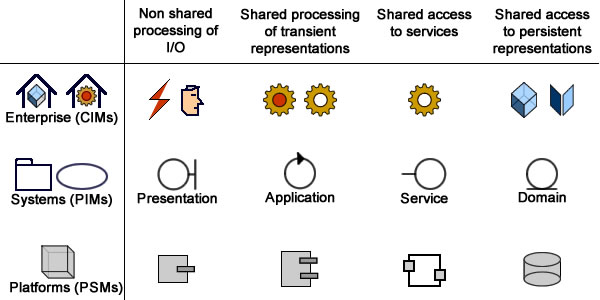
With regard to software (as opposed to enterprise) architecture, DDD identifies four layers: users interfaces (or presentation), applications, domains (or models), and infrastructures. Of these, the domain layer seems to be the only one unambiguously set apart, definitions of the others leaving room for overlaps; but potential qualms can be easily remedied by introducing formal criteria:

  • Presentation: non shared processing of I/O.
  • Application: shared processing of transient representations
  • Domain: shared access to persistent representations
  • Infrastructure: shared access to services.

Architecture Functional layers understood as PIM artifacts.

Furthermore, these layers are best understood when associated with the platform independent models (PIMs) of the model driven architecture (MDA) framework.

Aggregates & Roots

The distinction between the identity and structure of objects on one hand, features semantics and use on the other hand, is arguably a core tenet of DDD as it brings together objects designs and systems architectures.

With regard to objects design, aggregates to be accessed through a single root (#) guarantee the continuity and integrity of the threads anchoring business entities to their symbolic counterparts.

With regard to systems architectures, features of business entities surrogates can be shared across domains, each according to their own semantics, as epitomized by persons in the example below.

vvvv
Roots anchor identified (#) persons to their symbolic surrogates

Yet, the fact is that approach combines object with aspect oriented designs and its implementation at architecture level could come with serious drawbacks when functional facets are to be shared across domains. That’s where bounded contexts intervene.

Bounded Contexts

Contexts are introduced to conciliate continuity and integrity, managed through aggregates, and semantics and functional accesses, managed through contexts; bounded contexts (BCs) are ones with shared business entities. Adding to the example above, person usually appears in different functional contexts subject to specific responsibilities, with one and only one with explicit responsibility on aggregates (#).

Bounded contexts are used to distinguish between identification and integrity, managed through aggregates, and semantics and use, managed through contexts.

But as sound and useful as bounded contexts may be conceptually, their implementation is mostly entrusted to maps and best practices. Since the way shared business domains are managed by systems is arguably a key success factor of enterprise architectures, the lack of principled implementation schemes leaves the conceptual gap between business domains and software designs unaccounted for. That would be the purpose of ubiquitous languages (UL).

Ubiquitous or Domain Specific Languages.

The explicit objective of ubiquitous languages is to bring under a common semantic roof domain analysis and software design, and so to tie concepts and implementations. But that very endeavor may also be seen as controversial, shallow, and confusing:

  • Controversial: bringing together concepts and implementations appears to contradict OO principles as well as layered architectures.
  • Shallow: the so-called languages (as many as domains ?) are in fact just lists of entities and operations, without grammar or unifying semantics.
  • Confusing: they are supposedly derived from models, which would suggest specificity instead of ubiquity; that understanding would also belie the customary assumption that models are built with modeling languages.

One way out of the conundrum could be to see ubiquitous languages as variants of domain specific ones whose explicit objective is precisely to tie concepts with implementations. But that option would bypass the issue of principled BC design, and more generally the relationship between business domains, systems architectures, and software designs.

The other way would be to forsake ubiquitous (or specific) languages and use instead open concepts and functional patterns.

Bounded Contexts & Open Concepts

Open concepts are modeling artifacts whose semantics can be shared by business domains and systems functional architectures. For that purpose they have to meet standard OO principles:

  • Open-Closed Principle (OPC): open concepts should have no reason to change, they can only be refined. In other words open concepts are meant to be specialized, but not generalized. That ensures that the semantics of sub-types defined by different projects cannot be modified.
  • Substitution Principle (LSP): sets of instances denoted by specialized concepts are subsets of the sets denoted by more general ones. That ensures that individuals are consistently identified across projects.
  • Dependency-Inversion principle (DIP): higher levels semantics are defined independently of lower levels. That ensures that the semantics of sub-types are consistently, but not necessarily uniformly, defined across projects.
  • Interface-Segregation Principle (ISP): semantics and features are congruent, i.e all features are meaningful for whoever is using the concept. That ensures that there is no overlapping of semantics even when subsets of individuals overlap.

Assuming these criteria can be fulfilled, open concepts can be used as a modeling glue between bounded contexts overlaps.

Open concepts for entities (aka roots):

  • Structural inheritance means that the targeted entities (i.e shared between contexts) inherit both structures and aspects: parties are a subset of social agents.
  • Functional inheritance means that the targeted entities inherit all the aspects whatever the identified structure: an organization has all the features of a collective agent but is not necessarily identified as such.

Domains_BOCs
How to consolidate contexts overlaps using open concepts

Open concepts for aspects (aka features):

  • Structural inheritance is equivalent to composition, i.e inherited aspects are bound to domain individuals whatever their structure: symbolic references are an intrinsic component of products but can be used in any kind of domain.
  • Functional inheritance is equivalent to aggregation, i.e inherited aspects are not bound to domain individuals: business roles can combine different ones.

On a broader perspective, using open concepts to consolidate the overlaps between bounded contexts enables the formal verification of models, not only for internal consistency but also with regard to best practices. And best practices can be translated into functional (aka representation) patterns formally defined in terms of open concepts.

Further Readings

External Links

Models as Parachutes

Preamble

The recent paralysis of British Airways world operations (due to a power failure, if officials are to be believed), following the crash of Delta Airlines’ reservation system and a number of similar incidents, once again points to the reliability of large and critical IT systems.

László Moholy-Nagy-para
Models as Parachutes (László Moholy-Nagy)

Particularly at risk are airlines or banking systems, whose seasoned infrastructures, at the cutting edge when introduced half a century ago, have been strained to their limit by waves of extensive networked new functionalities. Confronted to the magnitude and complexity of overall modernization, most enterprises have preferred piecemeal updates to architectural leaps. Such policies may bring some respite, but they may also turn into aggravating factors, increasing stakes and urgency as well as shortening odds.

Assuming some consensus about stakes, hazards, and options, the priority should be to overcome jumping fears by charting a reassuring perspective in continuity with current situation. For that purpose models may provide heartening parachutes.

Models: Intents & Doubts

Models can serve two kinds of purposes:

  • Describe business contexts according to enterprise objectives, foretell evolution, and simulate policies.
  • Prescribe the architecture of supporting systems and the design of software components.

Business analyst figure maps from territories, software architects create territories from maps
Models Purposes: Describe contexts & concerns, Design supporting systems

Frameworks were supposed to combine the two perspectives, providing a comprehensive and robust basis to systems governance. But if prescriptive models do play a significant role in engineering processes, in particular for code generation, they are seldom fed by their descriptive counterpart.

Broadly speaking, the noncommittal attitudes toward descriptive models comes from a rooted mistrust in non executable models: as far as business analysts and software engineers are concerned, such models can only serve as documentary evidence. And since prescriptive models are by nature grounded to systems’ inner making, there is no secure conceptual apparatus linking systemic changes with their technical consequences. Hence the jumping frights.

Overcoming those frights could be achieved by showing the benefits of secure and soft landings.

Models for Secure Landings

As any tools, models must be assessed with regard to their purpose: prescriptive ones with regard to feasibility and reliability of architectures and design, descriptive ones with regard to correctness and consistency. As already noted, compared to what has been achieved for the former, nothing much has been done about the validity of the latter.

Yet, and contrary to customary beliefs, the rigorous verification of descriptive (aka extensional) models is not a dead-end. Of course these models can never be proven true because there is no finite scope against which they could be checked; but it doesn’t mean that nothing can be done to improve their reliability:

Models must be assessed with regard to their purpose
How to Check for secure landings

  • Correctness: How to verify that all the relevant individuals and features are taken into account. That can only be achieved empirically by building models open to falsification.
  • Consistency: How to verify that the symbolic descriptions (categories and connectors) are complete, coherent and non redundant across models and abstraction levels. That can be formally verified.
  • Alignment: How to verify that current and required business processes are to be seamlessly and effectively supported by systems architectures. That can be managed by introducing a level of indirection, as illustrated by MDA with platform independent models (PIMs) set between computation independent (CIMs) and platform specific (PSMs) ones.

Once established on secure grounds, models can be used to ensure soft landings.

Models for Soft Landings

Set within model based system engineering frameworks, models will help to replace piecemeal applications updates by seamless architectures modernization:

  • Systems: using models shift the focus of change from hardware to software.
  • Enterprise: models help to factor out the role of organization and regulations.
  • Project management: models provide the necessary hinge between agile and phased projects, the former for business driven applications, the latter for architecture oriented ones. Combining both approaches will ensure than lean and just-in-time processes will not be sacrificed to system modernization.

Seamless architectures modernization (a) vs Piecemeal applications updates (b).

More generally, and more importantly, models are the option of choice (if not the only one) for enterprise knowledge management:

  • Business: Computation independent models (CIMs), employed to trace, justify and rationalize business strategies and processes portfolios.
  • Systems: Platform specific models (PSMs), employed to trace, justify and rationalize technical alternatives and decisions.
  • Decision-making and learning: Platform independent models (PIMs), employed to align business and systems and support enterprise architecture governance.

And knowledge management is arguably the primary factor for successful comprehensive modernization.

Strategic Decision-making: Cash or Crash

Governance is all about risks and decision-making, but investing on truly fail-safe systems for airlines or air traffic control can be likened to a short bet on the Armageddon, and that cannot be easily framed in a neat cost-benefit analysis. But that may be the very nature of strategic decision-making: not amenable to ROI but aiming at risks assessment and the development of the policies apt to contain and manage them. That would be impossible without models.

Further Reading