Depending on devotees or dissenters, the Agile development model is all too often presented as dead-end or end-of-story. Some of that unfortunate situation can be explained, and hopefully pacified, by comparing users’ stories to plants, with their roots, trunks, and branches. Assuming that agility calls for sound footings and good springboards, it may be argued that many problems arise with stories barking at the wrong tree (application level) or getting lost in the woods (architecture level).
How to Mind/Mend a True/Tree Story
Application level: Trees, Bushes and Hedges
As Aristotle first stated, good stories have to follow the three unities: one course of action, located in a single space, run along continuous time.
That rule is clearly satisfied by stories that can be developed like plants growing from clearly identified roots.
Yet, stories like bushes may grow too many offshoots to be accounted for by a single action narrative; in that case it may be possible to single out a primary trunk and a set of forking branches along which different scenarii could be developed.
More serious difficulties may appear with thickets mixing offshoots from different bushes sharing the same space. That situation will first require some ground work in order to single out individual roots, and then use them to extricate each bush separately. When, like offshoots that actually mingle, story-lines cross and share actions, the description of such actions (aka features) is to be factored out and separated from the contexts of their enactment in the different story-lines.
Finally, like bushes in hedges, stories may chronicle repeated activities serving some collective purpose. That configuration is both easy to recognize and dealt with effectively by introducing a stereotyped story feature for collections and loops management.
Architecture level: Groves, Woods and Plantations
Contrary to hedges which are built on the similarity of their constituents, groves are based on their functional differences, and that can also be seen as a critical distinction between containers and architectures.
In agile parlance, that is best compared to the difference between stories and epics, the former telling what happens between users and applications, the latter taking a bird’s view of the relationships between business processes and systems.
In most of the cases the question will arise for sizable stories deemed too large for development purposes. When dealing with that situation the first step should be to look for thickets and bushes, respectively to be set apart as individual bushes or refined as scenarii. When still confronted with multiple roots, the question would be to decide between hedges and groves, that is between repeated activities and collaboration. And that decision would be critical because collaborations call for a different kind of story (aka epics or themes) set at a higher level, namely architecture.
Scaling Ups and Downs
Assuming the three-units rule cannot be met, two alternative approaches are possible, depending on whether the story has to be broken down or upgraded to an epic, and the undoing of the rule can be used to make a decision:
When the course of actions, once started, is to be contingent on subsequent business (aka external) events the story should be upgraded to an epic, as it will often refer to a part or whole of a business process.
Otherwise: when activities are set along different periods of time (i.e contingent on time-events) the story can be broken down depending on size, functional architecture, or development constraints.
Otherwise: when activities are distributed across locations it may be necessary to factor out architecture-dependent features dealing with shared address spaces and synchronization mechanisms
Applying those guidelines to stories will put the whole development processes on rails and help to align requirements with their architectural footprint: business logic, system functionalities, or platform technologies.
Enterprise architecture being a nascent discipline, its boundaries and categories of concerns are still in the making. Yet, as blurs on pivotal concepts are bound to jeopardize further advances, clarification is called upon for the concept of “capability”, whose meaning seems to dither somewhere between architecture, function and process.
Jumping capability of a four-legged structure (Edgard de Souza)
Hence the benefits of applying definition guidelines to characterize capability with regard to context (architectures) and purpose (alignment between architectures and processes).
Context: Capability & Architecture
Assuming that a capability describes what can be done with a resource, applying the term to architectures would implicitly make them a mix of assets and mechanisms meant to support processes. As a corollary, such understanding would entail a clear distinction between architectures on one hand and supported processes on the other hand; that would, by the way, make an oxymoron of the expression “process architecture”.
On that basis, capabilities could be originally defined independently of business specificity, yet necessarily with regard to architecture context:
Business capabilities: what can be achieved given assets (technical, financial, human), organization, and information structures.
Systems capabilities: what kind of processes can be supported by systems functionalities.
Platforms capabilities: what kind of functionalities can be implemented.
Well established concepts are used to describe architecture capabilities
Taking a leaf from the Zachman framework, five core capabilities can be identified cutting across those architecture contexts:
Who: authentication and authorization for agents (human or otherwise) and roles dealing with the enterprise, using system functionalities, or connecting through physical entry points.
What: structure and semantics of business objects, symbolic representations, and physical records.
How: organization and versatility of business rules.
Where: physical location of organizational units, processing units, and physical entry points.
When: synchronization of process execution with regard to external events.
Being set with regard to architecture levels, those capabilities are inherently holistic and can only pertain to the enterprise as a whole, e.g for bench-marking. Yet that is not enough if the aim is to assess architectures capabilities with regard to supported processes.
Purpose: Capability vs Process
Given that capabilities describe architectural features, they can be defined independently of processes. Pushing the reasoning to its limit, one could, as illustrated by the table above, figure a capability without even the possibility of a process. Nonetheless, as the purpose of capabilities is to align supporting architectures and supported processes, processes must indeed be introduced, and the relationship addressed and assessed.
First of all, it’s important to note that trying to establish a direct mapping between capabilities and processes will be self-defeating as it would fly in the face of architecture understood as a shared construct of assets and mechanisms. Rather, the mapping of processes to architectures is best understood with regard to architecture level: traceable between requirements and applications, designed at system level, holistic at enterprise level.
Alignment with processes is mediated by architecture complexity.
Assuming a service oriented architecture, capabilities would be used to align enterprise and system architectures with their process counterparts:
Holistic capabilities will be aligned with business objectives set at enterprise level.
Services will be aligned with business functions and designed with regard to holistic capabilities.
Services are a perfect match for capabilities
Moreover, with or without service oriented architectures, that approach could still be used to map functional and non functional requirements to architectures capabilities.
Functional requirements are defined with regard to business processes, non functional ones with regard to system capabilities.
The alignment of non-functional requirements with architectures capabilities can be seen as a key factor for enterprise architectures as it draws the line between what can be owned and managed by business units and what must be shared at enterprise level. It must also be noted that non-functional requirements should not be seen as a one-fits-all category but be defined by the footprint of business requirements on technical architecture.
Empathy is commonly defined as the ability to directly share another person’s state of mind: feelings, emotions, understandings, etc. Such concrete aptitude would clearly help business analysts trying to capture users’ requirements; and on a broader perspective it could even contribute to enterprise capability to foretell trends from actual changes in business environment.
Perceptions and Abstractions (Picasso)
Analysis goes in the opposite direction as it extracts abstract descriptions from concrete requirements, singling out a subset of features to be shared while foregoing the rest. The same process of abstraction being carried out for enterprise business and organisation on one hand, systems and software architectures on the other hand.
That dual perspective can be used to define alignment with regard to the level under consideration: users, systems, or enterprise.
Requirements & Architectures
Requirements capture can be seen as a transition from spoken to written language, its objective being to write down what users tell about what they are doing or what they want to do. For that purpose analysts are presented with two basic policies: they can anchor requirements around already known business objects or processes, or they can stick to users’ stories, identify new structuring entities, and organize requirements alongside. In any case, and except for standalone applications, the engineering process is to be carried out along two paths:
One concrete for the development of applications, the objective being to meet users’ requirements with regard to business logic and quality of service.
The other abstract for requirements analysis, the objective being to identify new business functions and features and consolidate them with those already supporting current business processes.
Those paths are set in orthogonal dimensions as concrete paths connect users’ activities to applications, and abstractions can only be defined between requirements levels.
Concrete (brown) and Abstract (blue) paths of requirements engineering
As business analysts stand at the crossroad, they have to combine empathy when listening to users concerns and expectations, and abstraction when mapping users requirements to systems functionalities and enterprise business processes.
Architectures & Alignments
As it happens, the same reasoning can be extended to the whole of engineering process, with analysis carried out to navigate between abstraction levels of architectures and requirements, and design used for the realization of each requirements level into its corresponding architecture level:
Users’ stories (or more precisely corresponding uses cases) are realized by applications.
Business functions and features are realized by services (assuming a service oriented architecture), which are meant to be an abstraction of applications.
Business processes are realized by enterprise capabilities, which can be seen as an abstraction of services.
How requirements are realized by design at each architecture level
That matrix can be used to define three types of alignment:
At users level the objective is to ensure that applications are consistent with business logic and provide the expected quality of service. That is what requirements traceability is meant to achieve.
At system level the objective is to ensure that business functions and features can be directly mapped to systems functionalities. That is what services oriented architectures (SOA) are meant to achieve.
At enterprise level the objective is to ensure that the enterprise capabilities are congruent with its business objectives, i.e that they support its business processes through an effective use of assets. That is what maturity and capability models are meant to achieve.
That makes alignment a concrete endeavor whatever the architecture layer, i.e not only for users and applications, but also for functions and capabilities.
Enterprise Fourth Dimension
Enterprise Architectures can be fully described as a cross between layers (platforms, systems, organization) and processes (business, engineering, operations). But the validity and usefulness of such outlook is contingent on homogeneous and stable semantics:
Homogeneous: some conceptual consensus can be sustained across business units.
Stable: some continuity and consistency can be achieved for the mapping between business objectives and targeted environments.
Meeting those conditions may become problematic with the growing part played by services and the crumbling of fences between enterprises and their business environment. In that case alignment will have to rely on a fourth conceptual dimension.
The emergence of Enterprise Architecture as a discipline of its own has put the light on the necessary distinction between actual (aka business) and software (aka system) realms. Yet, despite a profusion of definitions for layers, tiers, levels, views, and other modeling perspectives, what should be a constitutive premise of system engineering remains largely ignored, namely: business and systems concerns are worlds apart and bridging the gap is the main challenge of architects and analysts, whatever their preserve.
(Alignment with Dummies (J. Baldessari)
The consequences of that neglect appear clearly when enterprise architects consider the alignment of systems architectures and capabilities on one hand, with enterprise organization and business processes on the other hand. Looking into the grey zone in between, some approaches will line up models according to their structure, assuming the same semantics on both sides of the divide; others will climb up the abstraction ladder until everything will look alike. Not surprisingly, with the core interrogation (i.e “what is to be aligned ?”) removed from the equation, models will be turned into dummies enabling alignment to be carried out by simple pattern matching.
Models & Views
The abundance of definitions for layers, tiers or levels often masks two different understandings of models:
When models are understood as symbolic descriptions of sets of instances, each layer targets a different context with a different concern. That’s the basis of the Model Driven Architecture (MDA) and its distinction between Computation Independent Models (CIMs), Platform Independent Models (PIMs), and Platform Specific Models (PSMs)
When models are understood as symbolic descriptions built from different perspectives, all layers targets the same context, each with a different concern. Along that understanding each view is associated to a specific aspect or level of abstraction: processes view, functional view, conceptual view, technical view, etc.
As it happens, many alignment schemes use, implicitly or explicitly, the second understanding without clarifying the underlying assumptions regarding the backbone of artifacts. That neglect is unfortunate because, to be of any significance, views will have to be aligned with regard to those artifacts.
What is to be aligned
From a general perspective, and beyond lexical controversies, alignment has to be managed with regard to two basic scales:
Architectures: enterprise (concepts), systems (functionalities), and platforms (technologies).
From a practical point of view, alignment is meant to deal with two main problems: how business processes are supported by systems functionalities, and how those functionalities are to be implemented. Given that the latter can be fully dealt with at system level, the focus can be put on the alignment of business processes and functional architectures.
A naive solution could be to assume services on both processes and systems sides. Yet, the apparent symmetry covers a tautology: while aiming for services oriented architectures on the systems side would be legitimate, if not necessarily realistic, taking for granted that business processes also tally with services would presume some prior alignment, in other words that the problem has already been solved.
The pragmatic and logically correct approach is therefore to map business processes to system functionalities using whatever option is available, models (CIMs vs PIMs), or views (processes vs functions). And that is where the distinction between business and software semantics is critical: assuming the divide can be overlooked, some “shallow” alignment could be carried out directly providing the models can be translated into some generic language; but if the divide is acknowledged a “deep” alignment will have to be supported by a semantics bridge built across.
Shallow Alignment
Just like models are meant to describe sets of instances, meta-models are meant to describe instances of models independently of their respective semantics. Assuming a semantic continuity between business and systems models, meta-models like OMG’s KDM (Knowledge Discovery Meta-model) appear to provide a very practical solution to the alignment problem.
From a practical point of view, one may assume that no model of functional architecture is available because otherwise it would be aligned “by design” and there would be no problem. So something has to be “extracted” from existing software components:
Software (aka design) models are translated into functional architectures.
Models of business processes are made compatible with the generic language used for system models.
Associations are made based on patterns identified on each side.
While the contents of the first and third steps are well defined and understood, that’s not the case for the second step which take for granted the availability of some agreed upon modeling semantics to be applied to both functional architecture and business processes. Unfortunately that assumption is both factually and logically inconsistent:
Factually inconsistent: it is denied by the plethora of candidates claiming for the role, often with partial, overlapping, ambiguous, or conflicting semantics.
Logically inconsistent: it simply dodges the question (what’s the meaning of alignment between business processes and supporting systems) either by lumping together the semantics of the respective contexts and concerns, or by climbing up the ladder of abstraction until all semantic discrepancies are smoothed out.
Alignments built on that basis are necessarily shallow as they deal with artifacts disregarding of their contents, like dummies in test plans. As a matter of fact the outcome will add nothing to traceability, which may be enough for trivial or standalone processes and applications, but is to be meaningless when applied at architecture level.
Deep Alignment
Compared to the shallow one, deep alignment, instead of assuming a wide but shallow commonwealth, tries to identify the minimal set of architectural concepts needed to describe alignment’s stake. Moreover, and contrary to the meta-modelling approach, the objective is not to find some higher level of abstraction encompassing the whole of models, but more reasonably to isolate the core of architecture concepts and constructs with shared and unambiguous meanings to be used by both business and system analysts.
That approach can be directly set along the MDA framework:
Deep alignment makes a distinction between what is at stake at architecture level (blue), from the specifics of process or domain (green), and design (brown).
Contexts descriptions (UML, DSL, BPM, etc) are not meant to distinguish between architectural constructs and specific ones.
Computation independent models (CIMs) describe business objects and processes combining core architectural constructs (using a generic language like UML), with specific business ones. The former can be mapped to functional architecture, the latter (e.g rules) directly transformed into design artifacts.
Platform independent models (PIMs) describe functional architectures using core constructs and framework stereotypes, possibly enriched with specific artifacts managed separately.
Platform specific models (PSMs) can be obtained through transformation from PIMs, generated using specific languages, or refactored from legacy code.
Alignment can so focus on enterprise and systems architectural stakes leaving the specific concerns dealt with separately, making the best of existing languages.
Alignment & Traceability
As mentioned above, comparing alignment with traceability may help to better understand its meaning and purpose.
Traceability is meant to deal with links between development artifacts from requirements to software components. Its main objective is to manage changes in software architecture and support decision-making with regard to maintenance and evolution.
Alignment is meant to deal with enterprise objectives and systems capabilities. Its main objective is to manage changes in enterprise architecture and support decision-making with regard to organization and systems architecture.
As a concluding remark, reducing alignment to traceability may counteract its very purpose and make it pointless as a tool for enterprise governance.
Confronted with spreading and sundry regulations on one hand, the blurring of enterprise boundaries on the other hand, corporate governance has to adapt information architectures to new requirements with regard to regulations and risks. Interestingly, those requirements seem to be driven by two different knowledge policies: what should be known with regard to compliance, and what should be looked for with regard to risk management.
Governance (Zhigang-tang)
Compliance: The Need to Know
Enterprises are meant to conform to rules, some set at corporate level, others set by external entities. If one may assume that enterprise agents are mostly aware of the former, that’s not necessary the case for the latter, which means that information and understanding are prerequisites for regulatory compliance :
Information: the relevant regulations must be identified, collected, and their changes monitored.
Understanding: the meanings of regulations must be analyzed and the consequences of compliance assessed.
With regard to information processing capabilities, it must be noted that, since regulations generally come as well structured information with formal meanings, the need for data processing will be limited, if at all.
With regard to governance, given the pervasive sources of external regulations and their potentially crippling consequences, the challenge will be to circumscribe the relevant sources and manage their consequences with regard to business logic and organization.
Regulatory Compliance vs Risks Management
Risks: The Will to Know
Assuming that the primary objective of risk management is to deal with the consequences (positive or negative) of unexpected events, its information priorities can be seen as the opposite of the ones of regulatory compliance:
Information: instead of dealing with well-defined information from trustworthy sources, risk management must process raw data from ill-defined or unreliable origins.
Understanding: instead of mapping information to existing organization and business logic, risk management will also have to explore possible associations with still potentially unidentified purposes or activities.
In terms of governance risks management can therefore be seen as the symmetric of regulatory compliance: the former relies on processing data into information and expanding the scope of possible consequences, the latter on translating information into knowledge and reducing the scope of possible consequences.
With regard to regulations governance is about reduction, with regard to risks it’s about expansion
Not surprisingly, that understanding coincides with the traditional view of governance as a decision-making process balancing focus and anticipation.
Decision-making: Framing Risks and Regulations
As noted above, regulatory compliance and risk management rely on different knowledge policies, the former restrictive, the latter inclusive. That distinction also coincides with the type of factors involved and the type of decision-making:
Regulations are deontic constraints, i.e ones whose assessment is not subject to enterprises decision-making. Compliance policies will therefore try to circumscribe the footprint of regulations on business activities.
Risks are alethic constraints, i.e ones whose assessment is subject to enterprise decision-making. Risks management policies will therefore try to prepare for every contingency.
Yet, when set on a governance perspective, that picture can be misleading because regulations are not always mandatory, and even mandatory ones may left room for compliance adjustments. And when regulations are elective, compliance is less driven by sanctions or penalties than by the assessment of business or technical alternatives.
Decision patterns: Options vs Arbitrage
Conversely, risks do not necessarily arise from unidentified events and upshot but can also come from well-defined outcomes with unknown likelihood. Managing the latter will not be very different from dealing with elective regulations except that decisions will be about weighted opportunity costs instead of business alternatives. Similarly, managing risks from unidentified events and upshot can be compared to compliance to mandatory regulations, with insurance policies instead of compliance costs.
What to Decide: Shifting Sands
As regulations can be elective, risks can be interpretative: with business environments relocated to virtual realms, decision-making may easily turns to crisis management based on conjectural and ephemeral web-driven semantics. In that case ensuing overlaps between regulations and risks can only be managed if data analysis and operational intelligence are seamlessly integrated with production systems.
When to Decide: Last Responsible Moment
Finally, with regulations scope and weighted risks duly assessed, one have to consider the time-frames of decisions about compliance and commitments.
Regarding elective regulations and defined risks, the time-frame of decisions is set at enterprise level in so far as options can be directly linked to business strategies and policies. That’s not the case for compliance to mandatory regulations or commitments exposed to undefined risks since both are subject to external contingencies.
Whatever the source of the time-frame, the question is when to decide, and the answer is at the “last responsible moment”, i.e not until taking side could change the possible options:
Whether elective or mandatory, the “last responsible moment” for compliance decision is static because the parameters are known.
Whether defined or not, the “last responsible moment” for commitments exposed to risks is dynamic because the parameters are to be reassessed periodically or continuously.
Compliance and risk taking: last responsible moments to decide
One step ahead along that path of reasoning, the ultimate challenge of regulatory compliance and risk management would be to use the former to steady the latter.
Given the clear-cut and unambiguous nature of software, how to explain the plethora of “standard” definitions pertaining to systems, not to mention enterprises, architectures ?
Documents and Systems: which ones nurture the others (Gilles Barbier).
Tentative answers can be found with reference to the core functions documents are meant to support: instrument of governance, medium of exchange, and content storage.
Instrument of Governance: the letter of the law
The primary role of documents is to support the continuity of corporate identity and activities with regard to their regulatory and business environments. Along that perspective documents are to receive legal tender for the definitions of parties (collective or individuals), roles, and contracts. Such documents are meant to support the letter of the law, whether set at government, industry, or corporate level. When set at corporate level that letter may be used to assess the capability and maturity of architectures, organizations, and processes. Whatever the level, and given their role for legal tender or assessment, those documents have to rely on formal textual definitions, possibly supplemented with models.
Medium of Exchange: the spirit of the law
Independently of their formal role, documents are used as medium of exchange, across corporate entities as well as internally between their organizational units. When freed from legal or governance duties, such documents don’t have to carry authorized or frozen interpretations and assorted meanings can be discussed and consolidated in line with the spirit of the law. That makes room for model-based documents standing on their own, with textual definitions possibly set in the background. Given the importance of direct discussions in the interpretation of their contents, documents used as medium of (immediate) exchange should not be confused with those used as means of storage (exchange along time).
Means of Storage: letter only
Whatever their customary functions, documents can be used to store contents to be reinstated at a later stage. In that case, and contrary to direct (aka immediate) exchange, interpretations cannot be consolidated through discussion but have to stand on the letter of the documents themselves. When set by regulatory or organizational processes, canonical interpretations can be retrieved from primary contexts, concerns, or pragmatics. But things can be more problematic when storage is performed for its own purpose, without formal reference context. That can be illustrated by legacy applications with binary code can be accompanied by self-documented source code, source with documentation, source with requirements, generated source with models, etc.
Documentation and Enterprise Architecture
Assuming that the governance of structured social organizations must be supported by comprehensive documentation, documents must be seen as a necessary and intrinsic component of enterprise architectures and their design should be aligned on concerns and capabilities.
As noted above, each of the basic functionalities comes with specific constraints; as a consequence a sound documentation policy should not mix functionalities. On that basis, documents should be defined by mapping purposes with users across enterprise architecture layers:
With regard to corporate environment, documentation requirements are set by legal constraints, directly (regulations and contracts) or indirectly (customary framework for transactions, traceability and audit).
With regard to organization, documents have to met two different objectives. As a medium of exchange they are meant to support the collaboration between organizational units, both at business level (processes) and across architecture levels. As an instrument of governance they are used to assess architecture capabilities and processes performances. Documents supporting those objectives are best kept separate if negative side effects are to be avoided.
With regard to systems functionalities, documents can be introduced for procurements (governance), development (exchange), and change (storage).
Within systems, the objective is to support operational deployment and maintenance of software components.
Documents’ purposes and users
The next step will be to integrate documents pertaining to actual environments and organization (brown background) with those targeting symbolic artifacts (blue background).
Models are used to describe actual or symbolic objects and behaviors
[Enterprise architects] “…are like sailors who have to rebuild their ship on the open sea, without ever being able to dismantle it in dry dock and reconstruct it from the best components.”
Otto Neurath
Objective
Modeling is all too often a flight for abstraction when analysts should instead get their bearings and look for the proper level of representation, i.e the one best fitting their concerns. As a consequence, many debates that seem baffling when revolving around abstraction levels may suddenly clear up when reset in terms of artifacts and symbolic representations.
Models, artifacts, and the emergence of designs (R. Magritte)
That is especially the case for enterprise architectures which, contrary to system ones, cannot be reduced to planned designs but seem to emerge from a mix of cultural sediments, economic factors, technology constraints, and strategic planning.
Hence the need to understand the relationships between enterprise contexts, organization and processes on one hand, and their symbolic counterparts in systems on the other hand.
Artifacts & Models
When architectures are considered, a distinction should first be made between artifacts (e.g buildings) and models (blueprints), the former being manufactured objects designed and built on purpose, the latter symbolic artifacts reflecting those purposes and how to meet them.
Blueprints are used to design and build physical objects according to purposes.
That distinction between artifacts and symbolic descriptions is easy to make for physical objects built on plans, less so for symbolic objects which are artifacts of their own and as such are begot from symbolic descriptions. In other words symbolic artifacts crop up as designs as well as final products.
Symbolic artifacts have to be designed before being implemented as objects of their own.
Moreover, artifacts being used in contexts, their description must also include modus operandi. For enterprises that would mean business objectives, organization, and processes.
Business process: how to use artifacts and manage associated information.
Two kinds of models can be used to figure out actual contexts and activities with their symbolic counterpart in enterprise systems:
Models of business contexts and processes are descriptive as their aim is to build categories of actual or planned objects, assets, and activities.
Models of systems and software are prescriptive as their aim is to design and build the symbolic artifacts used by systems to represent business objects and processes.
Actual (orange) and symbolic (blue) views correspond to technical and software architectures.
That distinction can lend support to the main challenge of enterprise architects, namely the seamless and dynamic alignment of enterprise objectives, assets, and organization on one hand, supporting systems on the other hand.
Architecture & Design
Architecture and design may have a number of overlapping features yet they clearly differ with regard to software: contrary to architecture, software design is meant to fully describe how to implement system components. That difference is especially meaningful for enterprise architecture:
At enterprise level models are used to describe objects and activities from a business perspective, independently of their representation by system components. Whatever the nature of targeted objects and activities (physical or symbolic, current or planned), models are meant to describe business units (actual or required) identified and managed at enterprise level.
At system level models are used to describe software components. Given that systems are meant to represent business contexts and support business processes, their architecture has to be aligned on the units managed at enterprise level.
Assuming that functional, persistency, and execution units must be uniquely and consistently identified at both enterprise and systems level, their respective models have to share some common infrastructure.
Architecture models overlap for enterprise and systems, design models are only used for systems.
The overlapping of models with regard to enterprise and systems architectures and their yoking into systems design determine the background of architectures transformations.
Abstractions and Changes
If some continuity is to be maintained across architectures mutations, modeling abstractions are needed to frame and consolidate changes at both enterprise and system levels.
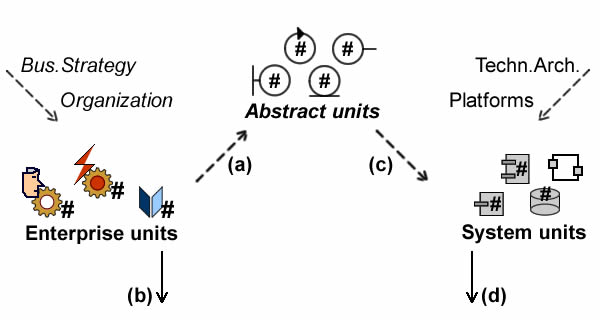
From the enterprise standpoint the primary factor is the continuity and consistency of corporate identity and activities. For that purpose abstractions will have to target functional, persistency, and execution units. Definitions of those abstract units will provide the backbone of enterprise architecture (a). That backbone can then be independently fleshed out with features providing identified structures of objects and activities are not affected (b).
From the systems standpoint the objective is the alignment of system and enterprise units on one hand, the effectiveness of technical architecture on the other hand. For that purpose abstract architecture units (reflecting enterprise units) are mapped to system units (c), whose design will be carried on independently (d).
Identified enterprise units (a) are detailed (b), (c) to be further designed (d).
That should determine the right level of abstraction, namely when corresponding abstract units can be used to align enterprise and systems ones.
Once securely locked to a common architecture backbone, enterprise and system models can be expanded according to their respective concerns, business and organization for the former, technology and platforms implementation for the latter. On that basis primary changes can be analyzed in terms of specialization and extension.
Specialization will change the local features of enterprise or systems units without affecting their identification or semantics at architecture level:
With regard to enterprise, entry points (a1), features (a2), business rules (a3), and control rules (a4) will be added, modified or removed.
With regard to systems, designs will be modified or new ones introduced in response to changes in enterprise or technological environments.
Basic architectural changes (enterprise level)
Contrary to specialization, architecture extension changes enterprise or systems units in ways affecting their identification, semantics or implementation at architecture level:
With regard to enterprise, entry points locations (b1), semantic domains (b2), business applications (b3), and processes (b4) will be added, modified or removed
With regard to systems, changes in platforms implementations following new technologies or operational requirements.
Hence, while specialization will not affect the architecture backbone, that’s not the case for extension. More critically, the impact of extensions may not be limited to basic changes to backbones as inheritance may also affect the identification mechanisms and semantics of existing units. That happens when abstract descriptions are introduced for aspects that cannot be identified on their own but only when associated to some identified object or behavior.
That can be illustrated by a banking example of a transition from account-based to customer-based management:
To begin with, let’s assume a single process for accounts, with customers represented as aspects of accounts.
Then, in order to support customers relationship management, customers become entities of their own, identified independently of accounts.
Finally, roles and types are introduced as abstract descriptions (not identified on their own) in order to characterize actual parties (customer, supplier, etc) and accounts (current, savings, insurance, etc).
When architectures grow extension can change identification mechanisms and semantics
That modeling shift from concrete to abstract descriptions can be seen as the hinge connecting changes in systems and enterprise architectures.
Eppur si muove
As enterprises grow and extend, architectures become more complex and have to be supported by symbolic representations of whatever is needed for their management: assets, roles, activities, mechanisms, etc. As a consequence, models of enterprise architectures have to deal with two kinds of targets, actual assets and processes on one hand, their symbolic representation as system objects on the other hand.
This apparent symmetry can be misleading as the former models are meant to reflect a reality but the latter ones are used to produce one. In other words there is no guarantee that their alignment can be comprehensively and continuously maintained. Yet, as Galileo purportedly once said of the Earth circling the Sun despite models of the contrary, it moves. So, what are the primary factors behind moves in enterprise architectures ?
What moves first: actual contexts and processes or enterprise abstractions.
Assuming that enterprise architecture entails some kind of documentation, changes in actual contexts will induce new representations of objects and processes. At this point, the corresponding changes in models directly reflect actual changes, but the reverse isn’t true. For that to happen, i.e for business objects and processes being drawn from models, the bonds between actual and symbolic descriptions have to be loosened, giving some latitude for the latter to be modified independently of their actual counterpart. As noted above, specialization will do that for local features, but for changes to architecture units being carried on from models, abstractions are a prerequisite.
Emerging Architectures and Grey Matter
As already noted, actual-oriented models describe instances of business objects and processes, while symbolic-oriented ones describe representations, both at instances level (aka concrete descriptions) and types level (aka abstract descriptions). As a corollary, changes in actual-oriented models directly reflect changes in contexts and processes (a); that’s not necessarily the case for symbolic-oriented models which can also take into account intended changes (b) to be translated into concrete targets descriptions at a later stage (c).
Emergence of architectural features is best observed when abstractions (italics) are introduced.
Obviously the room left for conjured up architectural changes is bounded by deterministic factors; nonetheless, thought up new functional features are bound to appear first, if at all, as abstract descriptions, and that’s where emerging architectures are best to be observed.
At that tipping point, and assuming a comprehensive understanding of objective factors (business logic, data structures, operational constraints, etc), the influence of non deterministic factors upon emerging architectures can be probed from two directions: pushing from the past or pulling from the future.
The past will make its mark through existing organizational structures and roles. Knowledge, power bases, and habits are much less pliable than processes and systems. When forced to change they are bound to bend the options, and not necessarily through informed decision making.
Conversely, the assessment of future events, non deterministic by nature, is the result of decision making processes mixing explicit rationale with more obscure collective biases. Those collective leanings will often leave their mark on the way changes in contexts are anticipated, risks weighted, and business objectives defined.
Those non deterministic influences are rooted in some enterprise psyche that steer individual behaviors and collective decisions. Like the hypothetical dark matter conjectured by astronomers in order to explain the mass of the universe, that grey matter of corporate entities is the shadow counterpart of actual systems, necessary to explain their position with regard to enterprises contexts, objectives, and organization.
Emerging Architectures as Systems Epigenetics
Epigenetics can be used as a metaphor to illustrate the relationships between enterprise architectures and environments.
To begin with, enterprises are compared to organisms, systems to organs and cells, and models (including source) to genome coded with the DNA.
According to classical genetics, phenotypes (actual forms and capabilities of organisms) inherit through the copy of genotypes and changes between generations can only be carried out through changes in genotypes. Applied to systems, it would entail that changes can only happen after being programmed into the applications supporting enterprise organization and business processes.
Systems Genetics & Epigenetics
The Extended Evolutionary Synthesis considers the impact of non coded (aka epigenetic) factors on the transmission of the genotype between generations. Applying the same principles to systems would introduce new mechanisms:
Enterprise organization and use of systems could be adjusted to changes in environments prior to changes in coded applications.
Enterprise architects could assess those changes, plan systems evolution, and use abstractions consolidate new designs with legacy applications.
Models would be transformed accordingly.
As for genetics, that understanding of enterprise architectures would put the onus of change on the cells, in that case the plasticity and versatility of applications
When interacting with systems, users do things they aren’t supposed to do and walk along irrelevant, even unthinkable, paths that can put tests designers at a loss. This apparent chink between users’ conscious self and their fingertips can be explained by the way humans assess situations and make decisions. Curtailing it is the aim of ergonomics.
Anatomy of Errors: from brain to fingers (Rembrandt)
Taking a leaf from A. Tversky and D. Kahneman (who received the 2002 Nobel Prize in Economics), decision-making relies on two cognitive mechanisms:
The first one “operates automatically and quickly, with little or no effort and no sense of voluntary control”. It’s put in use when actual situations must be assessed and decisions taken rapidly if not instantly.
The second one “allocates attention to the effortful mental activities that demand it, including complex computations”. It’s put in use when situations can be assessed with regard to past experience in order to support informed decisions making.
That distinction can be directly applied to users’ behaviors interacting with systems:
Intuitive behavior: decisions are taken on the basis of the visual context and options as presented by users interfaces before taking into account underlying business contents and logic.
Rational behavior: decisions are taken on the basis of business contents and logic disregarding supporting systems interfaces.
Set in context, that distinction can be put in parallel (but not confused) with the one between domain and functional requirements, the former dealing rationally with business objects and logic, the latter putting the former to use through interactions with supporting systems.
Functional requirements describe the part played by supporting systems
Assuming that business logic should not be contingent on supporting systems interfaces, the best option would be to test its implementation independently of users interactions; moreover, tests targeting intuitive behaviors (i.e not directly based on domain specific contents), could then be generated automatically.
Looking for Errors
Given that testing is meant to find flaws in deliverables, tests are certainly more effective when designers know what they are looking for.
For that purpose phased approaches rely on sequences of differentiated tests dealing successively with programming (unit tests), functional requirements (integration tests), and business requirements (acceptance tests). The unfortunate downside of those policies is that the most wide-ranging flaws are the last to be looked for, with the risk of being found after cascading and costly consequences for functionalities and programs.
Phased and Iterative approaches to tests
Conversely, agile approaches follow iterative policies, with each development cycle combining the definition, programming, and tests of software products. When properly implemented those policies significantly improve the early detection and correction of errors whatever their origin. Yet, since there is no explicit management of intermediate outcomes, it’s difficult to differentiate the tests according the kind of errors to look for, e.g faulty business rules implementation or flawed user interface.
Architecture driven approaches may provide an answer, with requirements unambiguously sorted out depending on their architectural footprint: business contents or system functionalities. As a corollary, tests could also be designed along the same lines, targeting business rationale or human behavior.
Errors in Mirrors
Acceptance tests being performed with regard to requirements, they should be designed along requirements taxonomy, respectively for business logic, users’ interactions, quality of services, and components implementation. Being aligned on requirements, those tests can be neatly defined with regard to closed sets of specifications, functional or otherwise.
Functional tests have to expect the unexpected
But that’s not the case for users’ interactions because people behaviors are not fully predictable; hence, while tests can be systematically designed with regard to the set of users’ actions framed by business and functional requirements, there is no way to comprehensively and unambiguously check for all and every possible behavioral contingencies. That will make for three levels of functional tests:
Implementation of business logic: tests should be designed directly from business requirements, independently of interactions with users.
Implementation of scenarii: while interactions are defined in reference to business logic, their validation should focus on the presentation of contents and dialog control.
Users exceptions: in addition to inputs validity, already checked with business logic, and users’ actions, supposedly secured by interaction scenarii, it is necessary to check that unexpected behaviors have been properly considered .
How to check that unexpected behaviors have been properly considered ?
In other words, functional tests will have to look simultaneously for errors in software (defined with regard to a finite set of requirements), and for users’ mistakes (set in an open range of behaviors). As if tests designers were to mirror users errors in order to look for software ones. So, assuming that errors in business logic and interactions have been considered, what should still be checked, and how ?
Fingertips Errors
When faced with choices, users bank on mental maps combining graphical and business layers, with the implicit assumption that maps’ contexts and concerns are kept up to date. Those maps combine three communication mechanisms:
Languages, natural or specific, use syntax and semantics to define business contents, logic, and operations.
Icons use similarity for the visual representation of business operations or functional primitives (e.g create, delete, etc).
Signals use proximity to draw users’ attention to predefined events (e.g sounds for operations completion or incoming emails).
While language-based interactions are supposedly fully covered by business and functional tests, icons and signals make room for “fingertips” reactions which cannot be directly framed within business logic or functional scenarii, and therefore cannot be comprehensively checked for erroneous behaviors.
Icons and signal based communication can trigger unexpected behaviors.
Yet, if instinctive reactions preclude rational considerations, decisions may be swayed by analogies and associations before being informed by the relevant business contents. To prevent that risk, test scenarii built on business logic and functional interactions should be extended in order to take into account the intuitive aspects of users’ behaviors.
Mental Maps & Automated Tests
As noted above, mental maps are built on three layers, one deep (language semantics) and two shallow (icons and signals). While the shallow layers are supposed to reference the deep one, icons and signals may induce instinctive behaviors independently of the referenced business logic. Those behaviors can be triggered by two kinds of mechanisms:
Analogy: users will look for similarities and familiar configurations.
Proximity: users will look for continuity with regard to scope and operations.
Clearly, lapses in such behaviors will normally escape tests designed for business and functional requirements; yet, by being driven by self-contained mechanisms, intuitive behaviors can be checked independently of references to business contents. And that may open the door to automated tests generation.
With regard to similarities, tests should look for possible confusion between:
Objects with common representation but specific features (inheritance).
Operations with shared semantics but different scope (polymorphism).
Sequences with shared operations but different timing .
With regard to proximity, tests should look for possible confusion between:
Objects and their parts, or between their parts (structural proximity).
Operations usually associated into the same activity (functional proximity).
Operations usually executed successively (chronological proximity).
Scripts for such tests could be generated through pattern-matching and run by wizard applications.
Computation Independent Models (CIMs) describe business objects and activities independently of supporting systems.
Platform Independent Models (PIMs) describe systems functionalities independently of platforms technologies.
Platform Specific Models (PSMs) describe systems components as implemented by specific technologies.
Since those layers can be mapped respectively to enterprise, functional, and technical architectures, the question is how to make heads or tails of the driving: should architectures be set along model layers or should models organized according architecture levels.
A Dog Making Head or Tail (Judy Kensley McKie)
In other words, has some typo reversed the original “architecture driven modeling” (ADM) into “model driven architecture” (MDA) ?
Wrong Spelling, Right Concepts
A confusing spelling should not mask the soundness and relevance of the approach: MDA model layers effectively correspond to a clear hierarchy of problems and solutions:
Computation Independent Models describe how business processes support enterprise objectives.
Platform Independent Models describe how systems functionalities support business processes.
Platform Specific Models describe how platforms implement systems functionalities.
MDA layers correspond to a clear hierarchy of problems and solutions
That should leave no room for ambiguity: regardless of the misleading “MDA” moniker, the modeling of systems is meant to be driven by enterprise concerns and therefore to follow architecture divides.
Architectures & Assets Reuse
As it happens, the “MDA” term is doubly confusing as it also blurs the distinction between architectures and processes. And that’s unfortunate because the reuse of architectural assets by development processes is at the core of the MDA framework:
Business objects and logic (CIM) are defined independently of the functional architectures (PIM) supporting them.
Functional architectures (PIM) are defined independently of implementation platforms (PSM).
Technical architecture (PSM) are defined independently of deployment configurations.
MDA layers coincide with categories of reusable assets
Under that perspective the benefits of the “architecture driven” understanding (as opposed to the “model driven” one) appear clearly for both aspects of enterprise governance:
Systems governance can be explicitly and transparently aligned on enterprise organization and business objectives.
Business and development processes can be defined, assessed, and optimized with regard to the reuse of architectural assets.
With the relationship between architectures and processes straightened out and architecture reinstated as the primary factor, it’s possible to reexamine the contents of models used as hinges between them.
Languages & Model Purposes
While engineering is not driven by models but by architectures, models do describe architectures. And since models are built with languages, one should expect different options depending on the nature of artifacts being described. Broadly speaking, three basic options can be considered:
Versatile and general modeling languages like UML can be tailored to different contexts and purposes, along development cycle (requirements, analysis, design) as well as across perspectives (objects, activities, etc) and domains (banking, avionics, etc)
Non specific business modeling languages like BPM and rules-based languages are meant to be introduced upfront, even if their outcome can be used further down the development cycle.
Domain specific languages, possibly built with UML, are also meant to be introduced early as to capture domains complexity. Yet, and contrary to languages like BPM, their purpose is to provide an integrated solution covering the whole development cycle.
Languages: general purpose (blue), process or domain specific (green), or design (brown).
As seen above for reuse and enterprise architecture, a revised MDA perspective clarifies the purpose of models and consequently the language options. With developments “driven by models”, code generation is the default option and nothing much is said about what should be shared and reused, and why. But with model contents aligned on architecture levels, purposes become explicit and modeling languages have to be selected accordingly, e.g:
Domain specific languages for integrated developments (PSM-centered).
BPM for business specifications to be implemented by software packages (CIM-centered).
UML for projects set across system functional architecture (PIM-centered).
The revised perspective and reasoned association between languages and architectures can then be used to choose development processes: projects that can be neatly fitted into single boxes can be carried out along a continuous course of action, others will require phased development models.
Enterprise Architecture & Engineering Processes
Systems engineering has to meet different kinds of requirements: business goals, system functionalities, quality of service, and platform implementations. In a perfect (model driven engineering) world there would be one stakeholder, one architecture, and one time-frame. Unfortunately, requirements are usually set by different stakeholders, governed by different rationales, and subject to changes along different time-frames. Hence the importance of setting forth the primary factors governing engineering processes:
Planning: architecture levels (business, systems, platforms) are governed by different time-frames and engineering projects must be orchestrated accordingly.
Communication: collaboration across organizational units require traceability and transparency.
Governance: decisions across architecture levels and business units cannot be made upfront and options and policies must be assessed continuously.
Those objectives are best supported when engineering processes are set along architecture levels:
Enterprise Architecture & Processes
Requirements: at enterprise level requirements deal with organization and business processes (CIMs). The enterprise requirements process starts with portfolio management, is carried on with systems functionalities, and completed with platforms operational requirements.
Problems Analysis: at enterprise level analysis deals with symbolic representations of enterprise environment, objectives, and activities (PIMs). The enterprise analysis process starts with the consolidation of symbolic representations for objects (power-types) and activities (scenarii), is carried on with functional architectures, and completed with platforms non-functional features. Contrary to requirements, which are meant to convey changes and bear adaptation (dashed lines), the aim of analysis at enterprise level is to consolidate symbolic representations and guarantee their consistency and continuity. As a corollary, analysis at system level must be aligned with its enterprise counterpart before functional (continuous lines) requirements are taken into account.
Solutions Design: at enterprise level design deals with operational concerns and resources deployment. The enterprise design process starts with locations and resources, is carried on with systems configurations, and completed with platforms deployments. Part of it is to be supported by systems as designed (PSMs) and implemented as platforms. Yet, as figured by dashed arrows, operational solutions designed at enterprise level bear upon the design of systems architectures and the configuration of their implementation as platforms.
When engineering is driven by architectures, processes can be devised depending on enterprise concerns and engineering contexts. While that could come with various terminologies, the partitioning principles will remain unchanged, e.g:
Agile processes will combine requirements with development and bypass analysis phases (a).
Projects meant to be implemented by Commercial-Off-The-Shelf Software (COTS) will start with business requirements, possibly using BPM, then carry on directly to platform implementation, bypassing system analysis and design phases (b).
Changes in enterprise architecture capabilities will be rooted in analysis of enterprise objectives, possibly but not necessarily with inputs from business and operational requirements, continue with analysis and design of systems functionalities, and implement the corresponding resources at platform level (c).
Projects dealing with operational concerns will be conducted directly through systems design of and platform implementation (d).
Examples of process templates depending on objectives and contexts.
To conclude, when architecture is reinstated as the primary factor, the MDA paradigm becomes a pivotal component of enterprise architecture as it provides a clear understanding of architecture divides and dependencies on one hand, and their relationship with engineering processes on the second hand.
Even in the thick of perplexing debates, enterprise architects often agree on the meaning of processes and services, the former set from a business perspective, the latter from a system one. Considering the rarity of such a consensus, it could be used to rally the different approaches around a common understanding of some of EA’s objectives.
Process with service (Robert Capa)
A Governing Dilemma
Systems have long been of three different species that communicated but didn’t interbred: information ones were calmly processing business records, industrial ones were tensely controlling physical devices, and embedded ones lived their whole life stowed away within devices. Lastly, and contrary to the natural law of evolution, those three species have started to merge into a versatile and powerful new breed keen to colonize the whole of enterprise ecosystem.
When faced with those pervading systems, enterprises usually waver between two policies, containment or integration, the former struggling to weld and confine all systems within technology boundaries, the latter trying to fragment them and share out the pieces between whichever business units ready to take charge.
While each approach may provide acceptable compromises in some contexts, both suffer critical flaws:
Centralized solutions constrict business opportunities and innovation by putting all concerns under a single unwieldy lid of technical constraints.
Federated solutions rely on integration mechanisms whose increasing size and complexity put the whole of systems integrity and adaptability on the line.
Service oriented architectures may provide a way out of this dilemma by introducing a functional bridge between enterprise governance and systems architectures.
Separation of Concerns
Since governance is meant to be driven by concerns, one should first consider the respective rationales behind business processes and system functionalities, the former driven by contexts and opportunities, and the latter by functional requirements and platforms implementation.
While business processes usually involve various degrees of collaboration between enterprises, their primary objective is to fulfill each one’s very specific agenda, namely to beat the others and be the first to take advantage of market opportunities. That put systems at the cross of a dual perspective: from a business point of view they are designed to provide a competitive edge, but from an engineering standpoint they aim at standards and open infrastructures. Clearly, there is no reason to assume that those perspectives should coincide, one being driven by changes in competitive environments, the other by continuity and interoperability of systems platforms. That’s where Service Oriented Architectures should help: by introducing a level of indirection between business processes and system functionalities, services naturally allow for the mapping of requirements with architecture capabilities.
Services provide a level of indirection between business and system concerns.
Along that reasoning (and the corresponding requirements taxonomy), the design of services would be assessed in terms of optimization under constraints: given enterprise organization and objectives (business requirements), the problem is to maximize the business value of supporting systems (functional requirements) within the limits set by implementation platforms (non functional requirements).
Services & Capabilities
Architectures and processes are orthogonal descriptions respectively for enterprise assets and activities. Looking for the footprint of supporting systems, the first step is to consider how business processes should refer to architecture capabilities :
From a business perspective, i.e disregarding supporting systems and platforms, processes can be defined in terms of symbolic objects, business logic, and the roles of agents, devices, and systems.
The functional perspective looks at the role of supporting systems; as such, it is governed by business objectives and subject to technical constraints.
From a technical perspective, i.e disregarding the symbolic contents of interactions between systems and contexts, operational processes are characterized by the nature of interfaces (human, devices, or other systems), locations (centralized or distributed), and synchronization constraints.
Service oriented architectures typify the functional perspective by factoring out the symbolic contents of system functionalities, introducing services as symbolic hinges between enterprise and system architectures. And when defined in terms of customers, messages, contract, policy, and endpoints, services can be directly mapped to architectures capabilities.
Services are a perfect match for capabilities
Moreover, with services defined in terms of architecture capabilities, the divide between business and operational requirements can be drawn explicitly:
Actual (external) entities and their symbolic counterpart: services only deal with symbolic objects (messages).
Actual entities and their roles: services know nothing about physical agents, only about symbolic customers.
Business logic and processes execution: contracts deal with the processing of symbolic flows, policies deal with operational concerns.
External events and system time: service transactions are ACID, i.e from customer standpoint, they appear to be timeless.
Those distinctions are used to factor out the common backbone of enterprise and system architectures, and as such they play a pivotal role in their alignment.
Anchoring Business Requirements to Supporting Systems
Business processes are meant to met enterprise objectives given contexts and resources. But if the alignment of enterprise and system architectures is to be shielded from changes in business opportunities and platforms implementation, system functionalities will have to support a wide range of shifting business goals while securing the continuity and consistency of shared resources and communication mechanisms. In order to conciliate business changes with system continuity, business processes must be anchored to objects and activities whose identity and semantics are set at enterprise level independently of the part played by supporting systems:
Persistent units (aka business objects): structured information uniquely associated to identified individuals in business context. Life cycle and integrity of symbolic representations must be managed independently of business processes execution.
Functional and execution units: structured activity triggered by an event identified in business context, and whose execution is bound to a set of business objects. State of symbolic representations must be managed in isolation for the duration of process execution.
Services can be defined according persistency and functional units (#)
The coupling between business units (persistent or transient) identified at business level and their system counterpart can be secured through services defined with regard to business processes (customers), business objects (messages), business logic (contract), and business operations (policy).
It must be noted that while services specifications for customers, messages, contracts, and policy are identified at business level and completed at functional level, that’s not the case for endpoints since services locations are set at architecture level independently of business requirements.
Filling out Functional Requirements
Functional requirements are set in two dimensions, symbolic and operational; the former deals with the contents exchanged between business processes and supporting systems with regard to objects, activities and events, or actors; the latter deals with the actual circumstances of the exchanges: locations, interfaces, execution constraints, etc.
Given that services are by nature shared and symbolic, they can only be defined between systems. As a corollary, when functionalities are slated as services, a clear distinction should be maintained between the symbolic contents exchanged between business processes and supporting systems, and the operational circumstances of actual interactions with actors.
Interactions: symbolic and local (a), non symbolic and local (b), symbolic and shared (c).
Depending on the preferred approach for requirements capture, symbolic contents can be specified at system boundaries (e.g use cases), or at business level (e.g users’ stories). Regardless, both approaches can be used to flesh out the symbolic descriptions of functional and persistency units.
From a business process standpoint, users (actors in UML parlance) should not be seen as agents but as the roles agents play in enterprise organization, possibly with constraints regarding the quality of service at entry points. That distinction between agents and roles is critical if functional architectures are to dissociate changes in business processes on one hand, platform implementation on the other hand.
Along that understanding actors triggering use cases (aka primary actors) can represent the performance of human agents as well as devices or systems. Yet, as far as symbolic flows are concerned, only human agents and systems are relevant (devices have no symbolic capabilities of their own). On the receiving end of use cases (aka secondary actors), only systems are to be considered for supporting services.
Mapping Processes to Services (through Use Cases)
Hence, when requirements are expressed through use cases, and assuming they are to be realized (fully or partially) through services:
Persistency and functional units identified by business process would be mapped to messages and contracts.
Business processes would fit service policy.
Use case containers (aka systems) would be registered as service customers.
Alternatively, when requirements are set from users’ stories instead of use cases, persistency and functional units have to be elicited through stories, traced back to business processes, and consolidated into features. Those features will be mapped into system functionalities possibly, but not necessarily, implemented as services.
Mapping Processes to Services (through Users’ Stories)
Hence, while the mapping of business objects and logic respectively to messages and contracts will be similar with use cases and users’ stories, paths will differ for customers and policies:
Given that use cases deal explicitly with interactions at system boundaries, they represent a primary source of requirements for services’ customers and policy. Yet, as services are not supposed to be directly affected by interactions at systems boundaries, those elements would have to be consolidated across use cases.
Users’ stories for their part are told from a business process perspective that may take into account boundaries and actors but are not focused on them. Depending on the standpoint, it should be possible to define customers and policies requirements for services independently of the contingencies of local interactions.
In both cases, it would be necessary to factor out the non symbolic (aka non functional) part of requirements.
Non Functional Requirements: Quality of Service and System Boundaries
Non functional requirements are meant to set apart the constraints on systems’ resources and performances that could be dealt with independently of business contents. While some may target specific business applications, and others encompass a broader range, the aim is to separate business from architecture concerns and allocate the responsibilities (specification, development, and acceptance) accordingly.
Assuming an architecture of services aligned on capabilities, the first step would be to sort operational constraints:
Customers: constraints on usability, customization, response time, availability, …
Messages: constraints on scale, confidentiality, compliance with regulations, …
Contracts: constraints on scale, confidentiality, …
Non functional constraints may cut across services and capabilities
Since constraints may cut across services and capabilities, non functional requirements are not a given but the result of explicit decisions about:
Architecture level: should the constraint be dealt with locally (interfaces), at functional level (services), or at technical level (resources).
Services: when set at functional level, should the constraint be dealt with by business services (e.g domain or activity), or architecture ones (e.g authorization or orchestration).
The alignment of services with architecture capabilities will greatly enhance the traceability and rationality of those decisions.